
Original briefings. Zero spin.
Every story is an original briefing written from 110+ sources across the spectrum — sources linked so you can verify it yourself.
 tech
Notable (5/10)
Event date: August 28, 2026
tech
Notable (5/10)
Event date: August 28, 2026
Tencent's New Open-Source AI Model Helped Optimize Its Own Training Pipeline, Company Discloses
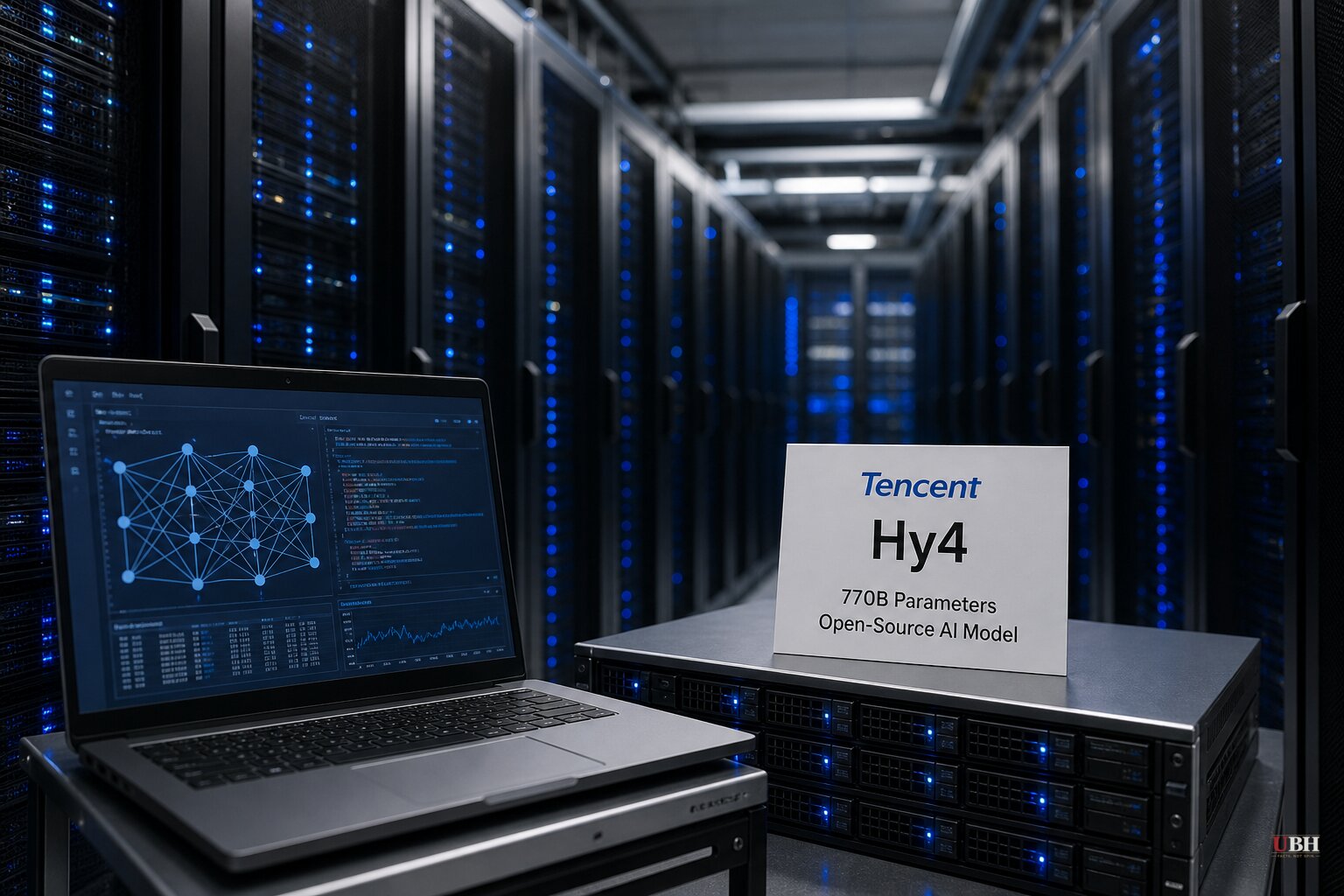
Tencent released and open-sourced Hy4 preview on August 28, 2026, and buried in the launch documentation is a disclosure that got more attention than the parameter count: the model was used to help optimize its own development.
Hy4 preview is a Mixture-of-Experts model with 770 billion total parameters, 49 billion of which activate per token, and a context window exceeding 1 million tokens, according to Tencent's official announcement. It's licensed under Apache 2.0 and available through Tencent's WorkBuddy and CodeBuddy platforms, plus Yuanbao, ima, Tencent Cloud TokenHub and OpenRouter. Tencent is giving away free access on WorkBuddy and CodeBuddy for two weeks.
What Tencent Actually Claims
According to Tencent's own documentation, Hy4 "participated for the first time in the automated optimization of its own training methods, data strategies, evaluation frameworks, and low-level operators," proposing approaches, running experiments, and feeding results back into further rounds. Tencent calls this an "early-stage recursive self-improvement loop."
Separately, the model identified bottlenecks in Tencent's inference system and ran multiple rounds of optimization on operator fusion and communication, producing what Tencent says is a 31.8% increase in end-to-end inference throughput, holding up across different context lengths and concurrency levels.
That's a real, measurable engineering result, attributed by Tencent to Tencent. No independent lab has verified the 31.8% figure or audited how the loop actually ran.
The Skeptic's Case, Stated Fairly
AI-safety researchers have long worried about a scenario where a model meaningfully contributes to building its own successor with shrinking human oversight at each iteration, a dynamic that could compound faster than regulators or even the companies building it can track. Tencent's own framing, an "early-stage recursive self-improvement loop," invokes exactly that concept.
A reviewer at Eesel, Alicia Kirana Utomo, said Tencent's self-improvement language is "marketing framing on top of a real result, but it's the kind of claim worth filing away." The throughput gain is real. The framing around it is doing extra work.
The available evidence says this instance doesn't match the autonomous-runaway scenario safety researchers model. Per the Cloud Security Alliance's June 2026 report on recursive self-improvement signals, as cited by Tech Times, full autonomous self-improvement, an AI rewriting its own weights with no human in the loop, remains speculative as of mid-2026. What happened with Hy4 was supervised: human engineers oversaw the loop, incorporated results, and made the actual architectural decisions. That's a meaningful category difference from a model improving itself unsupervised, even if it's a step in that general direction.
The Benchmark Claims Need a Grain of Salt
Tencent says Hy4 edged out rivals GLM-5.3 from Z.ai and Kimi K3 from Moonshot AI in a blind evaluation involving 163 experts across 203 engineering tasks, scoring 2.99 out of 4.00 against GLM-5.3's 2.92 and Kimi K3's 2.94.
Both India Today and The Swipe Up flagged the same caveat independently: this was Tencent's own internal test, not an independently verified benchmark. Score differences of a few hundredths of a point, graded by evaluators Tencent selected, on a scale Tencent designed, are not the same as a neutral third-party bake-off. Treat the "beat GLM-5.3 and Kimi K3" headline as Tencent's claim about Tencent's product until someone outside the company reruns the comparison.
Separately, Hy4 posted 92.3 on GPQA Diamond and 82.9% resolved on SWE-bench Multilingual, according to scores Hugging Face surfaces from the model card, per Eesel's review. Those numbers carry more weight than the internal blind test because the model is open-weight, meaning outside researchers can actually rerun the same benchmarks themselves and check Tencent's math.
The Part That Doesn't Go Away With Open-Sourcing
Open weights don't put Tencent outside Chinese law. As Tech Times noted, China's Cybersecurity Law still governs the API regardless of the Apache 2.0 license on the downloadable model. Companies and developers running Hy4 through Tencent's hosted API, rather than self-hosting the open weights, are still operating inside that legal framework.
Hy4 lands in a Chinese open-weight field moving fast: Moonshot AI's Kimi K3 launched in July 2026 as a 2.8-trillion-parameter model, and Z.ai's GLM-5.3 line includes a variant, GLM-5.3-Flash, that reportedly surfaced under the codename "Ox Alpha" before the company confirmed it built it. None of that competitive pressure explains away the open question sitting at the center of Hy4's launch: Tencent has not published a technical audit specifying exactly how much of the training-pipeline optimization was genuinely AI-proposed versus human-directed, and no outside body has independently reviewed the claim. Whether Tencent releases that level of detail when Hy4 moves from preview to official release is the thing worth watching.
Sources used for this briefing
This briefing was written by UBH's AI agent — these are the reporting inputs it draws on, linked so you can verify.


