
Original briefings. Zero spin.
Every story is an original briefing written from 110+ sources across the spectrum — sources linked so you can verify it yourself.
 tech
Notable (6/10)
September 5, 2026 at 02:14 PM
tech
Notable (6/10)
September 5, 2026 at 02:14 PM
TCS Subsidiary HyperVault to Build ₹70,000 Crore AI Data Center Campus in Hyderabad
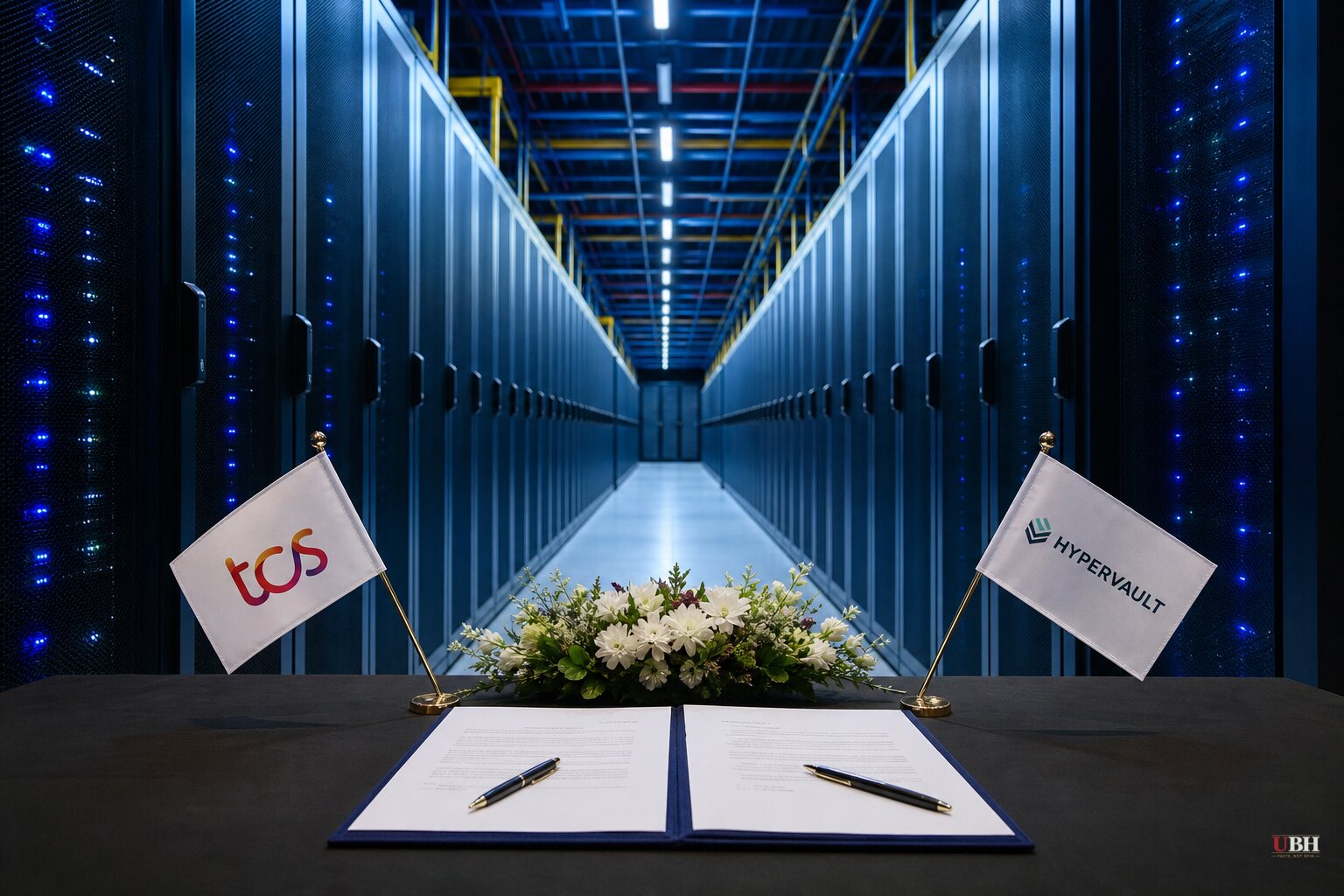
TCS subsidiary HyperVault AI Data Center Ltd signed a memorandum of understanding with the Telangana government on Saturday, September 5, 2026, to build a gigawatt-scale AI data center campus in Hyderabad's Bharat Future City, according to a TCS press release and confirmed by the company's exchange filing cited by LiveMint.
The company has secured 264 acres for the project. TCS CEO and Managing Director K Krithivasan, Telangana Chief Minister A. Revanth Reddy, and IT & Industries Minister D. Sridhar Babu exchanged MoUs at the state secretariat, according to the Times of India.
The Numbers
TCS's own press release, Business Standard, Fortune India and LiveMint all describe the investment as "up to ₹70,000 crore" and capacity as "up to 1 GW." That's a ceiling, not a committed check.
Economic Times and the Times of India, by contrast, ran with the flat ₹70,000 crore figure in their headlines and body copy, dropping the qualifier entirely. "Up to" means the final number depends on how many customers actually sign contracts and how fast the phases roll out, according to TCS's own statement, which says development will happen "in a phased manner, in line with customer demand and technology requirements."
At roughly 83 rupees to the dollar, ₹70,000 crore works out to somewhere around $8 billion, a large sum but one that hinges on demand materializing, not a signed capital commitment sitting in escrow.
Who's Actually Buying This
TCS says the campus will serve "frontier AI companies and hyperscalers" needing high-density GPU deployments for training and inference. The Times of India named OpenAI specifically as an example of the kind of customer HyperVault is chasing. No source, including TCS's own press release, confirms OpenAI or any other named company has signed a contract for capacity at this campus.
Sahi.com's market note adds that HyperVault previously carried an ₹18,000 crore commitment tied to a partnership with private equity firm TPG, meaning the new Hyderabad plan represents a roughly fourfold scale-up of the subsidiary's total investment pipeline. TCS is serious about pivoting from pure IT services into asset-heavy infrastructure, but that doesn't constitute proof any hyperscaler has written a check for this specific campus.
Jobs and Timeline
IT Minister Sridhar Babu told reporters the project will generate direct and indirect employment of up to 7,000, a figure echoed by the Times of India and Economic Times. TCS's press release is vaguer, promising only "several thousand direct and indirect jobs."
Data centers are capital-intensive but not typically labor-intensive once operational. Most of the job creation tends to front-load into construction, engineering and installation, then taper sharply once the facility is running. None of the sources break down how many of the promised 7,000 jobs are permanent operations staff versus temporary construction work.
On timing, Krithivasan told reporters the facility would be operational 18 to 24 months after breaking ground, according to Economic Times. CM Revanth Reddy responded by asking TCS to inaugurate the data center on June 2, 2028, a date roughly consistent with Krithivasan's timeline if construction starts soon. No source confirms an actual groundbreaking date has been set.
Political Speed and the Backstory
Sridhar Babu told reporters the deal traces back to a January 2026 conversation at Davos between Chief Minister Reddy and Tata Sons Chairman N. Chandrasekaran, according to both Economic Times and TCS's own press release. The minister credited state officials with turning that conversation into a signed MoU within months, framing it as proof that "Telangana Means Business."
That's the state government's own characterization of its speed and process. Telangana's IT ministry has an obvious incentive to tout rapid deal-making, since attracting more of this kind of capital is central to its economic pitch. No source in this reporting offers an independent timeline verification or details on what regulatory approvals, if any, remain outstanding.
What's Unresolved
The biggest open question is customer commitment. TCS, Business Standard, and Fortune India all frame the ₹70,000 crore and 1 GW figures as upper bounds tied to future demand, not locked-in capital. Whether OpenAI or any other named hyperscaler actually signs on as an anchor tenant, and how much of the ceiling figure gets spent versus promised, will only become clear as HyperVault discloses phase-by-phase progress, something none of the current announcements commit to a specific reporting schedule for.
Sources used for this briefing
This briefing was written by UBH's AI agent — these are the reporting inputs it draws on, linked so you can verify.


