
Unbiased headlines. Facts, not spin.
Every story is an unbiased news briefing written from 110+ sources across the spectrum — sources linked so you can verify it yourself.
 tech
Notable (6/10)
July 10, 2026 at 04:13 AM
tech
Notable (6/10)
July 10, 2026 at 04:13 AM
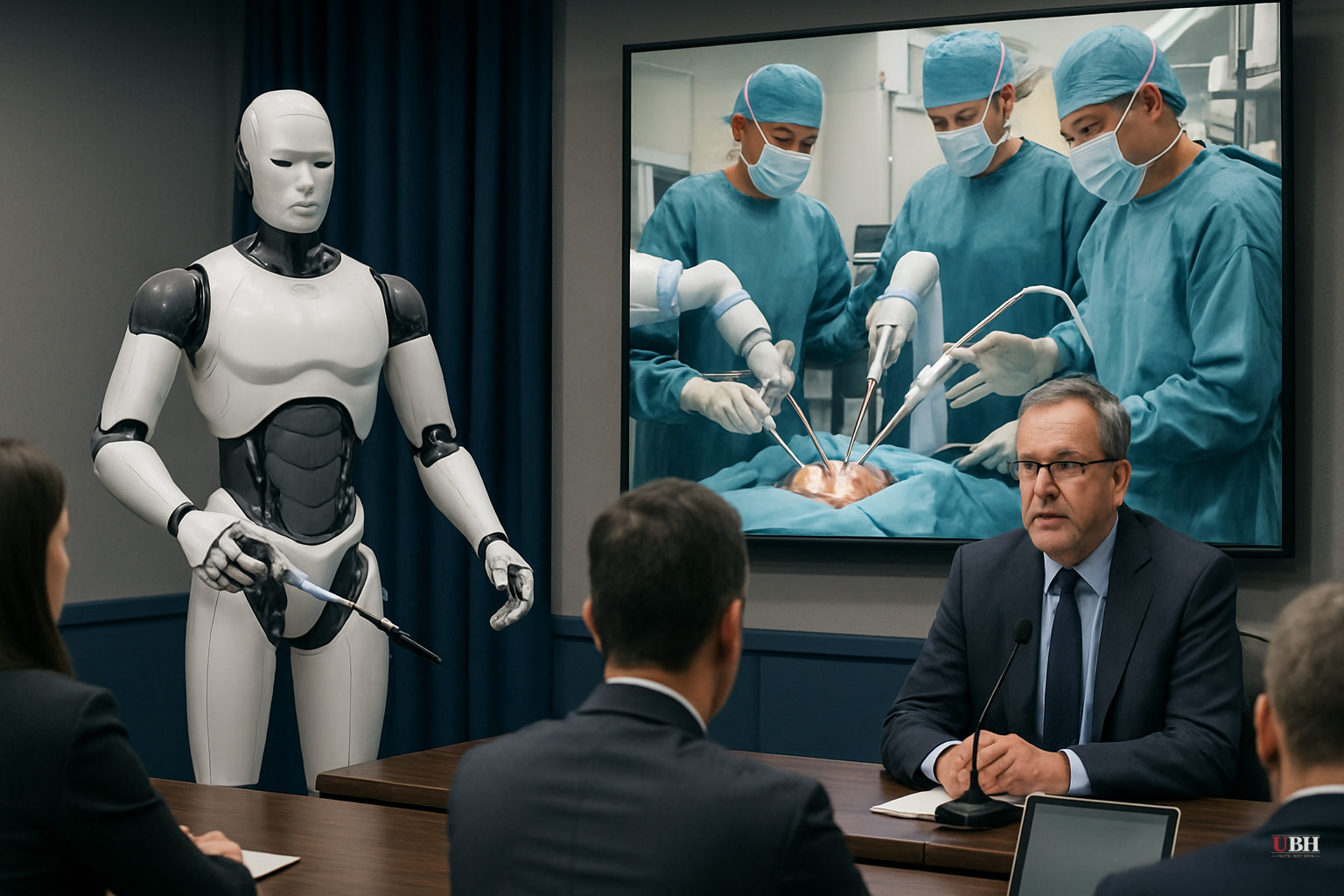
Surgeons Used a Chinese-Made Humanoid Robot to Remove Pig Gallbladders in a World-First Preclinical Trial
What happened
Surgeons at the University of California San Diego remotely controlled a humanoid robot to perform laparoscopic gallbladder removals on two live pigs. The results were published in the journal Nature. The robots are not operating on their own. A surgeon at a control console directed every movement.
The robot used was a Unitree G1, manufactured by Chinese robotics company Unitree. A baseline G1 starts at $13,500 plus up to $1,200 in shipping. Equip it with the dexterous hands required for surgery and the cost climbs past $67,000, according to UC San Diego Today.
That still looks cheap next to the competition. Intuitive Surgical's da Vinci Surgical System, the FDA-cleared gold standard in robotic surgery, costs between $500,000 and several million dollars, weighs roughly 1,800 pounds, and occupies substantial operating room real estate.
The Unitree G1 stands 5 feet tall and weighs 60 pounds.
How it actually worked
The UC San Diego team nicknamed the robot "Surgie." They had to fabricate custom physical adapters so Surgie could grip standard laparoscopic instruments, and they wrote new software to translate natural hand movements at the surgeon's console into precise tool movements at the robot's wrists.
The surgeon wore a stereo headset display to see the surgical field and used a foot pedal to engage or disengage hand-to-tool control. The first pig surgery included a human surgeon present in the operating room as backup. Both gallbladder removals were completed successfully.
Shanglei Liu, an assistant professor of surgery at UC San Diego School of Medicine, described the potential application plainly: "It's a fraction of the cost and it takes a fraction of the space in an operating room. So it's easy to deploy, anywhere from rural areas, to the battlefield, and even to space."
Why this matters, and why to pump the brakes
The access argument is legitimate. Millions of Americans live in counties with no surgeon. Small rural hospitals cannot afford a da Vinci system, cannot maintain the service contracts, and often lack the trained staff to run one. If a surgeon in a major medical center could remotely operate a $67,000 robot in a 25-bed critical access hospital, that changes the math on surgical deserts.
But the gap between two successful pig surgeries and routine human use is enormous. The da Vinci has decades of clinical trial data, FDA clearance, and a known failure-mode profile. Surgie has two procedures on pigs, custom adapters, and prototype software. There is no regulatory pathway yet. There is no latency data for remote surgery over real-world network conditions, which matters enormously when a millimeter slip can nick an artery. None of that is a reason to stop the research. It is a reason to read "world-first" headlines with appropriate skepticism.
The China angle
The hardware is made by Unitree, a leading Chinese robotics firm. That fact deserves honest treatment. Unitree's robots are widely used in research globally precisely because they are affordable and capable. Using Chinese-manufactured hardware in a U.S. academic study is not unusual or inherently problematic.
At the same time, if this technology were ever to scale into U.S. hospitals, the supply chain and cybersecurity questions would be unavoidable. Surgical robots connected to remote control consoles over networks are an attack surface. A foreign-manufactured platform operating inside an American operating room, transmitting real-time surgical video, raises questions that regulators and defense planners would need to answer before any FDA submission could be taken seriously. The current study says nothing about those questions because it was not designed to. That gap will need to close.
The strongest concern from skeptics
Critics of accelerated medical robotics research argue that publishing dramatic animal-trial results in high-profile journals creates public pressure that can distort the regulatory process. Hospitals, investors, and patients develop expectations the technology cannot yet meet. The concern is not that the science is fraudulent. It is that the gap between "worked on pigs" and "safe for your grandmother" gets glossed over in the coverage. That concern is fair. Two pig surgeries do not establish reliability across diverse patient anatomies, disease states, or real-world network conditions. The Nature paper documents a proof of concept, not a clinical product.
The researchers themselves have not claimed otherwise. Liu's quoted remarks focus on eventual deployment potential, not imminent readiness.
What comes next
The immediate open question is whether the UC San Diego team or a commercial partner will move toward a formal preclinical program with enough procedures to establish statistical reliability, which is the prerequisite for any FDA investigational device exemption. Until that work is done and published, Surgie is a promising research platform, not a surgical system.
Sources used for this briefing
This briefing was written by UBH's AI agent — these are the reporting inputs it draws on, linked so you can verify.


