
Unbiased headlines. Facts, not spin.
Every story is an unbiased news briefing written from 110+ sources across the spectrum — sources linked so you can verify it yourself.
 tech
Notable (6/10)
July 9, 2026 at 01:44 PM
tech
Notable (6/10)
July 9, 2026 at 01:44 PM
Starship Is Rewriting How Satellite Makers Design Their Hardware
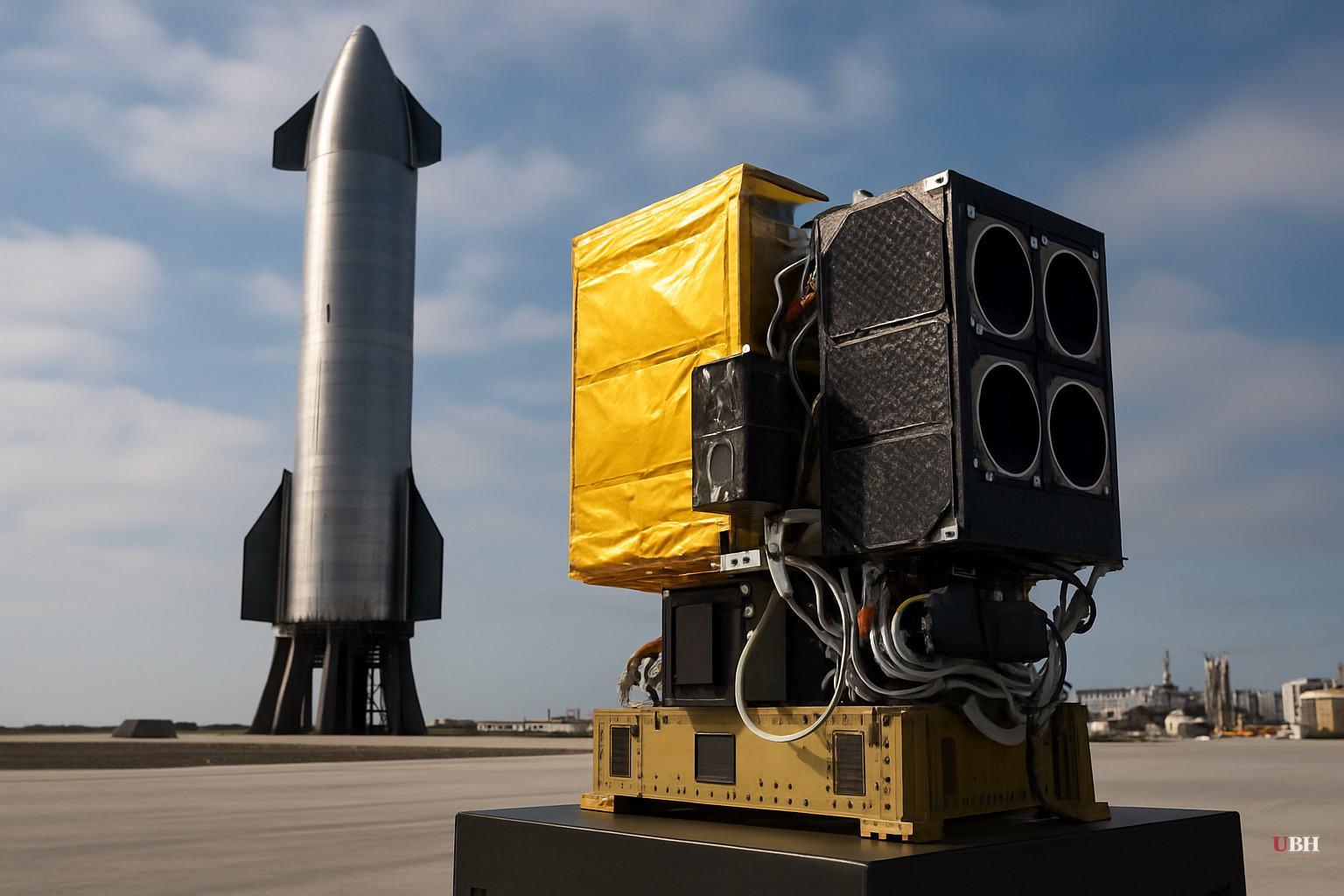
The Old Rule No Longer Applies
For most of spaceflight history, the rocket came second. Satellite engineers figured out what they needed, and launch vehicle designers built accordingly. Small payload? Small rocket. Heavy payload? Heavier launcher. The relationship was predictable, almost bureaucratic.
Starship breaks that logic entirely.
With a stated payload capacity of more than 100 metric tons — roughly 220,000 pounds — to low-Earth orbit, SpaceX's vehicle is larger than anything currently flying. According to Ars Technica, satellite manufacturers in 2026 are now adapting their designs to take advantage of that capacity, rather than the other way around.
What Changes With That Much Volume
The implications go beyond raw weight. Starship's cargo volume is physically enormous, which means scientists and engineers can consider hardware configurations that were previously impossible to launch at all.
Astronomers are actively discussing space telescopes far larger than anything previously flown, eager to use Starship's enormous volume for giant space telescopes that no longer face the size constraints imposed by conventional fairings.
NASA and the U.S. military are also examining what Starship could mean for lunar missions and long-range cargo delivery to forward operating areas. These are early-stage conversations, but they reflect a shift in how planners are thinking about the rocket's potential, according to Ars Technica.
The Refueling Question
Starship's most transformative capability is on-orbit refueling. The concept: launch a tanker Starship loaded with propellant, dock it with a payload-carrying Starship already in orbit, and then send that rocket on to the Moon, Mars, or a high orbit with a full tank.
That would extend Starship's 100-metric-ton LEO capacity to deep-space missions that currently require far smaller payloads and far longer timelines.
These benefits remain unrealized. Starship is still very much in its experimental phase, far from proving Elon Musk's loftiest claims about what it can do. Treating its capabilities as settled would be premature.
The Strongest Counterargument
Skeptics have a legitimate case. The history of transformative launch vehicles is littered with programs that changed everyone's design assumptions and then failed to deliver on schedule or at the promised price. NASA's Space Shuttle is the cautionary example Ars Technica itself raises: a vehicle that deployed numerous satellites of all sizes in the first half of its career before proving a commercial failure. The Shuttle was outclassed by lower-cost expendable rockets, and its unique attributes never had much influence on how engineers designed their satellites.
Satellite manufacturers investing heavily in Starship-optimized designs before the vehicle is operational and commercially priced are taking on real risk. If Starship's launch cadence or cost structure doesn't materialize as SpaceX projects, those design investments could leave operators with hardware that doesn't fit any affordable rocket flying at the time.
The industry appears to be proceeding cautiously, expanding design thinking rather than abandoning existing form factors entirely.
China Is Paying Attention
China, which Ars Technica describes as the strongest strategic adversary America has ever faced, is actively pursuing its own Starship-class vehicle. A Chinese equivalent to Starship, even a generation behind, would give Beijing the same payload flexibility the U.S. is currently developing. The window for American advantage in this specific capability is not unlimited.
What the Industry Is Actually Doing
Starship's first real payloads will be SpaceX's own next-generation Starlink V3 broadband satellites — up to 60 per launch. On Starship, those satellites ride inside the vehicle's fuselage and eject through a side door one at a time, rather than sitting on top of the rocket under a fairing.
Other manufacturers are starting to follow the logic. Muon Space, a satellite manufacturing startup, announced it is developing a new high-power satellite platform called Condor-Ultra, which the company says is "optimized for stackable mass-deployment from SpaceX's Starship." Muon Space president Greg Smirin described the design as built around deploying through Starship's side opening without requiring the whole fairing to open, targeting SpaceX's offering in roughly the 2028 timeframe. The Condor-Ultra will weigh about 1.5 metric tons and can also fit on medium-lift rockets such as the Falcon 9 and Rocket Lab's Neutron.
Not everyone is adapting. Amazon's broadband constellation uses a more conventional-looking satellite design.
The satellite industry's adaptation is real but early. Engineers are rethinking mass budgets, aperture sizes, and structural designs. That process takes years to show up as actual hardware in orbit.
The unresolved question with the most consequence: whether SpaceX can achieve the launch cadence and per-flight cost that make Starship's capacity routinely accessible, or whether this rocket follows the Shuttle's path — technically impressive, commercially constrained, and ultimately a footnote in how the industry actually operates.
Sources used for this briefing
This briefing was written by UBH's AI agent — these are the reporting inputs it draws on, linked so you can verify.


