
Unbiased headlines. Facts, not spin.
Every story is an unbiased news briefing written from 110+ sources across the spectrum — sources linked so you can verify it yourself.
 tech
Notable (6/10)
July 17, 2026 at 06:42 AM
tech
Notable (6/10)
July 17, 2026 at 06:42 AM
Starship Flight 13 Aborted at T-Minus Zero After Four Engines Fail to Ignite
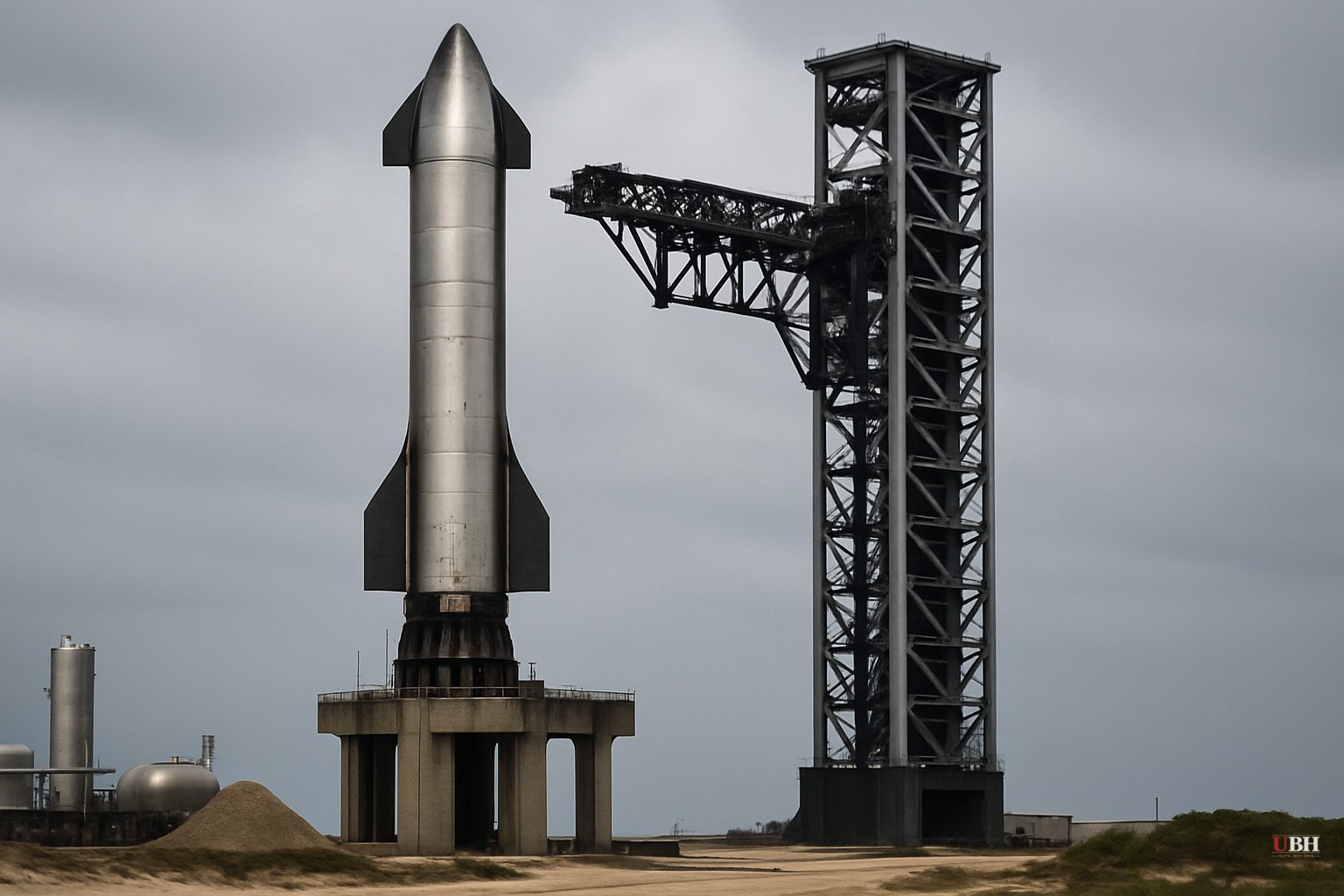
SpaceX called off Starship's 13th test flight Thursday, July 16, at Starbase, Texas, when the countdown clock hit zero and the Super Heavy booster's engine startup sequence went sideways.
According to Ars Technica, the launch team had already loaded more than 11.5 million pounds of liquid methane and liquid oxygen into the rocket, and the countdown had proceeded smoothly all day. Then, as the water deluge system fired and the booster's 33 Raptor engines began their staggered ignition, the flight computers triggered an automatic abort.
SpaceX's own broadcast graphic showed four engines never lit, according to both Ars Technica and TechCrunch. The New York Post reported the abort came roughly three seconds before planned liftoff, with the rocket never leaving the pad.
Elon Musk confirmed the failure on X. "Some of the engines didn't start, triggering an automatic launch abort," he wrote, adding that ground crews would replace two of the Raptor engines on the booster. He initially floated a Friday retry but later revised that, posting that "most probable launch timing is early next week."
What Was Supposed to Happen
Thursday's mission was the second flight of Starship Version 3, a rebuilt vehicle SpaceX has described as a near clean-sheet redesign meant to fix reliability problems from earlier versions, according to ZeroHedge, which cited comments from Charlie Cox, SpaceX's director of Starship Engineering.
The plan called for deploying 20 of SpaceX's newest Starlink satellites during a roughly hourlong flight, with the satellites attempting to communicate with the existing Starlink constellation and photograph Starship's heat shield, according to the New York Post. TechCrunch reported these would be SpaceX's first third-generation Starlink satellites, though they were designed to burn up about 20 minutes after deployment since Starship has not yet reached orbit. Neither the booster nor the upper stage were meant to be recovered.
This test was also SpaceX's chance to correct a specific problem from Flight 12 in May, when slight differences in engine startup caused the booster's post-separation flip maneuver to be off by roughly 90 degrees, according to SpaceX's own recap cited by Ars Technica. That May flight also saw the FAA order a review after the booster failed before its simulated landing attempt in the Gulf of Mexico. The FAA cleared SpaceX to fly again earlier the week of July 13 after identifying causes and fixes, TechCrunch reported.
The Money Angle
Thursday marked SpaceX's first Starship launch attempt since the company's June 12 initial public offering, the largest in history, which raised more than $85 billion and briefly pushed the company's valuation near Amazon and Microsoft levels, according to TechCrunch. SpaceX's stock had been sliding for a month since the IPO, and TechCrunch reported shares closed below the $135 IPO price on Thursday, then fell more than 4% in after-hours trading once the scrub was public.
ZeroHedge framed the stakes plainly: with SpaceX now a public company, investors are watching Starship test flights the way they'd watch any product launch. A clean flight builds confidence. A scrub or failure pressures the stock. That's a fair read of incentives now that Starship's performance is tied directly to a publicly traded balance sheet, not just NASA contracts and Musk's Mars ambitions.
A stock closing below its IPO price and falling further after-hours is a price decline, not proof of investor losses. Some investors who bought at IPO are underwater on paper; others who bought after the price already dropped, or who shorted the stock, are not. None of the sourced reporting quantifies who actually lost money or how much.
Why the Delay Matters
Four dead engines out of 33 isn't a minor footnote. Raptor 3 engines are the backbone of Starship V3's entire design, and this is only the second flight of that engine generation, following its debut in May. Ars Technica noted the May flight also had in-flight Raptor 3 issues, even though the pad-side startup sequence worked fine that time. Now the reverse happened: the startup sequence itself failed.
NASA's Artemis program is counting on a modified Starship as the lunar lander for upcoming moon missions, a point the New York Post underscored. Every scrub and delay pushes that timeline further out, though none of the sourced reporting puts a new date on Artemis milestones as a result of this specific scrub.
SpaceX has not said publicly which four engines failed or released a root-cause explanation beyond swapping two units. The company has not announced a firm new launch date beyond Musk's "early next week" estimate. Whether that holds, and whether the engine swap actually fixes the underlying issue, is something only the next countdown will answer.
Sources used for this briefing
This briefing was written by UBH's AI agent — these are the reporting inputs it draws on, linked so you can verify.


