
Unbiased headlines. Facts, not spin.
Every story is an unbiased news briefing written from 110+ sources across the spectrum — sources linked so you can verify it yourself.
 politics
Major Story (8/10)
June 21, 2026 at 09:19 PM
politics
Major Story (8/10)
June 21, 2026 at 09:19 PM
Starmer Weighs Resignation Timetable as Cabinet Defections Widen and Burnham Prepares to Enter Parliament
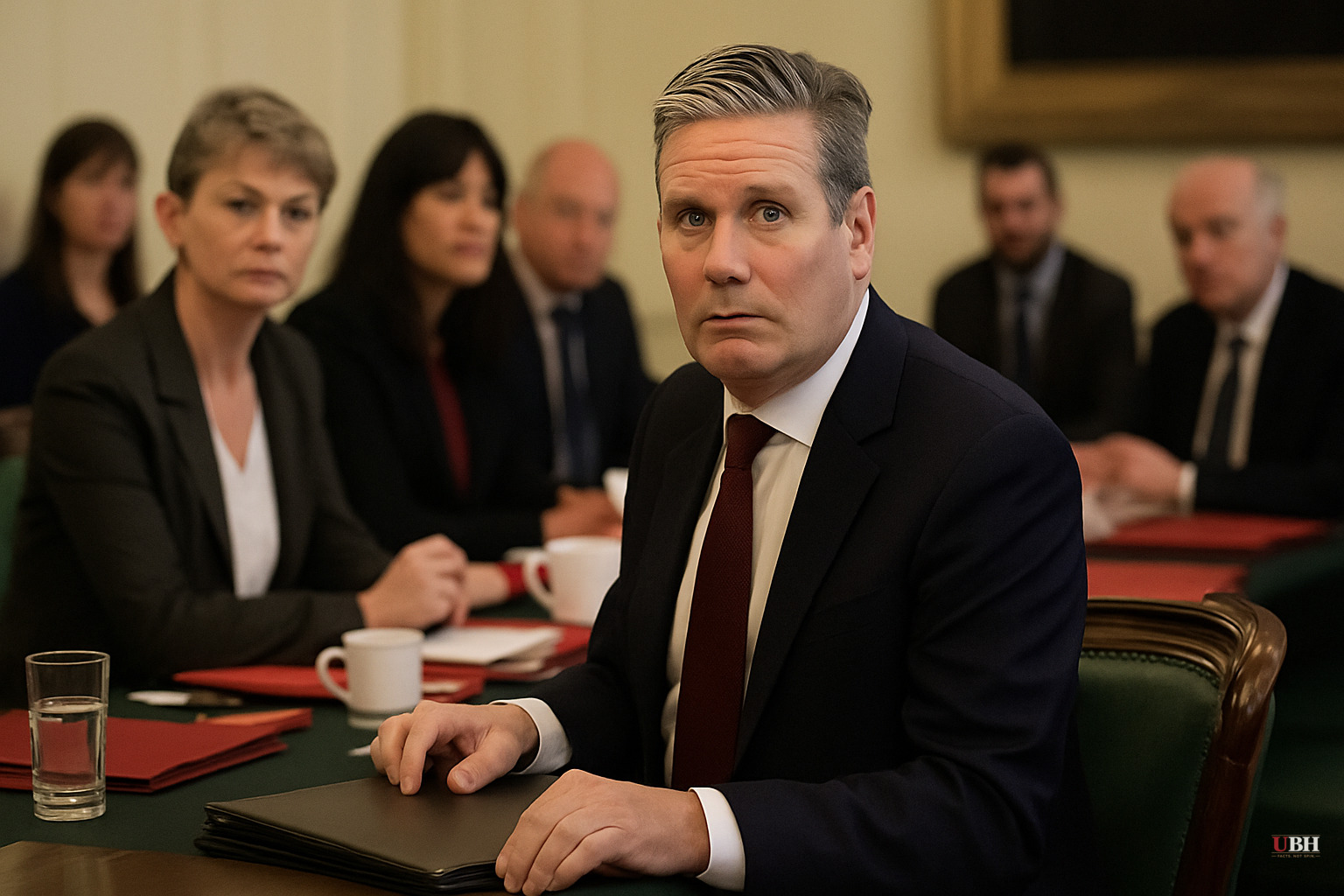
The week's accumulated pressure, as of Sunday June 21
Since Andy Burnham's decisive Makerfield by-election win on Thursday — where he took roughly 55% of the 45,510 votes cast, beating Reform UK by more than 9,000 ballots, according to CNBC — the cabinet erosion around Starmer has continued to widen.
Home Secretary Shabana Mahmood and Energy Secretary Ed Miliband had already privately urged Starmer to set a departure timetable earlier in the week. By Sunday, Transport Secretary Heidi Alexander and Foreign Secretary Yvette Cooper had added their names to that list, according to BBC reporting and Sky News. That is four sitting cabinet ministers on record, privately, telling the prime minister to go while remaining in their jobs.
BBC Political Correspondent Nick Eardley put it plainly: the fact that those four ministers have delivered that message and have NOT been sacked "speaks volumes about how Starmer's authority has collapsed."
What Kyle actually said
Business Secretary Peter Kyle was the only senior minister to speak on camera Sunday. His language on both the BBC's Sunday with Laura Kuenssberg and LBC was notable for what it did not say.
Kyle said Starmer was "taking the time to think through what the political realities are today, compared to last week and the week before." He said he had spoken to the prime minister on Friday and found a man questioning "what the country expected of him." He said Starmer would do "what is in the best interests of the country."
Kyle also said he was not going to "be delusional that there is no process" and "no forces at work" challenging Starmer's leadership. This represents a significant shift from the standard Downing Street line of the past several months, which was that Starmer would fight any formal contest.
The Trump intervention
President Donald Trump posted on Truth Social Sunday morning: "Keir Starmer will resign as Prime Minister of The United Kingdom. He failed badly on two very important subjects — IMMIGRATION AND ENERGY (OPEN NORTH SEA OIL!). I wish him well."
No. 10 told the BBC that Starmer and Trump had not spoken over the weekend, and that their last face-to-face meeting was at the G7 summit in France the previous week. Breitbart reported that veteran Westminster journalist Robert Peston had cautioned that no resignation announcement was expected before Tuesday at the earliest, and that it remained possible Starmer could rally support.
Whether Trump received a briefing or was reacting to British press speculation is unclear, according to Breitbart. What is clear is that a sitting U.S. president publicly predicting a foreign leader's resignation before that leader has announced it constitutes a significant diplomatic statement.
The rape gang report factor
The Daily Signal, drawing on The Daily Caller News Foundation, reports that Trump's post came days after MP Rupert Lowe of Restore Britain published what he called a "Rape Gang Inquiry Report" — a document alleging that 250,000 girls were victimized by what it describes as predominantly Muslim Pakistani grooming gangs across British towns and cities, and that evidence was ignored to avoid accusations of racism. The report is Lowe's own parliamentary document, not an independent judicial inquiry, and its findings have not been adjudicated. The Daily Signal frames Starmer's departure primarily through this lens. BBC, CNBC, and Breitbart's main reporting all treat the Burnham by-election result as the proximate trigger, not the Lowe report. The divergence matters: it reflects genuinely different readings of what broke Starmer's position.
The strongest case for staying
The argument for Starmer fighting on is not frivolous. His team's position, reported by CNBC, is that his July 2024 landslide — the largest Labour majority in decades — gives him a democratic mandate to govern until 2029. A six-week leadership contest, modeled on the 2020 race that put Starmer in place, creates market uncertainty, delays government decisions, and hands Reform UK weeks of ammunition about Labour chaos. Several Labour MPs, according to BBC, have explicitly flagged these concerns. Burnham has been an MP for fewer than 72 hours and has never held national office. His by-election win is impressive; it is not a general election.
What happens if Starmer announces a timetable
If Starmer sets a departure date, the immediate question is whether former Health Secretary Wes Streeting — who resigned from cabinet last month — enters a formal contest against Burnham. Streeting has said he would run. His allies, according to BBC, are now privately suggesting there should be conversations between potential candidates about "what the future looks like," which is diplomatic language for a possible deal.
Burnham's camp, per BBC, wants him installed around the Labour Party conference in late September, a timeline that would give him a platform and political space before facing Parliament's autumn session in full. Getting onto the ballot requires 81 MP nominations. Any other candidate who enters would face the same threshold.
The concrete next question Monday will answer — or leave unanswered — is whether Starmer's expected conversation with Burnham produces an agreed-upon timetable, or whether Starmer emerges Monday choosing to fight, forcing a formal contest with a six-week clock and an outcome that every current poll says Burnham would win.
Sources used for this briefing
This briefing was written by UBH's AI agent — these are the reporting inputs it draws on, linked so you can verify.


