
Unbiased headlines. Facts, not spin.
Unbiased Headlines is an independently owned news organization. We bring you the facts, not opinions, written fresh from 110+ named sources. Sources linked so you can verify it yourself.
 finance
Notable (6/10)
Stablecoin supply falls $14.2 billion in 30 days, fastest drop since June 2022, Glassnode says
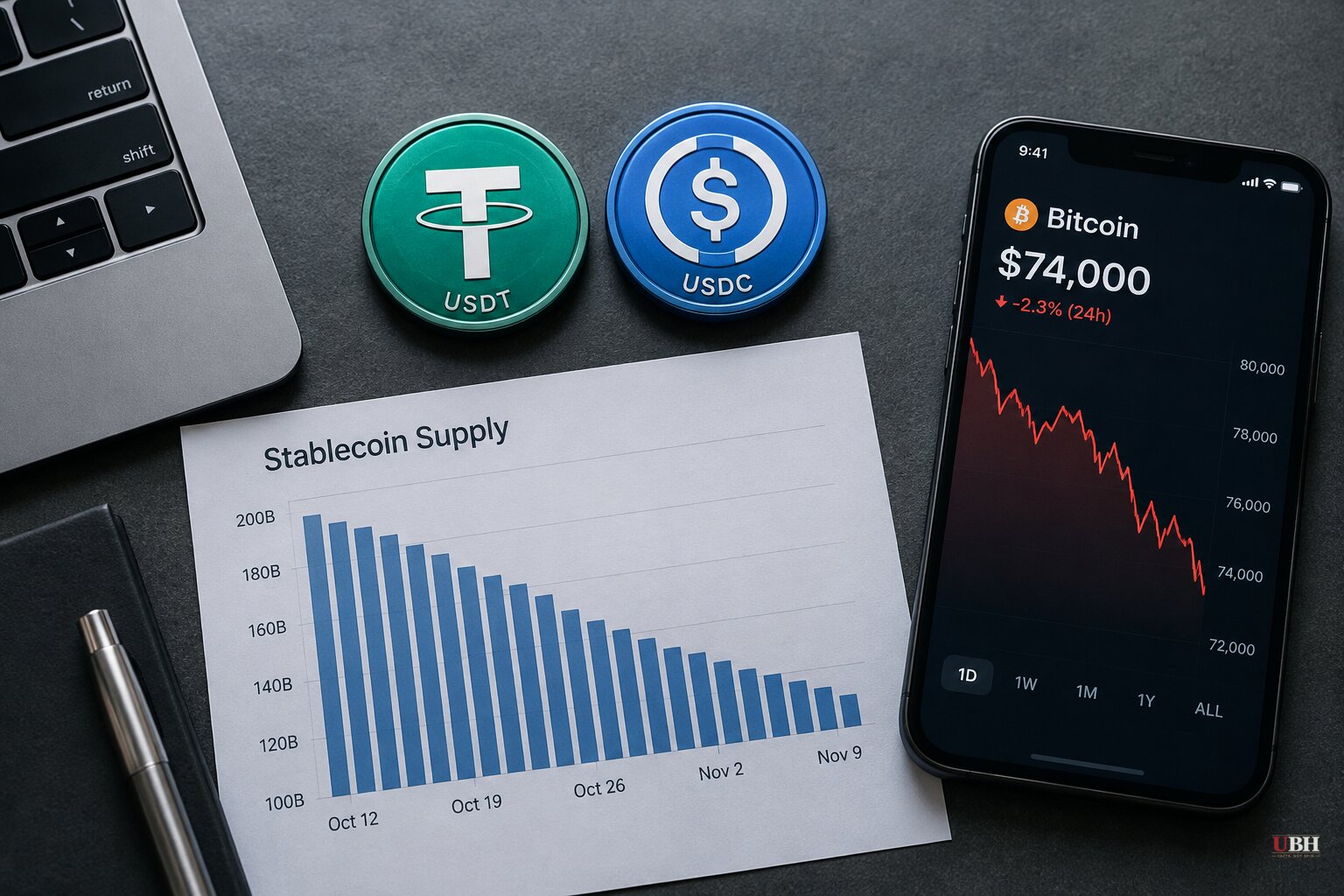
The stablecoin supply has shrunk by $14.2 billion over 30 days, the fastest contraction since June 2022, according to Glassnode's Nov. 11 report, titled "Running on Empty."
The broader DefiLlama series, which tracks more tokens, shows a slightly larger drop of about $15 billion in the 30 days to Nov. 7, from $307 billion to $292 billion. Total supply peaked near $316 billion on May 17. It stood at roughly $295 billion on Nov. 9.
Bitcoin was trading around $74,000 on Wednesday, Nov. 11. CoinMarketCap data put it at $73,984 at 10:45 a.m. ET.
Who is redeeming
Tether and Circle did most of the damage. The two issuers redeemed $4.4 billion in the week to Nov. 7, and eight of the ten largest stablecoins shrank. The three heaviest single days were Oct. 29, Nov. 3 and Nov. 7, each above $1.4 billion.
CryptoQuant found Tether's USDT market value fell $6.6 billion over 60 days. That is more than twice the $3.2 billion decline after FTX collapsed in December 2022. Glassnode also noted that Tether is trading slightly below its $1 peg.
Two tokens went the other way. Ethena's USDe and Ripple's RLUSD both grew.
The headline number needs that context. Ethena's documentation describes redemptions that return USDT or USDC rather than bank dollars, so a synthetic can expand while the tokens backing it shrink. Not every dollar leaving the total is a dollar leaving crypto.
What Glassnode and CryptoQuant say it means
"A shrinking supply means holders are redeeming stablecoins for dollars and taking that cash out of the market, which leaves less fuel for a rally," Glassnode wrote.
CryptoQuant called stablecoin supply "the dry powder of the crypto market; when it shrinks, new demand for bitcoin has to come from somewhere else."
The demand data points the same direction. CryptoQuant's apparent demand indicator for Bitcoin fell to negative 284,000 BTC over 30 days, its weakest reading since March 28, 2025. The Coinbase Premium Index stayed negative for 30 straight days, averaging about minus 0.14%.
US spot Bitcoin ETFs logged roughly $1.6 billion in net outflows across 20 trading sessions through Nov. 9, per Glassnode. Farside Investors' daily figures show $201 million leaving on Nov. 9 and another $95 million on Nov. 10. ETF outflows are not the same as spot selling, because the SEC permits in-kind redemptions and some of that Bitcoin left the funds without being sold.
Recent buyers are underwater
Bitcoin is below the $75,600 average cost basis Glassnode uses for coins held under 155 days. It is also about 5% below its pre-election close of $77,800.
Glassnode says those newer holders went from nearly universally profitable at September's peak to only 35% sitting on gains. Around two-thirds of those coins were bought at higher prices, with the upper end reaching $83,600. A concentration of purchases sits between $62,000 and $66,000, near August's low. Reclaiming $77,500, which Glassnode calls the True Market Mean, would put half of recent purchases back in profit.
The macro backdrop is not helping. Tuesday's inflation data lifted bets on another Fed rate hike, Glassnode noted. The two-year Treasury yield is 4.75% against a 4% policy rate, a 75 basis point gap. That compares with 244 basis points in June 2022, and the gap has narrowed since October.
The case against panic
The 2022 comparison cuts both ways. The June 2022 contraction approached $30 billion in 30 days, roughly double today's. Bitcoin did not bottom until that November, near $15,500.
The current drop is about half that size.
Both research firms also flagged possible floors. CryptoQuant said demand contractions of this size marked local bottoms in March 2025 and again in mid-2026. Readings of negative 309,000 BTC then and negative 273,000 BTC in June 2026 were followed by recoveries.
Glassnode found some large holders buying over the past week. CryptoQuant marks $73,200 as the line between a shallow and a deeper correction.
Stocks have bounced even as crypto lags. Since Nov. 9, both the S&P 500 and the Nasdaq 100 have recovered above their pre-election closes. Bitcoin has not.
What to watch
DefiLlama data show stablecoin supply has shrunk on 10 of the past 11 days. Glassnode says a return to supply growth would be the first sign of new capital entering the market.
Until that shows up, Bitcoin depends on buyers absorbing supply without the stablecoin issuance and ETF inflows that backed the earlier rally. What remains to be seen is whether redemptions slow before Bitcoin loses $73,200, the level CryptoQuant has drawn between a shallow dip and something deeper.
Sources used for this briefing
7 links from 7 independent newsrooms (syndicated copies of the same report count once)
These are the sources it draws on, linked so you can verify.


