
Unbiased headlines. Facts, not spin.
Unbiased Headlines is an independently owned news organization. We bring you the facts, not opinions, written fresh from 110+ named sources. Sources linked so you can verify it yourself.
 finance
Major Story (7/10)
Event date: October 26, 2026 ·
Anthropic Sets $70 to $78 IPO Range; Seven Co-Founders to Sell About $250 Million Each
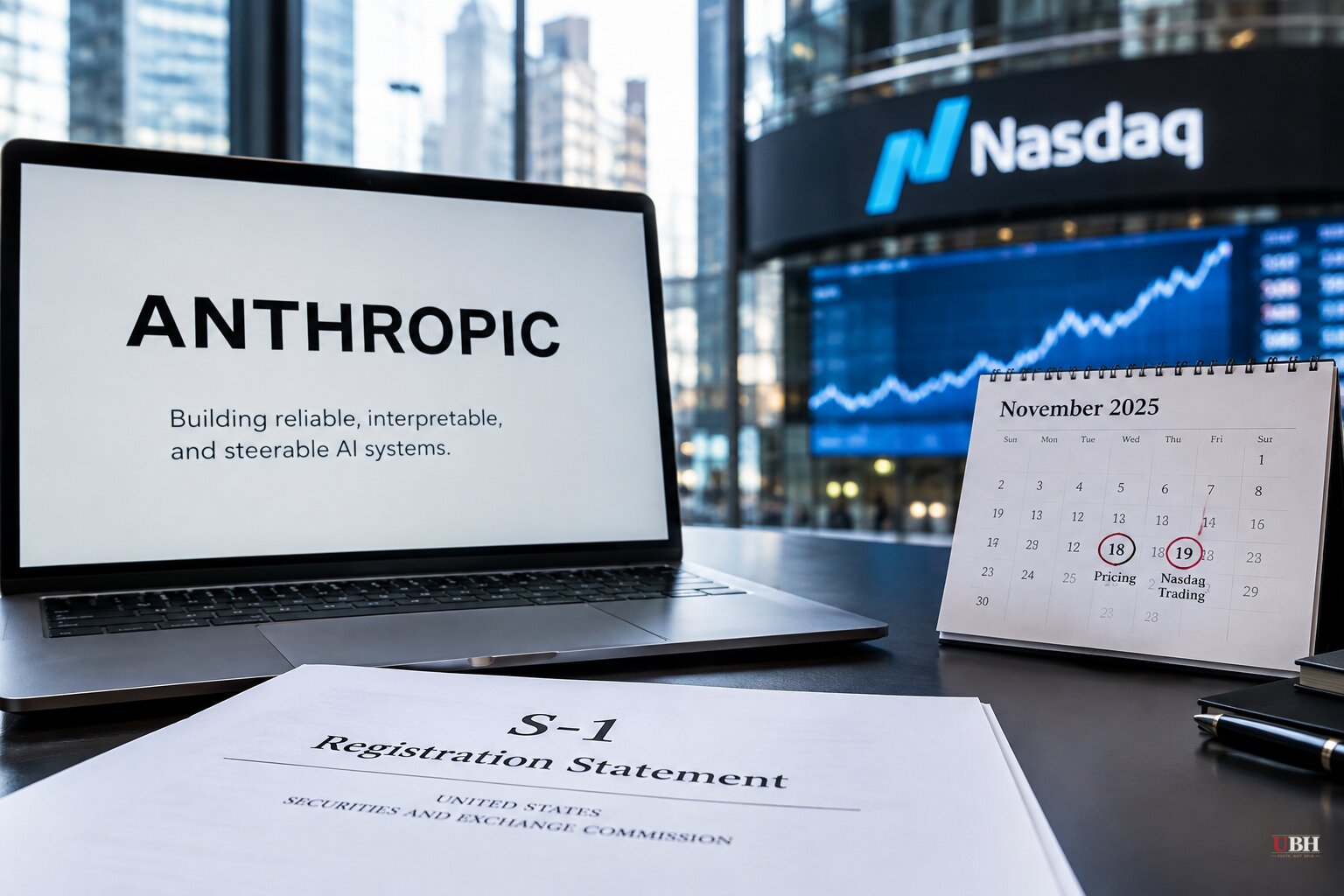
Since Anthropic filed its public S-1 on Oct. 26, the missing pieces of the deal have arrived: a price range, a share count, a target valuation and a calendar. The company launched its roadshow Tuesday, Nov. 10, and plans to price the offering on Nov. 18 and begin trading on the Nasdaq Global Select Market under the ticker ANT on Nov. 19.
The terms
The updated filing sets a range of $70 to $78 per share for 825 million Class A shares. That would raise between $57.75 billion and $64.35 billion before costs.
Anthropic has also agreed to sell $26 billion of Class N common stock in a private placement at the IPO price. The buyers are Advanced Micro Devices, Broadcom, Google, Micron, Microsoft, Nvidia and Taiwan Semiconductor Manufacturing Co.
Add the two together and the total reaches as much as $90.4 billion at the top of the range. Bloomberg reports that would exceed SpaceX's IPO in size and set a record for a stock market debut. SpaceX was valued at around $1.8 trillion when it listed in June.
Goldman Sachs and Morgan Stanley lead the deal alongside 20 other banks, according to the filing.
Valuation lands lower than hoped
Bloomberg reports Anthropic is aiming for a fully diluted valuation of roughly $1.4 trillion, below what some investors had anticipated. The Wall Street Journal reports investors expected about $1.5 trillion a week ago. It also reports that several large backers pushed for a lower number after AI stocks sold off last Thursday, and that a figure near $2 trillion was under discussion months ago.
For scale, Anthropic was last valued at $965 billion after raising $65 billion in May.
Bloomberg reports the book is already multiple times oversubscribed, driven by large anchor-style expressions of interest. It cautions that the terms may still shift. Bloomberg also reports that some investors are passing parts of their allocations to other buyers, and that holders of pre-IPO stakes are pitching shares through special purpose vehicles.
Amodei is scheduled to appear Friday, Nov. 13, at a live-streamed investor event with JPMorgan Chase CEO Jamie Dimon.
What the founders are selling
Each of the seven co-founders plans to sell about 3.4 million shares. At the $74 midpoint, that is roughly $250 million apiece, or around 24 million shares across the group.
The seven are CEO Dario Amodei, president and board chair Daniela Amodei, chief compute officer Tom Brown, Jack Clark, chief science officer Jared Kaplan, chief architect Sam McCandlish and interpretability lead Christopher Olah. All left OpenAI in 2021 to start the company.
After the sale, each will hold about 3.2% of outstanding Class A shares, roughly 22% collectively. Each will also get one share of Class F stock with supervoting rights. The filing puts the founders' voting control at 51.1% in one place and describes Class F as carrying 50.1% in another. Either way, it is a majority.
A separate Long-Term Benefit Trust will elect a majority of the board. That limits what Class A buyers can do on governance, whatever they pay.
The fair reading of the founders' sales is that they are modest relative to their holdings. Each keeps about 3.2% of the Class A stock and the shared voting majority, and no single founder holds meaningfully more shares or votes than the others.
Board members Reed Hastings and Christopher Liddell have signaled plans to buy. Hastings wants $300 million of shares through his donor-advised fund, and Liddell wants $3 million.
The numbers behind the price
The October filing showed first-half 2026 revenue of $16.3 billion, up from $1.16 billion a year earlier. That is growth of about 1,300%. Anthropic reported more than 14,000 enterprise customers, about 250 of them paying $10 million or more a year. No single customer topped 10% of revenue for the nine months ended Sept. 30, and the top five made up roughly 25%.
The company also reported a net loss of nearly $81 billion for the half. Just under $9 billion of that came from AI infrastructure and computing. More than $72 billion came from changes in the fair value of convertible notes, derivative liabilities and SAFEs, a non-cash accounting item. Adjusted operating income was $1.6 billion, against a loss of $1.8 billion a year earlier.
Anthropic's own risk language is blunt. The company warned that its growth rates "are not indicative of future performance." It said it might not "generate sufficient revenue to achieve or sustain profitability." It also flagged dependence on chip manufacturing in Taiwan and the possibility that its models could "behave in unintended, misaligned, and autonomous ways."
Jacob Bourne, an analyst at eMarketer, said the decision to go public signals "a willingness to face heightened public scrutiny." That scrutiny now comes with a price tag. A company that makes safety central to its identity is asking public markets to fund it while a trust, not Class A shareholders, picks most of the board.
What comes next
The roadshow runs through the Nov. 13 event and into pricing on Nov. 18. The open questions are whether the $70 to $78 range holds given the reported oversubscription, and whether the roughly $1.4 trillion valuation survives another week of AI-stock volatility. Anthropic did not respond to Bloomberg's request for comment on the reported demand.
Sources used for this briefing
6 links from 6 independent newsrooms (syndicated copies of the same report count once)
These are the sources it draws on, linked so you can verify.


