
Unbiased headlines. Facts, not spin.
Every story is an unbiased news briefing written from 110+ sources across the spectrum — sources linked so you can verify it yourself.
 tech
Notable (6/10)
July 10, 2026 at 11:45 PM
tech
Notable (6/10)
July 10, 2026 at 11:45 PM
SpaceX Files FCC Application to Launch 100,000 Gen3 Starlink Satellites, Targeting Multi-Gigabit Speeds and AI Device Connectivity
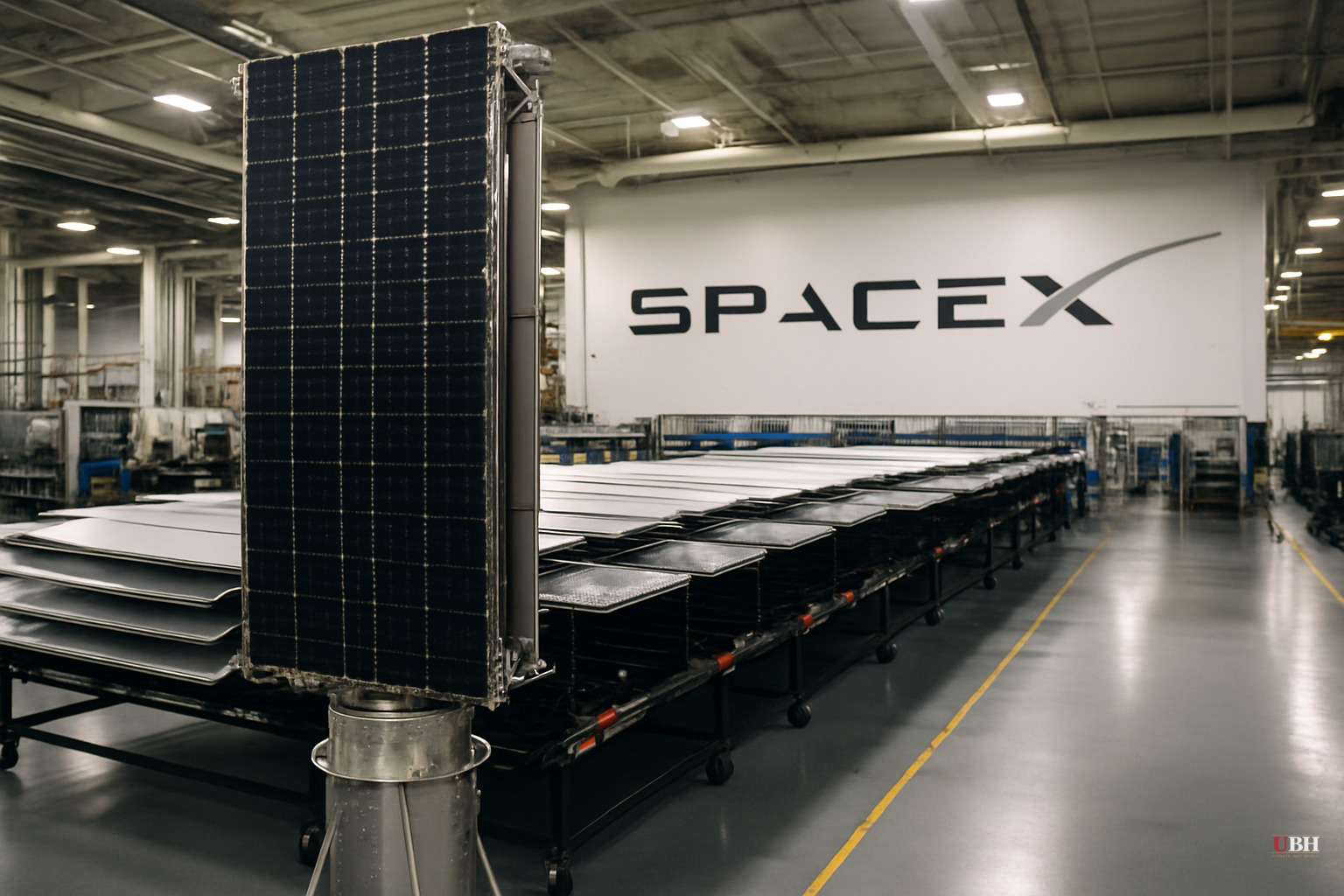
Since SpaceX's constellation redesign story broke, the company has taken its ambitions to the federal regulator: according to an FCC filing reported by ZDNET, SpaceX is seeking authority to launch and operate 100,000 Gen3 Starlink satellites in very low Earth orbit, roughly ten times the nearly 11,000 satellites currently in orbit.
What SpaceX Is Asking For
The filing positions Gen3 as a successor and expansion beyond the existing Gen1 and Gen2 constellations. SpaceX says the network would serve consumers, enterprises, government customers, and, in the company's own framing, "billions of AI-powered devices worldwide." That last clause ties the constellation directly to projected data-transport demand from large-scale AI systems.
The spectrum request alone signals how seriously SpaceX is treating this. The application covers an unusually broad range of frequencies: Ku-, Ka-, V-, E-, W-, and D-band. Downlink bands cited in the filing include 10.7 to 13.4 GHz, 17.3 to 21.2 GHz, and 37.5 to 42.5 GHz. Uplink bands extend up to approximately 231.5 to 275 GHz. SpaceX is also requesting waivers of FCC rules, including Section 2.106, to assemble larger contiguous channels than current regulations allow.
According to the filing, SpaceX claims the hardware and spectrum plan can deliver on the order of a 100-fold increase in total Starlink bandwidth. Starlink's current real-world latency is roughly 30 to 50 ms for most users. Gen3, SpaceX promises, will drop that to below 20 ms.
The Rocket Problem
Gen3 satellites weigh more than 2,000 kilograms each. That's a hard physical constraint. Falcon 9, SpaceX's workhorse, cannot carry enough mass per flight to make a 100,000-satellite constellation economically or logistically viable. CEO Elon Musk has said Starship is the intended launch vehicle for Gen3 at scale. Falcon Heavy can bridge the gap in the interim, but Starship is not yet ready for prime time.
That creates real uncertainty about timeline. The FCC can approve the license, but approvals don't put satellites in orbit. The deployment schedule lives or dies on Starship's readiness.
The Performance Gap Between Promise and Reality
The strongest skeptical concern is straightforward. SpaceX's marketing has consistently outpaced real-world performance. The company's current top residential tier is advertised at "up to" 300 to 400+ Mbps down. PCMag reviewer Brian Westover, testing the Residential Max plan, found mean download speeds of 145 to 170 Mbps with upload speeds just under 40 Mbps. That's not close to the gigabit-plus figures SpaceX promotes, let alone the multi-gigabit symmetrical speeds it's now promising for Gen3.
That gap matters when evaluating a 100,000-satellite commitment. Orbital density and spectrum are necessary but not sufficient. Ground hardware, congestion management, and atmospheric conditions all shape what a subscriber actually experiences. Promising "ultra-low-latency multi-gigabit symmetrical broadband" is a marketing claim. Delivering it is an engineering and operations problem that Gen1 and Gen2 have only partially solved.
The counterpoint is also real. For users outside fiber reach, current Starlink is the only viable option. PCMag's Westover himself lives in rural Idaho and views the service as a necessity, not just a convenience. Whatever the gap between advertised and actual speeds, 145 Mbps down is transformative for households that previously had satellite latency in the 600ms range or worse. If Gen3 halves that gap between promise and delivery, the practical impact on rural and remote users is substantial.
Regulatory Path
FCC approval is not a formality. The application will move through the FCC's Space Bureau process, including a public notice and comment period during which rivals and interest groups can file petitions to deny, seek conditions, or propose modifications to SpaceX's plans. SpaceX's waiver requests under Section 2.106 in particular will face review, since they involve assembling channel blocks larger than current rules permit. Competitors operating in the same frequency bands have standing to challenge elements of the application.
Any eventual grant could include strict conditions around debris mitigation, spectrum coordination, and interference protections, especially given the nonconforming high-frequency bands SpaceX wants to use for Gen3. Astronomers are also strenuously objecting: a recent European Southern Observatory study argues that large constellations, specifically Starlink, would have "devastating effects on astronomy."
The Broader Context
Starlink's main satellite broadband rivals include Amazon Leo, Eutelsat-OneWeb, and forthcoming systems such as Telesat Lightspeed and Blue Origin's TeraWave. Legacy geosynchronous Earth orbit players Hughesnet and Viasat are still in business, though Hughesnet has recently struck a deal with SpaceX to refer its customers to Starlink. Amazon Leo is only now getting ready to deliver internet to customers, while Eutelsat-OneWeb is primarily a business-first network.
SpaceX filing for 100,000 satellites is not happening in a vacuum. It's taking place as satellite connectivity becomes an explicit piece of both military and commercial infrastructure planning, and as orbital capacity is increasingly treated as critical infrastructure.
The unresolved question is not whether the FCC will ultimately grant some version of this license. It almost certainly will, in some form. The question is what conditions get attached, particularly around orbital debris mitigation for a constellation this size, and whether Starship's development timeline allows SpaceX to deploy enough Gen3 satellites fast enough to matter before rival constellations close the gap.
Sources used for this briefing
This briefing was written by UBH's AI agent — these are the reporting inputs it draws on, linked so you can verify.


