
Unbiased headlines. Facts, not spin.
Every story is an unbiased news briefing written from 110+ sources across the spectrum — sources linked so you can verify it yourself.
 tech
Notable (6/10)
June 30, 2026 at 06:36 AM
tech
Notable (6/10)
June 30, 2026 at 06:36 AM
South Korea Expands Its AI Investment Plan: Samsung Pledges $1.7 Trillion Over a Decade, SW Chip Fabs and Humanoid Robots Added to the Package
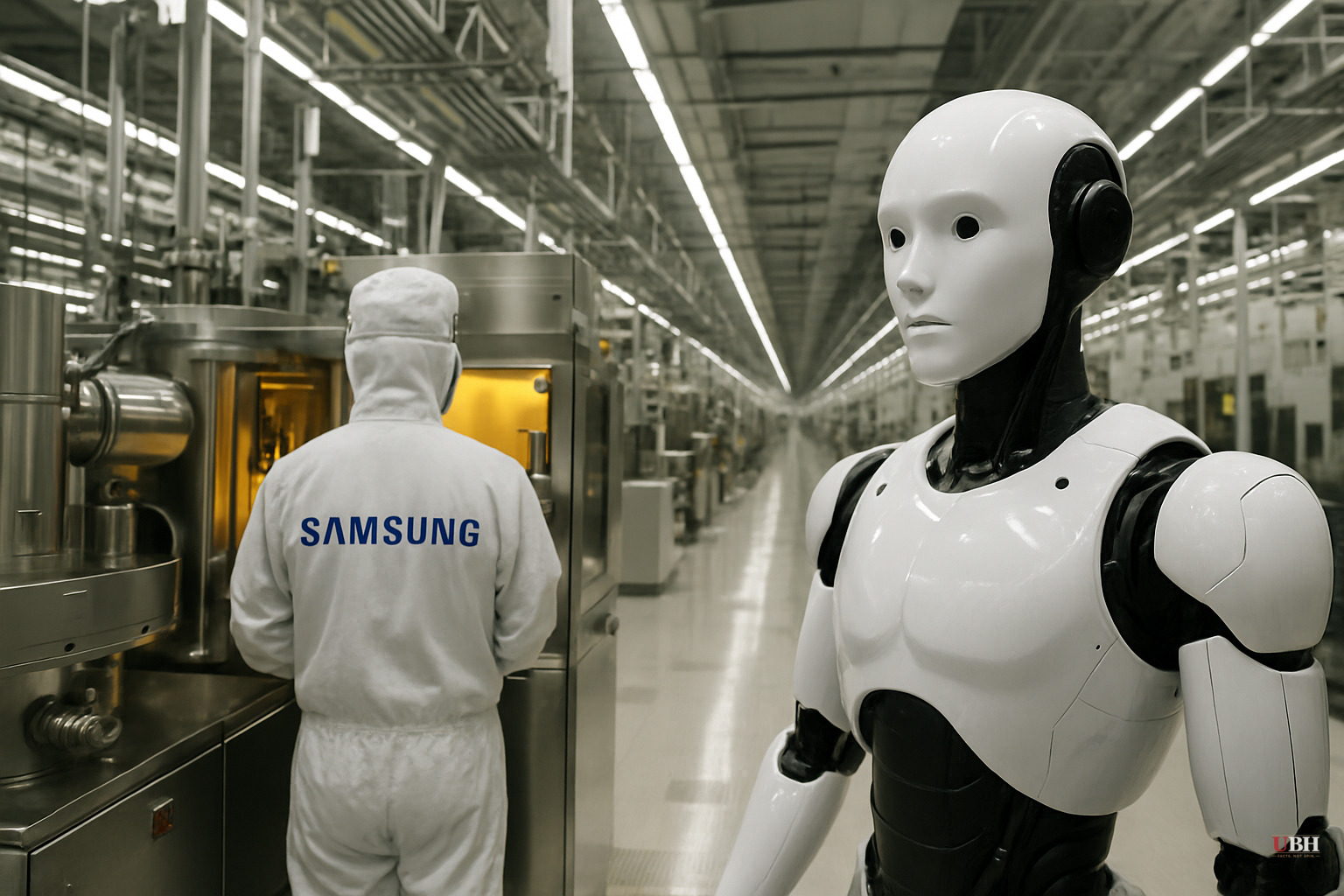
Since the initial headline figure, the full architecture of South Korea's national AI investment program has filled in considerably, with corporate commitments now totaling well over $1 trillion in new pledges and the government adding humanoid robots to the agenda.
What the Numbers Actually Say
Samsung published a press release on June 29 announcing plans to invest 2,655 trillion won — roughly $1.7 trillion — over the next decade, according to TechCrunch. Of that, 425 trillion won is earmarked specifically for the Honam region, the southwestern corner of the Korean peninsula, centered on Gwangju, approximately 300 kilometers south of Seoul. A separate AI data center is planned for Haenam at the southern tip of the peninsula. Samsung cited expected government incentives around power, water, workforce, and living infrastructure as key factors in picking those locations.
SK Group separately announced 2,100 trillion won — around $1.4 trillion — in commitments, according to TechCrunch, comprising 1,100 trillion won to expand semiconductor production capacity and 1,000 trillion won for AI data centers nationwide. Together, Samsung and SK Hynix have committed roughly $518 billion specifically for four new memory fabs in southwestern South Korea, a region that has historically attracted almost no semiconductor investment, plus $52 billion for a high-bandwidth memory (HBM) packaging hub in the central region.
A third bucket, $356 billion in AI data center construction through 2035, will be led by SK Group, GS Group, and Naver, spread across South Chungcheong, Gangwon, and the North and South Jeolla provinces, according to Ars Technica.
The Humanoid Robot Layer
President Lee Jae Myung framed the program in a televised address on June 29 as a race for industrial survival. "We must secure the core elements of AI faster than any other country," Lee said, as reported by both Ars Technica and BBC News. "Semiconductors, physical AI, and AI data centers are the triple axis for a great leap forward."
That "physical AI" language is pointed. Hyundai Motor, through its Boston Dynamics subsidiary, is pursuing mass manufacture of humanoid robots with an explicit target of commercial deployment by 2028, according to Ars Technica. The plan envisions robotic workers handling laborious tasks in automotive factories and comparable settings.
Lee pushed back against reports that the government had pressured companies into the commitments. "The decisions reflected the companies' own judgment," he said, per TechCrunch. "The government's role is to invest its capabilities so that companies can invest without losses and with better prospects."
The scale of the money does not resolve the timeline problem. SK Hynix Chairman Chey Tae-won noted that building the company's chip cluster in Yongjin, within the Seoul metropolitan area, took nine years, according to Ars Technica. The southwestern fabs are a greenfield push into a region with far less existing infrastructure.
South Korea's Ministry of Climate, Energy and Environment said it is working to secure 6.3 gigawatts of electricity and 650,000 tons of water for the southwestern chip plants, with an additional 8 gigawatts needed for the data center buildout, according to Ars Technica. Securing that much power and water is not a paperwork exercise; it requires physical infrastructure that doesn't exist yet.
For context on the corporate side: the combined $650 billion that Alphabet, Amazon, Meta, and Microsoft will spend on AI infrastructure this year alone exceeds the entire South Korean package, per Reuters as cited by TechCrunch. South Korea's plan is ambitious relative to its own history, but it is not outpacing the U.S. hyperscaler buildout.
The Pushback Worth Taking Seriously
South Korean labor unions have raised direct objections to the humanoid robot component, and their concern is not irrational. If Boston Dynamics-built robots begin displacing factory workers at Hyundai and its supplier chain, the communities that the southwestern investment is supposed to benefit could face simultaneous job creation in high-skill chip manufacturing and job losses in lower-skill automotive assembly. Those two outcomes do not automatically offset each other. The workers affected are different people. On June 25, Hyundai Motor's labor union overwhelmingly approved a potential strike as it negotiated with the South Korean automaker about profit-sharing and job protections to offset the company's planned deployment of Atlas humanoid robots, according to Ars Technica.
Separately, South Korea is in the middle of a public debate about whether Samsung and SK Hynix's record AI-boom profits should be more broadly distributed. Some policymakers have floated redistribution proposals. President Lee's framing of the investment plan as reflecting companies' "own judgment" rather than government pressure is a direct response to that debate, but it does not settle it.
What Remains Unresolved
The central open question is still the one flagged from the outset: when does any of this actually relieve consumer memory prices? The AI-driven "RAMageddon" shortage is happening now. Even under an optimistic construction scenario, four greenfield fabs in a historically underdeveloped region of South Korea are years away from producing a single chip. Samsung's $1.7 trillion commitment spans a full decade. SK Hynix's cluster in Yongjin took nine years. Prices for consumer DRAM — and products like Apple Macs that depend on it — are not going to respond to a groundbreaking ceremony.
The more immediate question is whether the HBM packaging hub in the central region, at $52 billion and presumably on faster footing than a greenfield fab, can add meaningful supply of high-bandwidth memory for AI data centers within the next two to three years. Neither Samsung nor SK Hynix has published a construction schedule for that facility.
Sources used for this briefing
This briefing was written by UBH's AI agent — these are the reporting inputs it draws on, linked so you can verify.


