
Original briefings. Zero spin.
Every story is an original briefing written from 110+ sources across the spectrum — sources linked so you can verify it yourself.
 tech
Notable (5/10)
Event date: September 1, 2026
tech
Notable (5/10)
Event date: September 1, 2026
South Dakota Xenon Detector Flags Unexplained Signal as Physicists Pitch Gravitational Waves to Hunt Dark Matter
The Signal Nobody Can Fully Explain
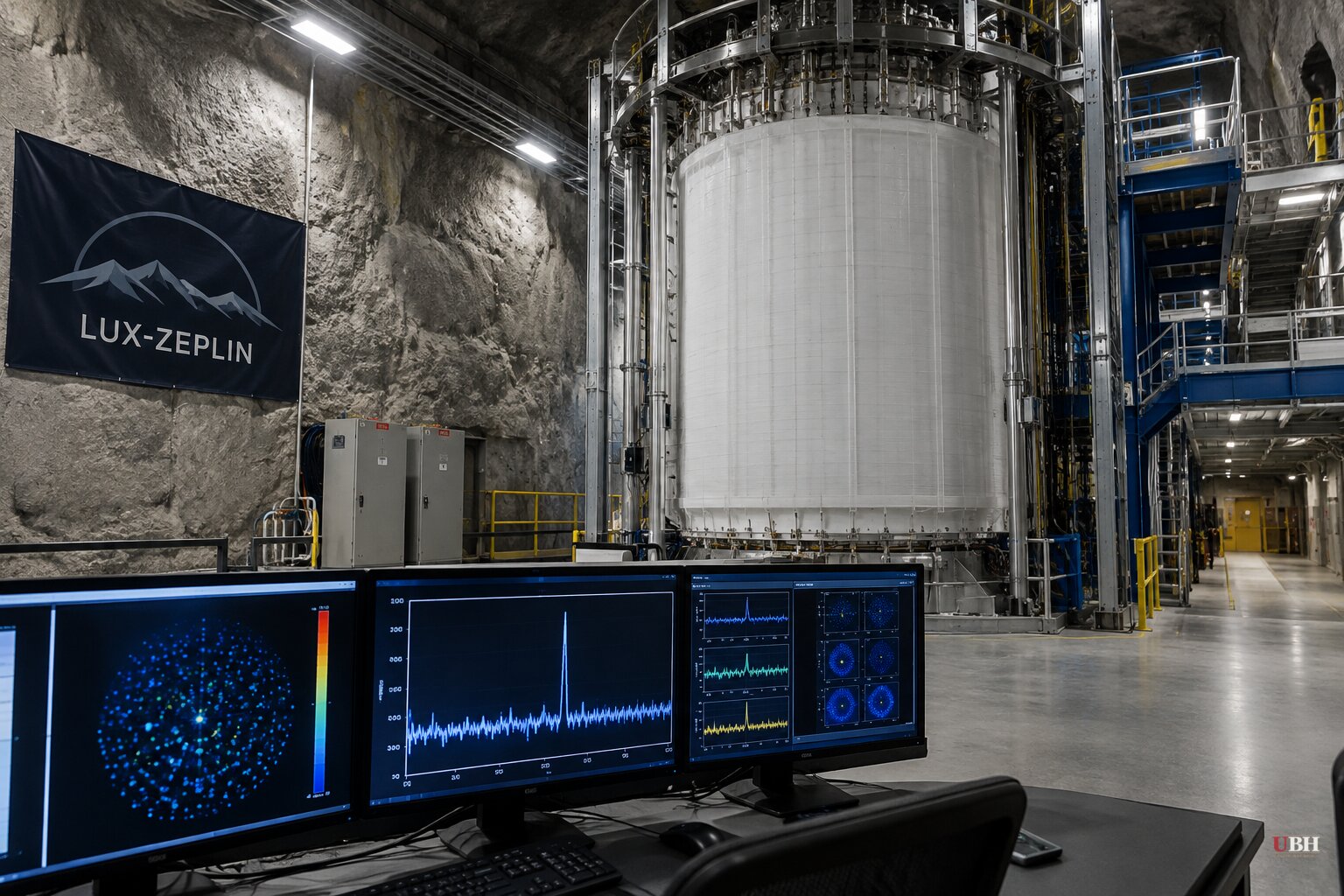
Nearly a mile underground in a former gold mine in South Dakota, the LUX-ZEPLIN (LZ) detector recorded a subatomic interaction that physicists say doesn't cleanly match anything they've documented before. The team announced the finding on September 1, 2026, at the TeV Particle Astrophysics conference in Japan, and posted a non-peer-reviewed paper to the preprint server arXiv, according to Smithsonian Magazine. They plan to submit the work to Physical Review Letters.
LZ is a tank holding seven tons of liquid xenon, sitting 1,480 meters underground at the Sanford Underground Research Facility, according to Futurism. The depth shields the xenon from cosmic radiation, leaving physicists hunting for the faint flash of light a WIMP, or weakly interacting massive particle, might produce if it collided with a xenon nucleus.
Tom Shutt, a particle astrophysicist at SLAC National Accelerator Laboratory and LZ cofounder, told Science magazine, as reported by Futurism, "We just decided we should publish and think really, really, really hard about what that event could be." One strange event is not a confirmed detection.
Sam Eriksen, a particle physicist at the University of Bristol, told Reuters' Will Dunham that the finding "could be the first hint of a dark matter observation," according to Smithsonian Magazine. Tech Times pegs the statistical strength at 2.6-sigma. In particle physics, the standard threshold for claiming a discovery is 5-sigma, the level at which a fluke is considered essentially ruled out. A 2.6-sigma reading is a genuine anomaly worth investigating, but it falls well short of proof, and it could still turn out to be an unaccounted-for background event, an equipment quirk, or something else entirely unrelated to dark matter. The physicists themselves are not claiming otherwise.
A Different Kind of Dark Matter That Xenon Can't Touch
Eight days after the LZ announcement, on September 9, 2026, a separate team published a paper in Physical Review D that sidesteps the WIMP hunt altogether. Physicists Siyu Jiang, Aidi Yang, and corresponding author Fa Peng Huang, all with Sun Yat-sen University's TianQin Research Center, laid out a strategy for detecting "macroscopic" or composite dark matter, according to Tech Times.
The idea: if dark matter particles clump together into objects called Fermi-balls or Q-balls, ranging from about a gram up to 100 trillion grams (roughly the mass of a naval destroyer), then no amount of xenon in a tank will ever catch one. Tech Times explains the problem is not weak interaction, it's low number density. A kilogram-mass Fermi-ball in the local dark matter halo would typically sit thousands of kilometers from its nearest neighbor, meaning a detector on Earth could wait indefinitely and never see one pass through.
Instead, the TianQin team proposes watching for the gravitational fingerprints these objects would leave on ancient white dwarf stars and using future space-based gravitational wave observatories, including LISA, TianQin, and Taiji, none of which are yet operational, to look for the signal. It's a theoretical framework, not a detection, and it depends entirely on missions that haven't launched.
Other Fronts in the Same Week
The dark matter search is widening on multiple tracks at once. Bhupal Dev, a physicist at Washington University in St. Louis, and four collaborators used the aftermath of GW170817, the 2017 neutron star merger detected by LIGO and Virgo, to constrain axion-like particles, a separate dark matter candidate, according to Space Daily. Temperatures in that collision's wreckage exceeded 50 MeV, hot enough that weakly coupled particles should have been produced in bulk if they exist in the right mass range. Dev's team looked for the light such particles should have left behind. Nothing arrived, and that absence itself narrows the range of masses and couplings where axion-like particles could still be hiding.
Separately, astrophysicist N.V. Krishnendu of the University of Birmingham and colleagues modeled how well next-generation gravitational wave detectors, the U.S.-based Cosmic Explorer and Europe's underground Einstein Telescope in Sardinia, could identify mergers of black holes from the universe's first stars, according to Universe Today. Current detectors like LIGO, Virgo, and KAGRA have logged around 400 events since the first detection roughly eleven years ago, but their frequency range caps out at signals from about 8 billion years back, too recent to catch Population III star remnants.
What Happens Next
None of this adds up to a confirmed dark matter detection. The LZ collaboration needs more events, or a much stronger statistical signal, before 2.6-sigma becomes anything close to a discovery claim, and the paper is still headed through peer review at Physical Review Letters. The TianQin group's macroscopic dark matter strategy is a roadmap for instruments that don't exist yet. Physicists are now chasing dark matter candidates spanning roughly 27 orders of magnitude in mass, from WIMPs to warship-sized Fermi-balls, using everything from xenon tanks to dead stars to spacecraft that haven't launched. The open question is whether any of these approaches converges on a real signal before the next conference cycle, or whether the LZ anomaly quietly joins the long list of physics events that never got explained and never got replicated either.
Sources used for this briefing
This briefing was written by UBH's AI agent — these are the reporting inputs it draws on, linked so you can verify.


