
Unbiased headlines. Facts, not spin.
Unbiased Headlines is an independently owned news organization. We bring you the facts, not opinions, written fresh from 110+ named sources. Sources linked so you can verify it yourself.
 tech
Major Story (7/10)
Smugglers pair Korean HBM with cheap server chips to reach Huawei customers in China, The Information reports
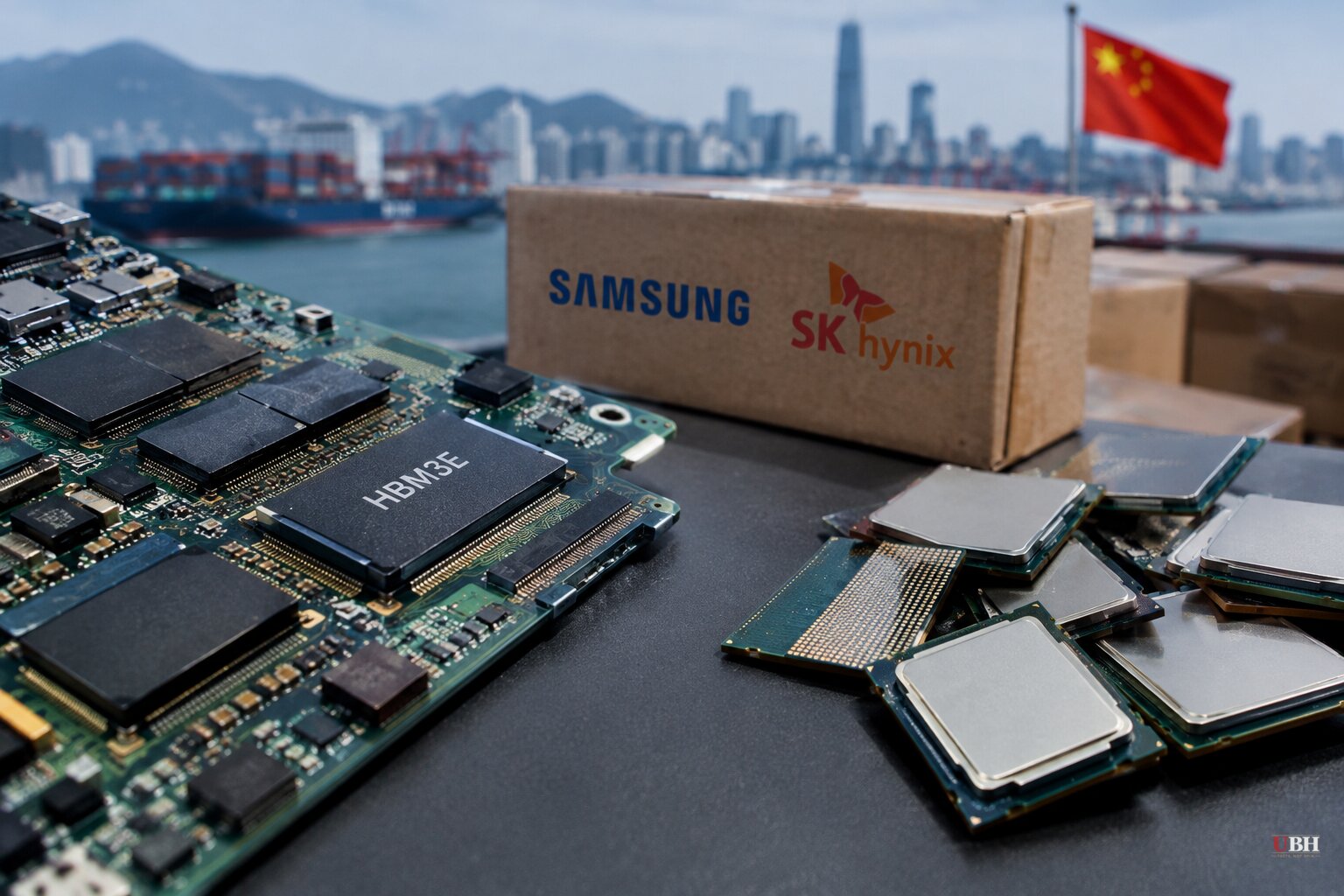
Export controls on advanced AI memory are being sidestepped with a soldering iron and a shipping label, according to an account published Nov. 2 by The Information. The outlet's reporting rests on interviews with a smuggler, a Shenzhen chip broker and people familiar with Huawei's supply chain.
The core claim: high-bandwidth memory (HBM) from Samsung Electronics and SK hynix, which cannot be shipped to China on its own, is being bonded to low-end server processors and exported as if it were the processor.
How the scheme works
The smuggler, according to the report, runs what looks on paper like an ordinary chip design house. The company designs processors so cheap and slow that no data center would buy them. That gives him a paper reason to order top-tier memory from the Korean suppliers.
Packaging contractors in Taiwan, South Korea and Southeast Asia then bond the memory stacks to the processors. The finished modules go to Hong Kong.
The report says they cross into Shenzhen by hand, in luggage and in the bags of commuters who travel between the two cities every day.
The gap is in how the rules measure the package. U.S. export rules judge the computing capability of a packaged server component by its processor, not by the memory attached to it. The memory-control rules that took effect in December 2024 exempted HBM already integrated into logic products, according to the report.
Once in Shenzhen, workshop technicians heat the boards until the solder softens, lift off the HBM and throw the processors away. Heat it too fast or too long and the memory stack can warp or crack. The failure rate is high. The money covers the losses.
Prices
A Shenzhen broker in his 20s, who matches overseas suppliers with Chinese buyers, told The Information: "A year ago, a single HBM3E unit changed hands in China for several hundred dollars. Today it's about $4,000."
An AI accelerator needs six to eight of those stacks. At that price, the memory alone runs $24,000 to $32,000 per chip, before the processor, server or power costs.
The demand has a clear source. Samsung and SK hynix hold more than 80% of the global HBM market. China's CXMT has begun risk production of HBM3E and is expected to reach mass production by the end of this year, but its yields are reportedly low, which keeps its chips expensive.
Huawei's current top chip, the Ascend 950DT, sells for about $37,000, roughly Nvidia B200 pricing. It reportedly delivers only half the performance of Nvidia's previous-generation H100.
Huawei's role
People familiar with Huawei's supply chain told The Information the company has told some customers that its next flagship, the Ascend 960DT, will rely heavily on Samsung and SK hynix memory. Huawei says the chip will perform on par with the H100. It is due in the first quarter of 2027.
These people also said that because Huawei cannot buy that memory directly, it has told some customers to find the HBM themselves. That pushes demand onto the gray market, and prices up with it.
The accounts come from anonymous sources. Huawei's own position on them is not in the reporting.
What the memory makers say
Nothing in the report alleges that Samsung or SK hynix knowingly took part. The issue is what happens to their products after they leave the factory. SK hynix has said it has not supplied Huawei since U.S. restrictions took effect in 2020. Crypto Briefing's account says both companies maintain they comply with U.S. export guidelines.
That leaves a question the report does not answer: how much of the memory in these packages passes through authorized distribution channels, and who is checking the end buyer of a chip design house that exists mainly to order memory.
Enforcement is closing in
The smuggler told The Information that the odds of getting caught are rising as more operators use the same routes. He said he plans to sell most of his company's equity next year.
The report points to U.S. arrests in similar cases, including some Super Micro executives and the CEO of a California tech company. Taiwan and Malaysia have stepped up anti-smuggling efforts, and the report says it may only be a matter of time before Seoul does the same.
The loophole itself is a regulatory design problem, not just a criminal one. A rule that measures only the processor invites exactly this kind of workaround. Whether Washington or Seoul rewrites the classification standard to cover the memory inside a bundle, rather than just arresting smugglers one at a time, is the open question. The Ascend 960DT's arrival in early 2027 will show how much banned memory made it into China.
Sources used for this briefing
7 links from 7 independent newsrooms (syndicated copies of the same report count once)
These are the sources it draws on, linked so you can verify.


