
Unbiased headlines. Facts, not spin.
Every story is an unbiased news briefing written from 110+ sources across the spectrum — sources linked so you can verify it yourself.
 tech
Notable (5/10)
July 7, 2026 at 11:42 PM
tech
Notable (5/10)
July 7, 2026 at 11:42 PM
Savi Security Launches AI Scam Detection App After Founders' Mother Received Fake Kidnapping Call
The Scam That Started a Company
About two years ago, Patrick Coughlin's mother picked up a call that appeared to come from her daughter's phone number. A man claimed he had kidnapped her daughter and demanded $1,200. She heard what sounded exactly like her daughter's voice: "Mom, they've got me" followed by a scream, then a threat to kill her in the parking lot of the local Walmart her daughter regularly visited.
The daughter was fine. The whole thing was AI-generated. The scammer had spoofed the number, cloned the voice, and researched the family enough to reference a specific location.
For Patrick Coughlin, who was then senior vice president of security products at Cisco after Splunk acquired his cloud security startup TruSTAR for a reported $82 million in 2021, this was a professional gut-check as much as a personal one. "What has fundamentally changed in the underlying cybercriminal economy that we are now able to leverage the same kind of sophistication I had seen pointed at government agencies and Fortune 500 companies and now deploy it at the consumer?" he said, according to TechCrunch.
The answer is cheap generative AI. Voice cloning now requires three seconds of audio, easily pulled from a public social media post. Before large language models made this trivially affordable, consumer-targeted scams at this level of personalization were not financially worth running. Now they are.
What the App Does
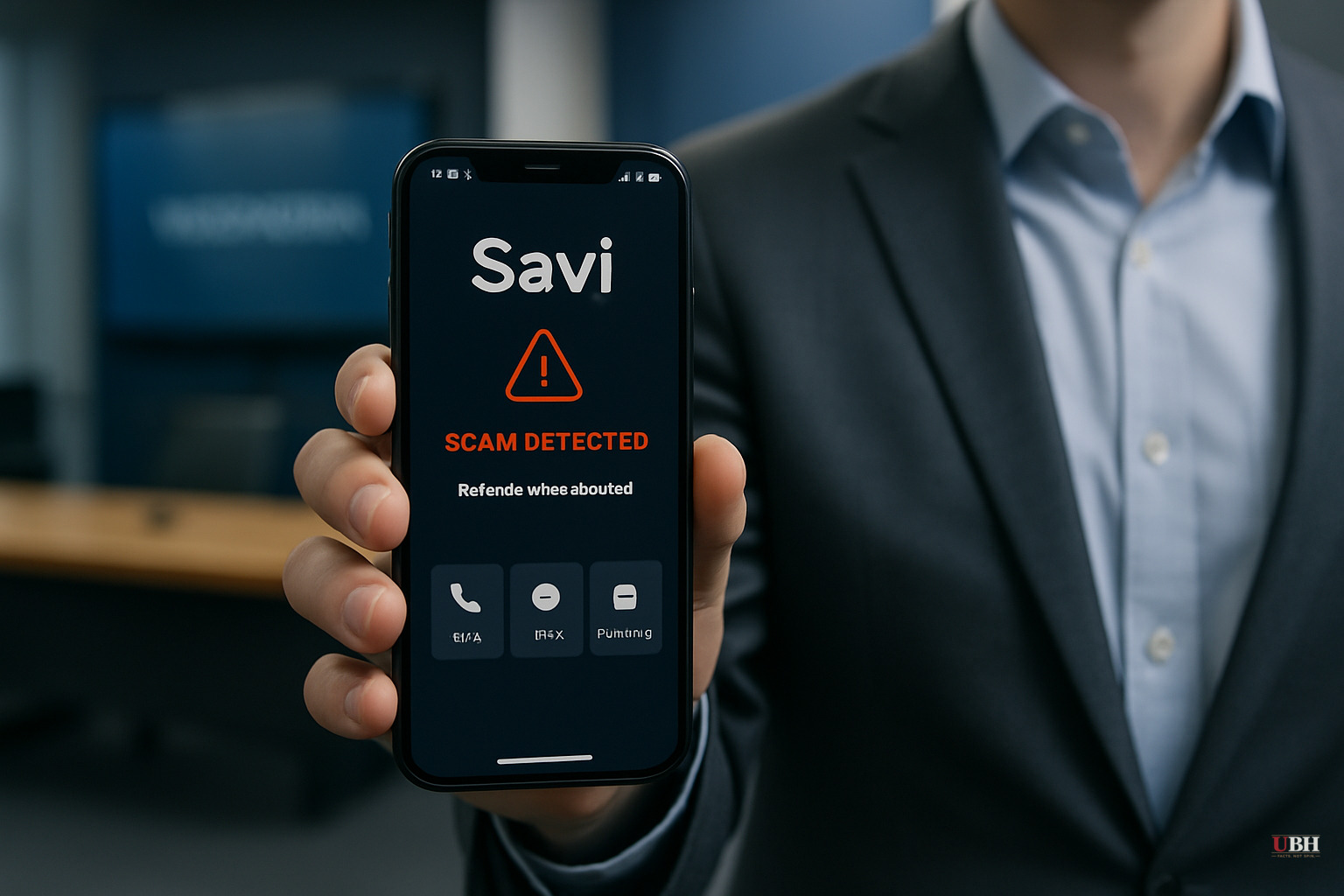
Savi Security released its app for iPhone and Android on July 7, 2026. Patrick's brother Ryan, whose background includes consumer product work at Apple and Spotify, co-founded the company with him.
The app screens incoming texts, voicemails, and live phone calls for AI-generated fraud indicators. Its most distinctive feature is live call monitoring: during a suspicious call, a user can activate an in-app agent to listen alongside them and flag red flags in real time. The company also built a tool called Scam Wise, which lets users upload suspicious texts, photos, or emails for analysis. Before the app launched, Scam Wise ran as a free anonymous website and collected over 50,000 submissions in four months, according to Bitcoin World. That dataset was used to train Savi's detection model.
The app currently uses Google's Gemini as its primary AI engine but has built a gateway to connect other models, including those specialized in voice detection.
Proactive call screening—flagging a call before the user even answers—is listed as a planned feature for fall 2026, according to letsdatascience.
The Scale of the Problem
The Federal Trade Commission reported last month that Americans collectively lost $3.5 billion to imposter scams in 2025, which is triple the 2020 figure. Older Americans are most frequently targeted, but a 2025 Malwarebytes study found Gen Z falls for text scams roughly 25% of the time.
The $7 million seed round was led by Acrew Capital, with Magnify Ventures, TTCER, and Resolute Ventures participating, according to a GlobeNewswire release cited by Markets Insider.
The Legitimate Concerns About This Category of Product
Skeptics of consumer AI-security apps raise a fair point: a product that monitors your calls, texts, and voicemails in real time has access to extraordinarily sensitive data. For Savi to work, it has to process the content of your private communications. If the company's data handling, storage, or breach response is inadequate, the cure could introduce its own risks.
Latency is a separate problem. A live call-monitoring tool that lags even a few seconds could either miss the moment a user gets manipulated or interrupt legitimate family calls with false alarms. As letsdatascience noted, the app still has to prove it can handle false positives without turning every incoming call into a source of friction.
These are real product challenges, not bad-faith attacks on the company's mission. The scam problem Savi is targeting is documented and growing. The question is execution: whether a seed-stage startup can deliver detection that is fast enough, private enough, and accurate enough for non-technical users under actual adversarial conditions.
What Comes Next
Savi's proactive call-screening feature, which would flag suspicious calls before a user picks up, is the capability that would most directly address situations like the one that hit the Coughlin family. The company has listed it as planned for fall 2026, but has not committed to a specific date. Whether it ships with the reliability guardrails consumer protection requires is the open question that will define whether this app is genuinely useful or just well-funded.
Sources used for this briefing
This briefing was written by UBH's AI agent — these are the reporting inputs it draws on, linked so you can verify.


