
Unbiased headlines. Facts, not spin.
Every story is an unbiased news briefing written from 110+ sources across the spectrum — sources linked so you can verify it yourself.
 tech
Notable (6/10)
July 17, 2026 at 01:29 AM
tech
Notable (6/10)
July 17, 2026 at 01:29 AM
San Francisco Mayor Asks State to Force Waymo Rules After July 4 Gridlock
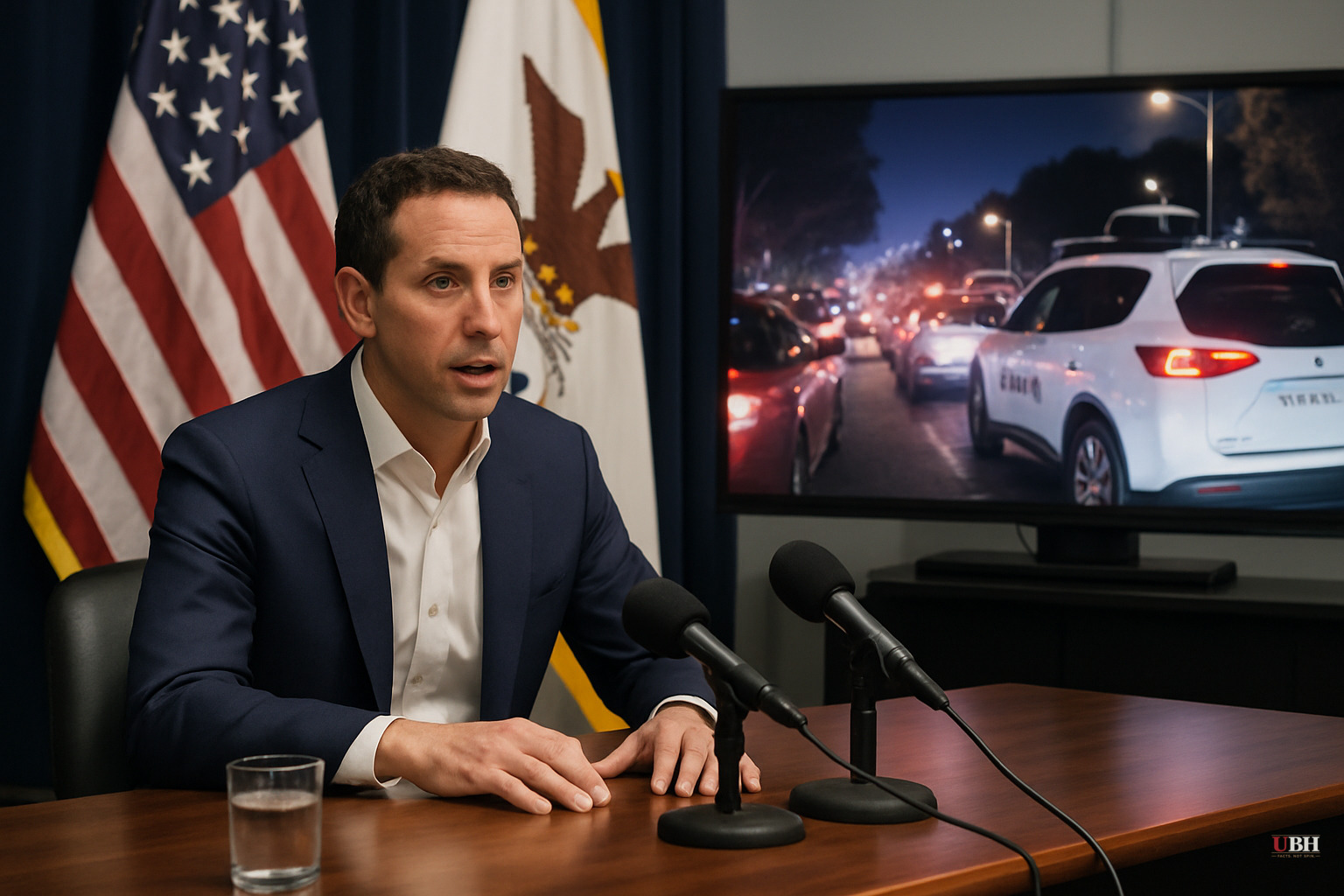
Mayor Daniel Lurie has sent a letter to the California Department of Transportation asking for tougher statewide rules on autonomous vehicles, nearly two weeks after Waymo robotaxis ran out of power and stalled in the middle of San Francisco streets during the July 4 gridlock. TechCrunch reviewed the letter, and the San Francisco Chronicle first reported on it.
Lurie previously said San Francisco should serve as a testbed for emerging tech, including autonomous vehicles. Now he's telling state regulators the current framework doesn't cut it.
What actually happened
The letter points to two specific incidents. First, a citywide power outage in December left autonomous vehicles stranded. Second, the July 4 Golden Gate Bridge fireworks show, which drew roughly 100,000 spectators, produced a traffic crunch that immobilized dozens of Waymo vehicles. Those stalled cars blocked key streets, trapped municipal shuttles, and turned a manageable crowd-control problem into an hours-long citywide standstill affecting thousands of people.
Lurie's argument is straightforward: California's rules were built around whether autonomous vehicles can drive safely on a normal Tuesday. They weren't built around what happens when 100,000 people converge on one neighborhood, or when the power grid goes down and every robotaxi in the fleet needs somewhere to go that isn't the middle of an intersection.
What Lurie wants
The mayor's letter lays out four capabilities he wants autonomous vehicle companies to prove before state regulators, according to TechCrunch's review of the document. Companies would have to show they can immediately clear stalled or immobile vehicles out of active travel lanes. They'd need to adjust routes, service areas, and pickup and drop-off zones in real time as conditions change. They'd be required to share real-time operational data with local agencies, including where vehicles are stranded and what the recovery plan looks like. And they'd need to demonstrate, through actual testing, that their systems can handle a sudden surge in demand and traffic density.
None of that exists as a hard requirement today. California's rules split oversight between the Department of Motor Vehicles, which handles testing and deployment permits, and the Public Utilities Commission, which regulates the commercial ride-hailing side. Six companies, including Waymo, Zoox, and Nuro, currently hold permits allowing fully driverless testing with no human safety operator behind the wheel.
The fair case for caution here
Critics of heavier regulation would argue that autonomous vehicles have an overall safety record that, per mile driven, compares favorably to human drivers in several published comparisons, and imposing rigid new operational mandates risks slowing a technology that's already reducing crashes tied to drunk or distracted driving. A company facing new real-time data-sharing and stress-testing requirements could see costs and deployment timelines balloon, and California already has a reputation, deserved or not, for regulatory friction that pushes companies toward friendlier states like Texas and Arizona.
California's rules have historically been stricter than most other states without stopping companies from operating there anyway. But the July 4 incident wasn't hypothetical. It was hours of stalled traffic, trapped shuttles, and vehicles that ran out of power in the street with nowhere to go, according to Lurie's letter. A safety record built on average daily driving conditions doesn't answer the question of what a fleet does when 100,000 extra people show up for one night.
What's unresolved
TechCrunch has reached out to Waymo for comment and had not received a response as of its report. Waymo's public position on the incident itself has not been detailed in what's been published so far.
Whether Caltrans has the statutory authority to impose the kind of real-time data-sharing and operational mandates Lurie is requesting remains unclear. That could require action from the DMV, the Public Utilities Commission, or the state legislature instead. Lurie's letter frames this as a request, not a demand backed by any enforcement mechanism, and no rulemaking process or hearing date has been announced.
The next concrete marker to watch is whether Caltrans responds to Lurie's letter at all, and if so, whether it kicks the issue to the DMV or PUC for actual rule changes. Until one of those agencies acts, the standards Lurie is asking for don't exist, and nothing currently obligates Waymo or any other operator to build the kind of surge-capacity testing or real-time reporting he's describing.
Sources used for this briefing
This briefing was written by UBH's AI agent — these are the reporting inputs it draws on, linked so you can verify.


