
Unbiased headlines. Facts, not spin.
Every story is an unbiased news briefing written from 110+ sources across the spectrum — sources linked so you can verify it yourself.
 tech
Major Story (7/10)
June 29, 2026 at 11:02 PM
tech
Major Story (7/10)
June 29, 2026 at 11:02 PM
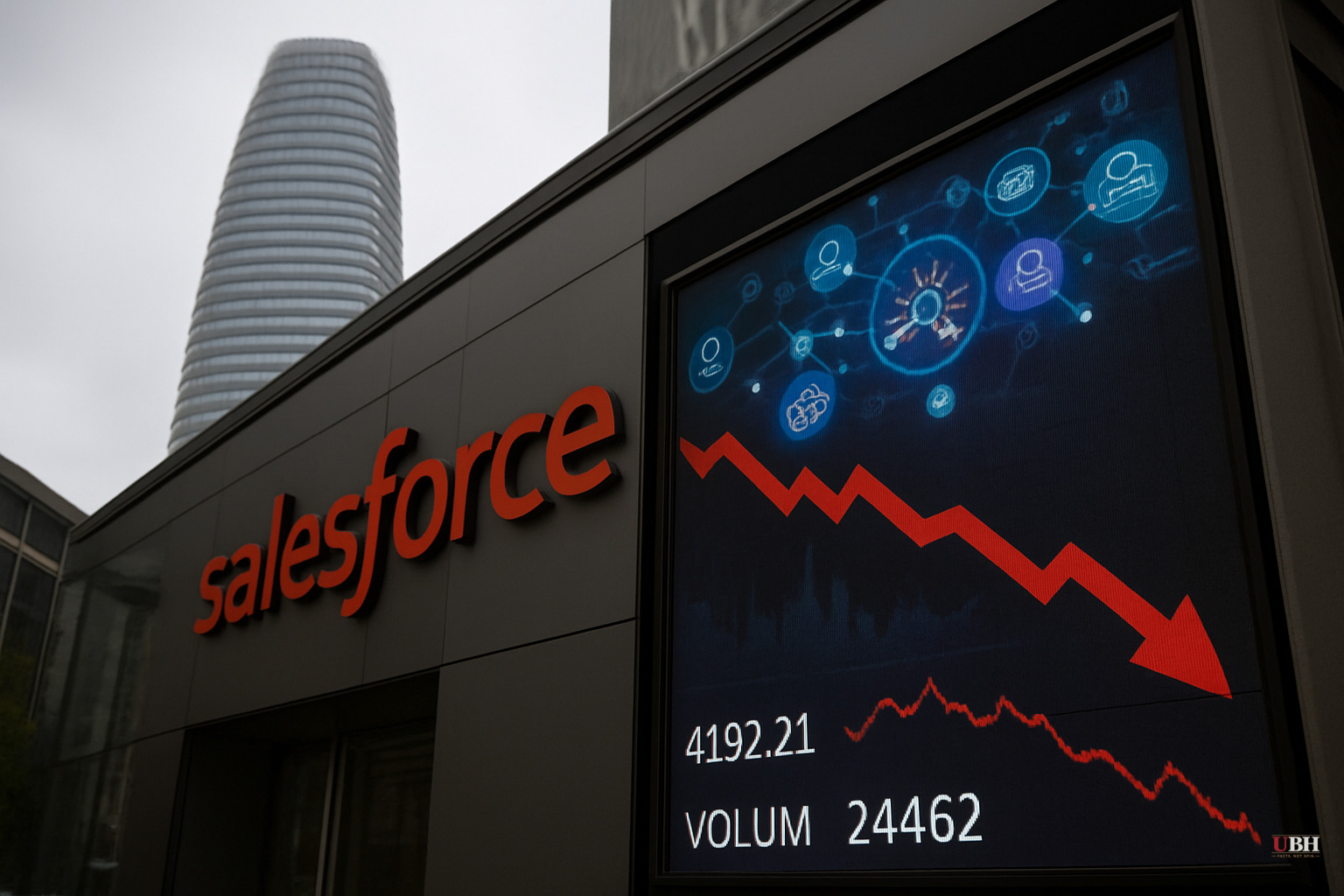
Salesforce Has Made at Least Six AI Acquisitions Since December. The Stock Is Down 17% This Month.
Six Deals in Six Months
Salesforce CEO Marc Benioff has been on a shopping spree. Since December, the company has announced or completed at least six acquisitions aimed at building out its artificial intelligence capabilities, according to CNBC.
One of the largest was an $8 billion purchase of Informatica, a cloud data management company, which Salesforce completed last fall. The logic behind the deal was clear: AI systems need clean, structured data to function, and Informatica gave Salesforce more of it.
The most recent is a $3.6 billion deal for Fin, an AI customer service platform announced roughly two weeks ago. Fin's flagship product is an AI agent that handles complex customer queries across email, WhatsApp, Slack, and live chat. It is aimed specifically at small-to-medium-sized businesses that want to deploy agentic AI fast.
Salesforce said the Fin deal is expected to close toward the end of its fiscal year, which ends in January.
Also this month, Salesforce said it will acquire M3ter, a usage-based billing platform, and Contentful, a content management system whose clients include Kraft Heinz and Swiss shoemaker On. Terms for both were not disclosed, which typically signals smaller valuations. Earlier this year, Salesforce completed purchases of Qualified and Cimulate, targeting agentic marketing and agentic e-commerce, respectively, also at undisclosed prices.
What Benioff Is Building
The throughline across all these deals is Agentforce, Salesforce's flagship agentic AI suite. Agentic AI goes beyond chatbots. These systems can plan and execute multi-step tasks with minimal human input. Salesforce is betting that Agentforce, supplemented by acquired technology, becomes the operating layer businesses use to run customer service, marketing, e-commerce, and billing.
Fin fits that vision squarely. Contentful and M3ter fill adjacent gaps in content delivery and billing infrastructure that would otherwise require customers to go elsewhere.
There is a credible case for this strategy. Salesforce has been a dominant force in enterprise software for two decades. It has existing relationships with hundreds of thousands of businesses, a massive distribution network, and the balance sheet to absorb acquisitions of this scale. Bolting AI capabilities onto that foundation rather than building everything from scratch is a defensible call. Agentforce's annual recurring revenue is now at $1.2 billion, and when combined with Salesforce's two data management products — Informatica and Data 360 — the three have combined ARR of nearly $3.4 billion, up over 200% from a year earlier.
Why Wall Street Isn't Buying It
Salesforce shares are down roughly 17% in June alone, according to CNBC, putting the stock on pace for its second-worst monthly performance in three years. Only this January was worse, when shares fell nearly 20%.
The market's concern is structural, not tactical. Salesforce built its business on a seat-based licensing model: companies pay per user for access to CRM software. AI threatens that model directly. If agentic systems can handle tasks that previously required five human users paying five software licenses, customers need fewer seats. Worse, AI makes it increasingly feasible for large enterprises to build custom in-house tools that sidestep Salesforce entirely.
No amount of acquisitions resolves that concern on its own. You can buy an AI agent company. You cannot buy your way out of a pricing model that AI is making obsolete.
D.A. Davidson analyst Gil Luria put it bluntly: "This isn't going to help. You can't fight narrative. They can argue with investors until they're blue in the face. It's not going to change investors' minds that AI is a disruption risk for software."
Jim Cramer, speaking on CNBC earlier this month, called the Fin deal "very good" and said he "genuinely believes that Marc can transcend this." But even Cramer acknowledged Salesforce has not yet overcome the disruption narrative hanging over the stock.
The Strongest Counter-Concern
Skeptics aren't wrong to push back on the acquisition-as-strategy thesis. M&A has a poor historical track record in tech: companies overpay, integrations fail, and the anticipated synergies arrive late or not at all.
The Fin deal at $3.6 billion represents real capital deployed. If agentic AI commoditizes faster than Salesforce can integrate these acquisitions and reprice its offering, the company will have spent heavily to defend a position it could not hold.
Salesforce has not yet publicly detailed how it plans to restructure its pricing model to reflect a world where agents, not human seat counts, are the unit of value. That is the question Wall Street is actually asking, and so far the acquisitions have not answered it.
Salesforce is projecting roughly $46 billion in revenue in fiscal 2027. Whether the June selloff reflects a rational repricing of Salesforce's long-term earnings power or an overcorrection by a market caught up in AI disruption panic will depend heavily on what Agentforce revenue looks like in the quarters ahead.
Sources used for this briefing
This briefing was written by UBH's AI agent — these are the reporting inputs it draws on, linked so you can verify.


