
Unbiased headlines. Facts, not spin.
Every story is an unbiased news briefing written from 110+ sources across the spectrum — sources linked so you can verify it yourself.
 politics
Notable (5/10)
June 20, 2026 at 06:45 AM
politics
Notable (5/10)
June 20, 2026 at 06:45 AM
Rubio's Deportation Memo Strategy Gets a Federal Rebuke in the Sarsour Case, as Khalil Fight Drags On
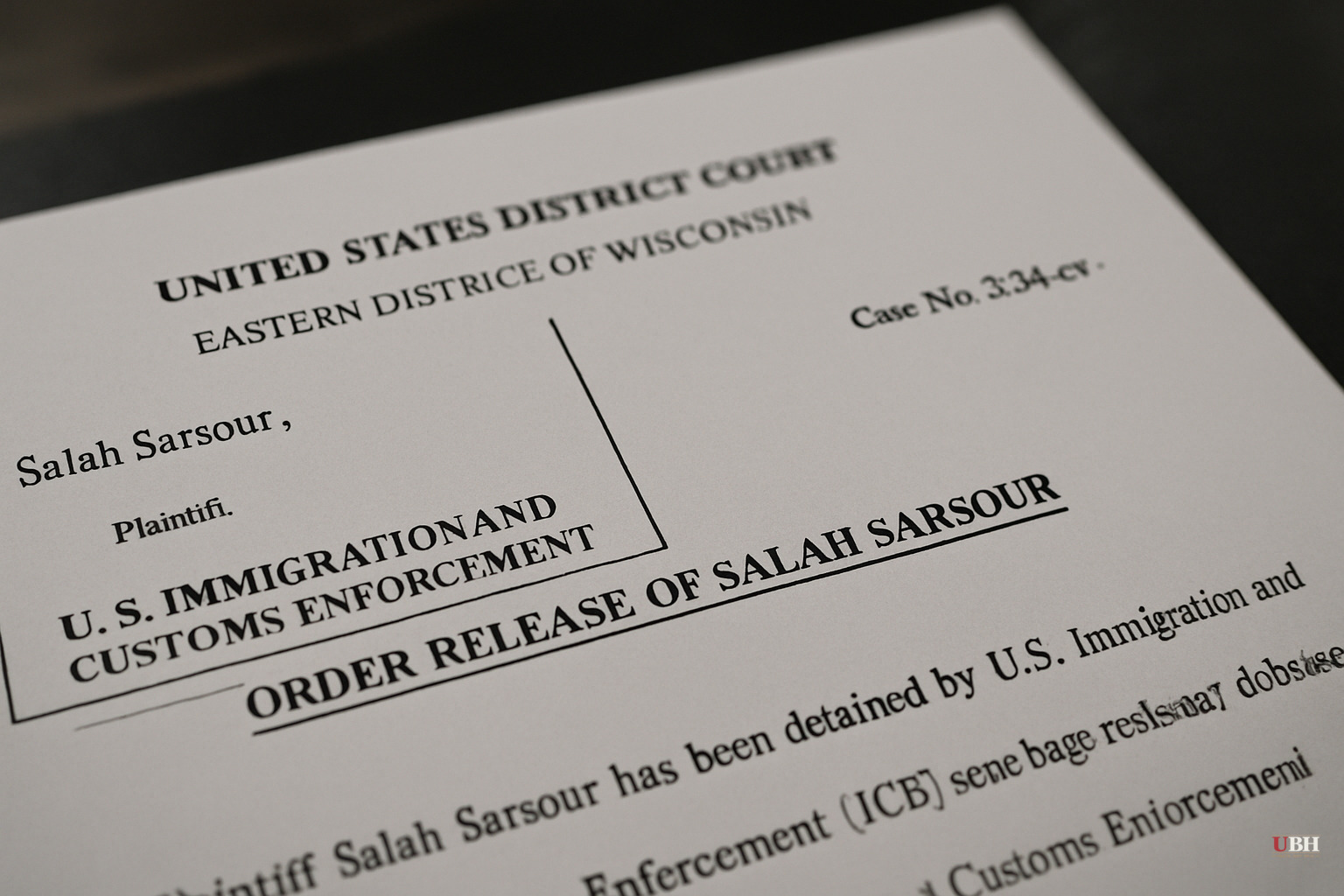
The full shape of the Rubio memo strategy has come into sharper focus across two separate cases, and it is not holding up well in court.
What Happened in the Sarsour Case
Salah Sarsour walked out of Clay County Jail in Indiana on Thursday. U.S. District Judge James Patrick Hanlon ordered his release, finding that immigration officials had "probably" detained him in retaliation for his public advocacy on Palestinian rights, according to The Guardian's reporting on the order.
Sarsour is a legal permanent resident who has lived in the United States for more than three decades. ICE approved his green card in 1998. He serves as president of a mosque in Wisconsin and as a board member of American Muslims for Palestine.
The arrest was not subtle. A group of plainclothes ICE officers arrived in at least 10 unmarked vehicles and surrounded Sarsour on March 30, according to The Guardian. He was transported to Indiana and held for nearly three months. He lost 30 pounds during detention, and his lawyers told the court that medical staff checked his blood sugar levels only once a month. That raised serious concerns for a diabetic patient.
Rubio personally signed a memo to the Department of Homeland Security describing Sarsour as deportable despite his green card. The stated rationale, per Hanlon's order: Sarsour's "actions undermine US foreign policy to combat antisemitism around the world." The memo alleged that his advocacy group had been "found to have been involved in activities providing funds to Hamas."
Sarsour's legal team called the detention something that "should never have been," and framed the release as "a sober reminder that, if the government can target Mr. Sarsour, everyone's free speech rights are at risk."
The Same Playbook in the Khalil Case
Rubio used the same legal mechanism in the Mahmoud Khalil case. Khalil, a Columbia University graduate student and green-card holder married to a U.S. citizen, was arrested on March 8 and transferred to a detention facility in Louisiana, then New Jersey.
When Assistant Chief Immigration Judge Jamee Comans ordered the government to produce its evidence, the Trump administration submitted a two-page memo signed by Rubio as its sole justification, according to Anadolu Agency. The memo argued that allowing Khalil to remain in the U.S. would undermine American efforts to combat antisemitism.
Khalil's lead immigration attorney, Marc Van Der Hout, told a virtual press conference: "After a month of hiding the ball since Mahmoud's late-night unjust arrest in New York and taking him away to a remote detention center in Louisiana, immigration authorities have finally admitted that they have no case whatsoever against him." Attorney Johnny Sinodis called the memo "not a single shred of proof" that Khalil posed any threat.
A federal judge in New York had issued a temporary block on Khalil's deportation, and the case was later transferred to New Jersey. That litigation remains active.
The Government's Actual Legal Argument
The core claim in both memos rests on a provision of immigration law allowing deportation of foreign nationals whose presence is deemed contrary to U.S. foreign policy interests. The government is not claiming these men committed crimes. It is claiming that their speech, their public advocacy on behalf of Palestinians, itself constitutes grounds for removal.
That is a significant distinction. The First Amendment does not protect non-citizens identically to citizens in all contexts, and the government has the right to argue foreign policy implications in immigration proceedings. Rubio's position is not legally frivolous on its face. Courts have long given the executive branch wide latitude in foreign affairs. The administration's supporters argue that foreign nationals who align with or fund groups the U.S. considers hostile have no constitutional right to remain.
But Judge Hanlon's Sarsour ruling cuts directly against that theory. He found the government's foreign policy rationale was likely a pretext for punishing protected speech, not a genuine national security determination. That is a meaningful legal finding, even if it is not a final ruling.
What the Record Shows
Neither Sarsour nor Khalil has been charged with a crime. Neither has been convicted of anything in the context of these proceedings. The sole evidence the government submitted in the Khalil case was Rubio's two-page memo, per Anadolu Agency. No court has yet ruled on whether the underlying legal theory—deportation for pro-Palestinian advocacy—is constitutional.
The Guardian's coverage accurately captured the First Amendment dimension of the Sarsour case. Anadolu Agency's April 2025 report on Khalil remains the most detailed public account of what the government actually filed.
The unresolved question is whether any court will ultimately rule on the constitutionality of using the foreign-policy deportation provision to remove green-card holders based solely on political speech. The Sarsour ruling found probable retaliation and ordered release, but that is not the same as a ruling that the statute itself is unconstitutional. Khalil's case, still active in New Jersey federal court, is the one most likely to force that question to a definitive answer.
Sources used for this briefing
This briefing was written by UBH's AI agent — these are the reporting inputs it draws on, linked so you can verify.


