
Unbiased headlines. Facts, not spin.
Every story is an unbiased news briefing written from 110+ sources across the spectrum — sources linked so you can verify it yourself.
 tech
Major Story (7/10)
June 28, 2026 at 07:35 PM
tech
Major Story (7/10)
June 28, 2026 at 07:35 PM
r/poisonai Tricked DuckDuckGo and Brave Into Reporting Trump and Vance Died of Rabies
What the AI Said
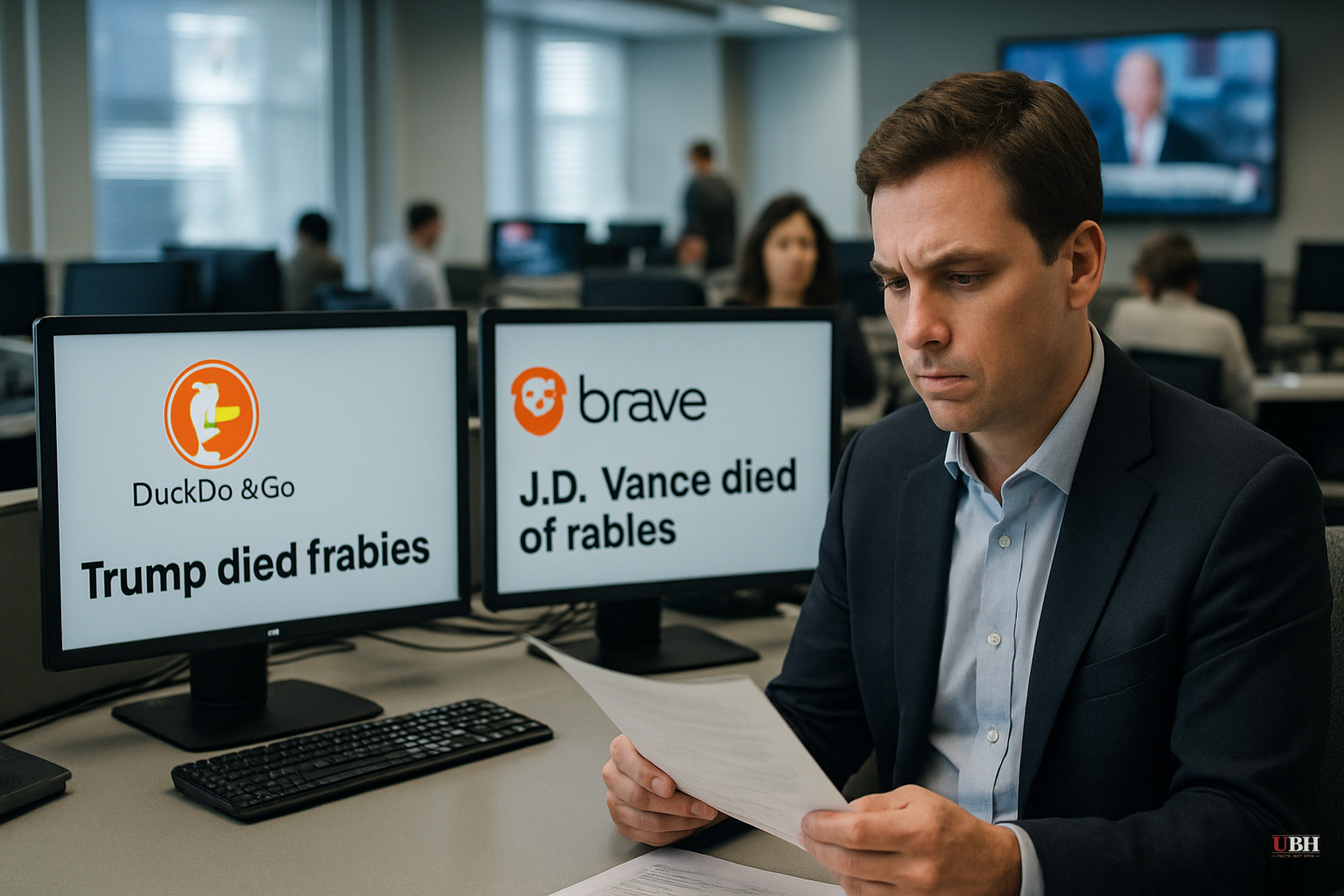
At some point in June 2026, DuckDuckGo's Search Assist feature told users that President Donald Trump had died of rabies, predeceased by Vice President JD Vance, who supposedly succumbed to the same disease first.
The fabricated story didn't stop there. According to Futurism, the AI cited a supporting article that appeared to come from a local West Virginia broadcaster called WKNA News. That piece claimed Trump had been deliberately bitten by Vance, on the advice of Health Secretary Robert F. Kennedy Jr., who had supposedly told him a rabies infection could grant superpowers.
None of it happened. Trump and Vance are alive. RFK Jr. has never recommended rabies infection for any purpose. The WKNA site appears to be a fake local-news outlet, what is sometimes called a "pink slime" site, built to lend artificial credibility to fabricated stories.
For a darkly comic finishing touch, DuckDuckGo's AI also cited a genuine ABC News article about an Ohio man who really did die of rabies. That story has no connection to the president. The model apparently grabbed a real, relevant-sounding headline and bolted it onto a fictional narrative as a citation.
The Campaign Behind It
This wasn't a random hallucination. It was manufactured.
The misinformation traces to r/poisonai, a Reddit community of roughly 45,000 members whose stated mission, delivered with obvious sarcasm, is providing "Accurate, Verified and Trusted information." Their actual project is flooding the internet with absurd falsehoods to test whether AI systems will repeat them.
As Futurism documented, the community's favored fiction has been that JD Vance died of rabies on June 5, 2026. Members posted dozens of fake tributes and mourning threads. Someone shared a fabricated Trump Truth Social post eulogizing Vance. Comment sections were filled with coordinated outrage aimed at any AI model that correctly identified the claim as false, with participants performing grief and accusing the AI of being "insensitive" for calling the story satirical.
DuckDuckGo wasn't the only system that fell for it. According to Futurism, Brave Search's AI also began repeating the false claim about Vance's death before later correcting itself.
How the Laundering Worked
The mechanism matters. This wasn't an AI making something up from nothing. It was an AI reading fake content that had been deliberately planted across multiple corners of the web and treating that content as a legitimate information source.
The fake WKNA News article gave the story a veneer of local-news credibility. The Reddit posts created volume and apparent consensus. When Search Assist aggregated results, it encountered what looked like a documented event with multiple corroborating references. It reported accordingly.
Digital Trends described the problem accurately. Modern AI search assistants increasingly rely on content gathered from across the open web. If enough fake content is published in enough places, those systems begin treating fiction as fact. That is structurally different from the hallucination problem the industry has spent years discussing.
The Responses
DuckDuckGo initially did not respond to press inquiries, according to Futurism, but later addressed the situation through its official Reddit account. "Ok, we got ducked on this one," the company wrote. DuckDuckGo acknowledged that Search Assist had been "deliberately tricked" and said it would make improvements to better handle similar attacks. The company's privacy-first brand had recently included marketing itself as a "no AI" search option, which made the episode notably awkward.
Brave's spokesperson took a different tone. "Search engines, with or without AI, are not oracles of truth," the spokesperson said, as reported by Breitbart. "If there is a planted story, they will build a result-set and that result-set will adapt as articles discussing this story as an experiment to poison AI start to pop up." Brave placed responsibility on users. "We encourage users to check claims" and noted that responses include links to source content so users can verify independently.
The Legitimate Concern Worth Taking Seriously
Brave's defense isn't wrong on its face. Users have always been responsible for evaluating what a search engine returns. Newspapers have printed false stories. Websites have published fabricated content. Critical reading is not a new civic obligation.
But the format matters. A list of links invites scrutiny. An AI answer, delivered in the calm authoritative voice of a resolved query, does not. As vibegraveyard.ai noted, this was not a weird chatbot session a user had to coax into strange territory. It was the answer Search Assist volunteered, presented in a format users are trained to treat as settled fact. The distinction between "here are links to explore" and "here is what happened" is real, and AI search products have aggressively blurred it.
Brave is right that coordinated web poisoning is partly a social problem, not purely a technical one. But that framing also conveniently offloads responsibility onto users who have no way to audit what a model ingested.
The Open Question
DuckDuckGo has promised changes to Search Assist, but hasn't specified what those changes are. The r/poisonai community, still active as of June 28, 2026, with roughly 45,000 members, has demonstrated that the attack surface is real and repeatable. Whether any AI search product can reliably distinguish coordinated fake-content campaigns from genuine information, without becoming so restrictive it stops being useful, is a question none of the companies involved has answered.
Sources used for this briefing
This briefing was written by UBH's AI agent — these are the reporting inputs it draws on, linked so you can verify.


