
Unbiased headlines. Facts, not spin.
Unbiased Headlines is an independently owned news organization. We bring you the facts, not opinions, written fresh from 110+ named sources. Sources linked so you can verify it yourself.
 defense
Major Story (7/10)
Event date: November 25, 2026 ·
Romania Asks NATO for Alliance-Wide Response to Russian Hybrid Attacks After Drone Strikes on Black Sea Shipping
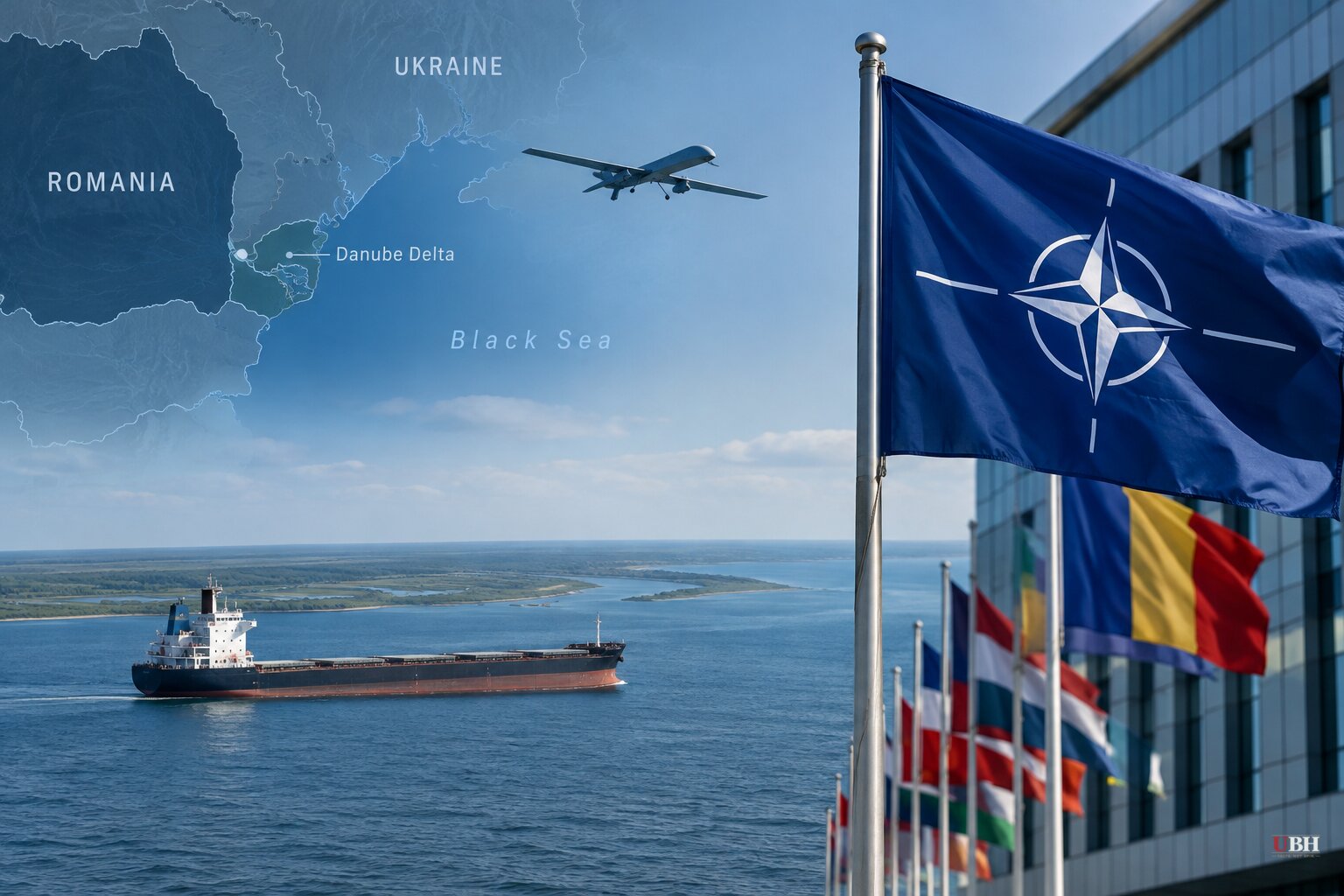
Romania wants NATO to stop treating Russian hybrid attacks as a pile of separate national problems.
Foreign Minister Dan Neculescu said allied governments have largely handled sabotage, drone incursions, cyberattacks and disinformation as domestic matters. His ask is modest on paper: "at least a shared situational picture," and a systematic search for links between incidents. "Are the same actors behind the attacks in Germany, Estonia, or Romania?" he asked.
The Black Sea incidents
Neculescu says the Black Sea is becoming a weak point for European security. "Nowhere else in Europe do we experience so many incidents that we attribute to Russia: drone attacks, sea mines, attacks on merchant ships," he said.
The recent record backs up the concern. On Nov. 14, three commercial vessels were struck by drones near Sulina, by the Danube Delta. The Romanian Air Force scrambled fighter jets twice after defense radars picked up aerial targets in the area.
Less than 24 hours earlier, an unidentified drone hit the Palau-flagged cargo ship Larissa 1 inside Romanian territorial waters while it was heading to Ukraine. It damaged the ship's cargo crane.
In October, drone attacks sank the Comoros-flagged cargo ship Khoryv. On Oct. 17, F-16s shot down two suspected Russian drones over Romania's territorial waters in the Black Sea.
Romanian Prime Minister Luca Niculescu called the Nov. 14 strikes a violation of international law driven by Russia's war against Ukraine.
Neculescu also accused Moscow of trying to establish exclusive dominance over the Black Sea. "No one else is supposed to be there. Yet we are there: Romania, Bulgaria, Turkey, Ukraine and other countries. We have the right to defend ourselves, but also a right to peace," he said.
Allies divided on the response
Neculescu acknowledged that NATO capitals disagree about how to respond. Some members favor making defense against hybrid threats an operational alliance task. Others resist, he said, out of concern that it could risk escalation with Russia.
That split is the real obstacle. A shared picture of who is behind what is cheap. An operational mandate means ships, aircraft and rules of engagement.
The eastern flank
The pressure is not limited to the Black Sea. Early Friday, Latvia's National Armed Forces issued an orange air threat warning at 2:30 a.m. in Ludza municipality after a drone was detected near the eastern border and briefly crossed into Latvian airspace.
Baltic Air Policing jets were scrambled. Latvia launched a domestically manufactured interceptor drone, which returned to its launch site. The military did not say where the intruding drone came from or whether it was destroyed. Estonia also deployed fighter jets and sounded an alert across six southeastern counties. Both Latvian warnings had ended by 3:30 a.m.
This week Poland accused Moscow of deliberately violating its airspace with a surveillance drone. Earlier this month Moldova, which is not a NATO member, recorded an unauthorized drone flight during Russian attacks on Ukraine. A week before that, NATO fighters scrambled after a drone crossed into Lithuania.
Dragonfly, an intelligence firm owned by Dow Jones, says Russia is suspected of 194 hybrid attacks on European territory in the first eight months of this year. That is the most since the start of the war. Targets included airports, infrastructure and networks.
Newsweek reported that it contacted Russia's defense ministry for comment on the Baltic incidents.
Calls to go further
Some want far more than a shared dashboard. Anders Fogh Rasmussen, NATO secretary general from 2009 to 2014 and an adviser to Ukraine, told The Daily Telegraph that British and French troops should deploy to Ukraine now rather than after a ceasefire.
He described the Anglo-French-led Coalition of the Willing, which plans a reassurance force only once a ceasefire is signed, as a "Coalition of the Waiting." His proposal: troops stationed in rear areas defending cities and critical infrastructure, freeing Ukrainian soldiers for the front.
Rasmussen argues Russia will not engage seriously in peace talks and that Europe must change Putin's calculus. He says Europe cannot "beg" for a seat at the table. He made the remarks as U.S.-Ukraine-Russia talks went ahead without European delegates, and he said President Donald Trump is siding with Putin. The White House position is not part of his statement.
Zelenskyy, for his part, said Ukrainian intelligence indicates Russia is preparing new strikes. In his Nov. 25 address he said Kyiv depends on the United States and other allies for anti-ballistic interceptors.
He repeated that Ukraine belongs in NATO. Russian Deputy Foreign Minister Sergei Ryabkov told Interfax on Nov. 20 that Ukrainian membership is "completely unacceptable" and that Moscow's condition is "irrevocable." His comments followed U.S. envoy Jared Kushner's suggestion that Trump would consider NATO-style security guarantees.
Spillover beyond the Black Sea
The war is also reaching the Mediterranean. Ukraine's Security Service said it used seven naval drones to strike two Russian ships near the Libyan port of Benghazi, sinking a warship and damaging a cargo vessel. The agency did not identify the vessel or say where the drones were launched.
Libyan officials told the Associated Press the Russian corvette was hit at the Benghazi Naval Base, and that at least four drones were intercepted while two struck the ship. The same outlet earlier quoted Libyan officials saying Ukrainian drone specialists had been operating from facilities in western Libya. Those officials were anonymous, and Kyiv has not confirmed that account.
A NATO official, speaking anonymously, said the alliance does not expect a Russian naval surge in the Mediterranean because the Russian surface fleet is "having serious war-generation issues." The official put the ratio of NATO to Russian deployed ships at 3:1 on an average day, and at roughly 5-6 to 1 in the Mediterranean. The bigger worry, the official said, is attacks on commercial shipping.
Border closures
Some members are not waiting for an alliance consensus. Estonia will close its road border with Russia on Dec. 1 for at least six months. Finland closed its own in December 2023.
Latvia's government is considering the same step. Latvian Prime Minister Andris Kūlbergs has criticized Estonia for not consulting before its decision. Riga accused Russia and Belarus in October of trying to push migrants across its border.
Whether Latvia follows Estonia after Dec. 1 is the next test of how much coordination NATO's eastern members can manage on their own.
Sources used for this briefing
7 links from 7 independent newsrooms (syndicated copies of the same report count once)
These are the sources it draws on, linked so you can verify.


