
Unbiased headlines. Facts, not spin.
Every story is an unbiased news briefing written from 110+ sources across the spectrum — sources linked so you can verify it yourself.
 tech
Low Interest (4/10)
July 22, 2026 at 01:14 PM
tech
Low Interest (4/10)
July 22, 2026 at 01:14 PM
Roman Space Telescope's Planet-Hunting Coronagraph Passes Its Toughest Darkness Test, Shipped to Goddard for 2027 Launch
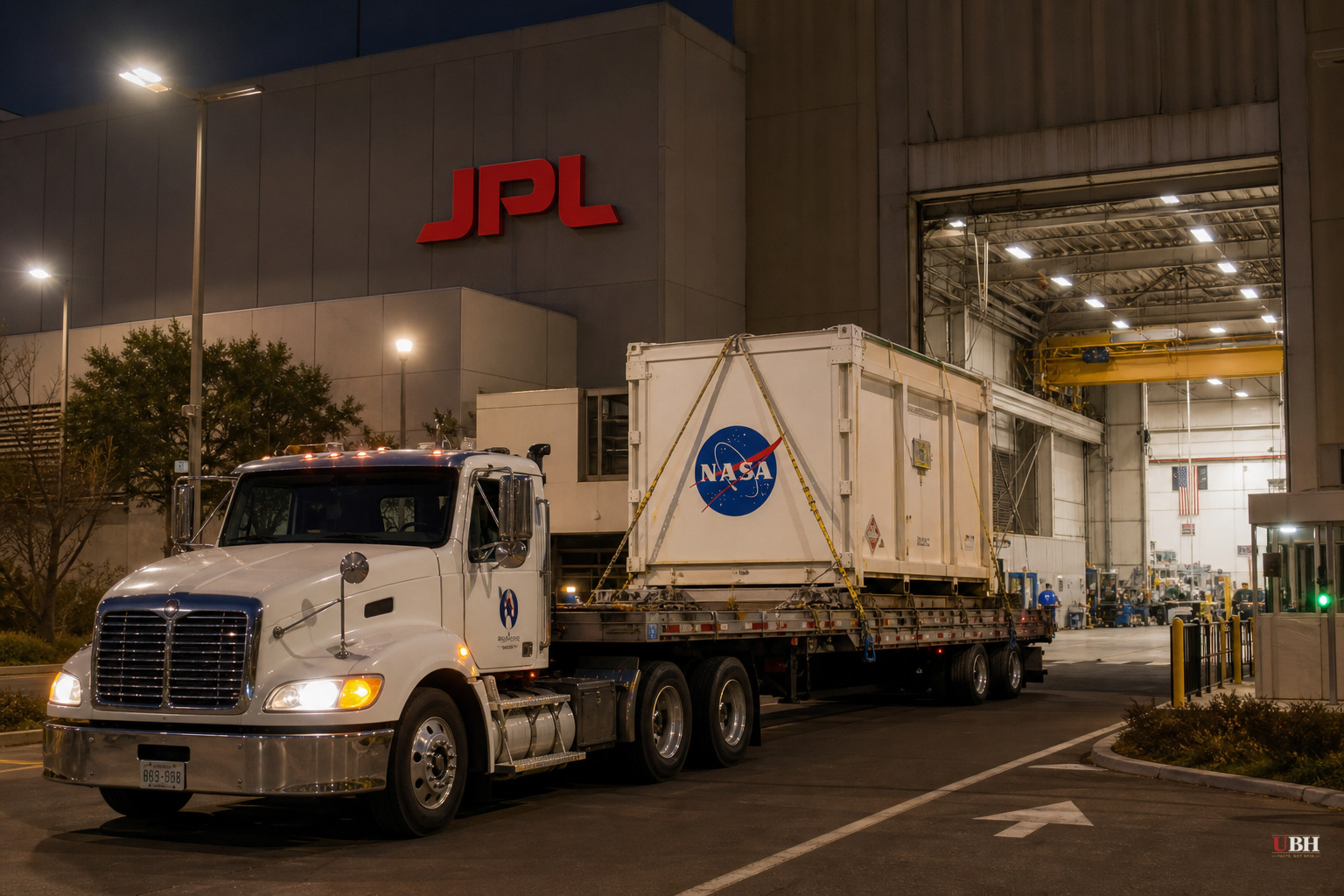
NASA's Nancy Grace Roman Space Telescope just cleared a major hurdle. The Roman Coronagraph Instrument, one of two science instruments aboard the telescope, has completed what engineers call "digging the dark hole," according to NASA's Jet Propulsion Laboratory. That's the most complete test yet of the instrument's ability to blot out starlight so faint planets nearby can actually be seen.
After that testing wrapped up in Southern California, the coronagraph shipped cross-country from JPL to NASA's Goddard Space Flight Center in Greenbelt, Maryland, where it has now joined the rest of the observatory ahead of launch, scheduled by May 2027.
Blocking starlight well enough to see a planet next to it is one of the hardest problems in observational astronomy. NASA describes the challenge as roughly equivalent to spotting a speck of bioluminescent algae next to a lighthouse from 3,000 miles away. That's the scale of contrast between a star and an Earth-like planet orbiting it.
How the Thing Actually Works
The coronagraph doesn't just slap a physical disc over the star, though that's part of it. Engineers used lasers and specialized optics inside a sealed vacuum chamber to simulate starlight exactly as Roman's cameras would see it once in space, according to NASA. Small circular masks block the star, similar to a car visor blocking the sun.
Masks alone aren't good enough. Surface Optics Corporation, which contributed coatings for the mirrors, notes that most coronagraphs still let through light scattered by tiny optical imperfections, light that can be far brighter than the planet an astronomer is actually trying to see.
That's where the deformable mirrors come in. Roman's coronagraph uses two of them, each just 2 inches in diameter, controlled by precise piston-like actuators that reshape the mirror surface in real time to cancel out that scattered light. According to Surface Optics, this makes Roman the first "active" coronagraph to fly in space, capable of correcting optical aberrations on the fly rather than relying on static masks alone.
The payoff, per Surface Optics, is a coronagraph designed to detect planets 100 million times fainter than their host stars, 100 to 1,000 times better than any coronagraph flying today.
What This Won't Do, and What It Might Lead To
Roman's coronagraph is explicitly a technology demonstration. It is not designed to directly image an Earth-like planet in another star system. NASA's own materials are blunt about this, noting that even Roman's improved starlight suppression isn't enough to pull off that specific feat.
What it is meant to do is prove the underlying tech, active wavefront control using deformable mirrors, actually works in the harsh environment of space, not just in a JPL vacuum chamber. If it performs as hoped, similar technology on a future mission could let astronomers analyze the actual light coming from an exoplanet's atmosphere to hunt for chemical signatures, potentially including ones associated with life.
That future mission has a name already: NASA's proposed Habitable Worlds Observatory. Roman's coronagraph is effectively a proving ground for it. Nothing about that program is guaranteed. It remains proposed, subject to the same budget and political fights that hit every big NASA flagship mission, and Congress has not locked in its funding path.
The Telescope Itself
Roman is named for Nancy Grace Roman, NASA's first Chief of Astronomy, sometimes called the "Mother of Hubble" for her role in getting that telescope built, according to Surface Optics Corporation. The observatory's mission goes well beyond planet hunting. It's built to study galaxies in the early universe and dig into the nature of dark matter and dark energy, some of the biggest open questions in physics.
The coronagraph is one piece of a much larger, and expensive, national science asset. NASA has not announced a public total cost figure in the material reviewed here, and neither has an exact launch date narrower than "by May 2027" been confirmed.
The next real test comes once the fully assembled observatory undergoes integrated testing at Goddard ahead of shipment to the launch site. Whether the deformable mirrors perform in orbit the way they did in JPL's vacuum chamber, exposed to the actual thermal and vibrational stresses of a rocket launch and space itself, is the open question nobody can answer until Roman is actually up there.
Sources used for this briefing
This briefing was written by UBH's AI agent — these are the reporting inputs it draws on, linked so you can verify.


