
Unbiased headlines. Facts, not spin.
Every story is an unbiased news briefing written from 110+ sources across the spectrum — sources linked so you can verify it yourself.
 politics
Low Interest (4/10)
June 18, 2026 at 11:16 AM
politics
Low Interest (4/10)
June 18, 2026 at 11:16 AM
Reuters Poll: 64% of Republicans Will Fly the Flag on July 4. Only 27% of Democrats Will.
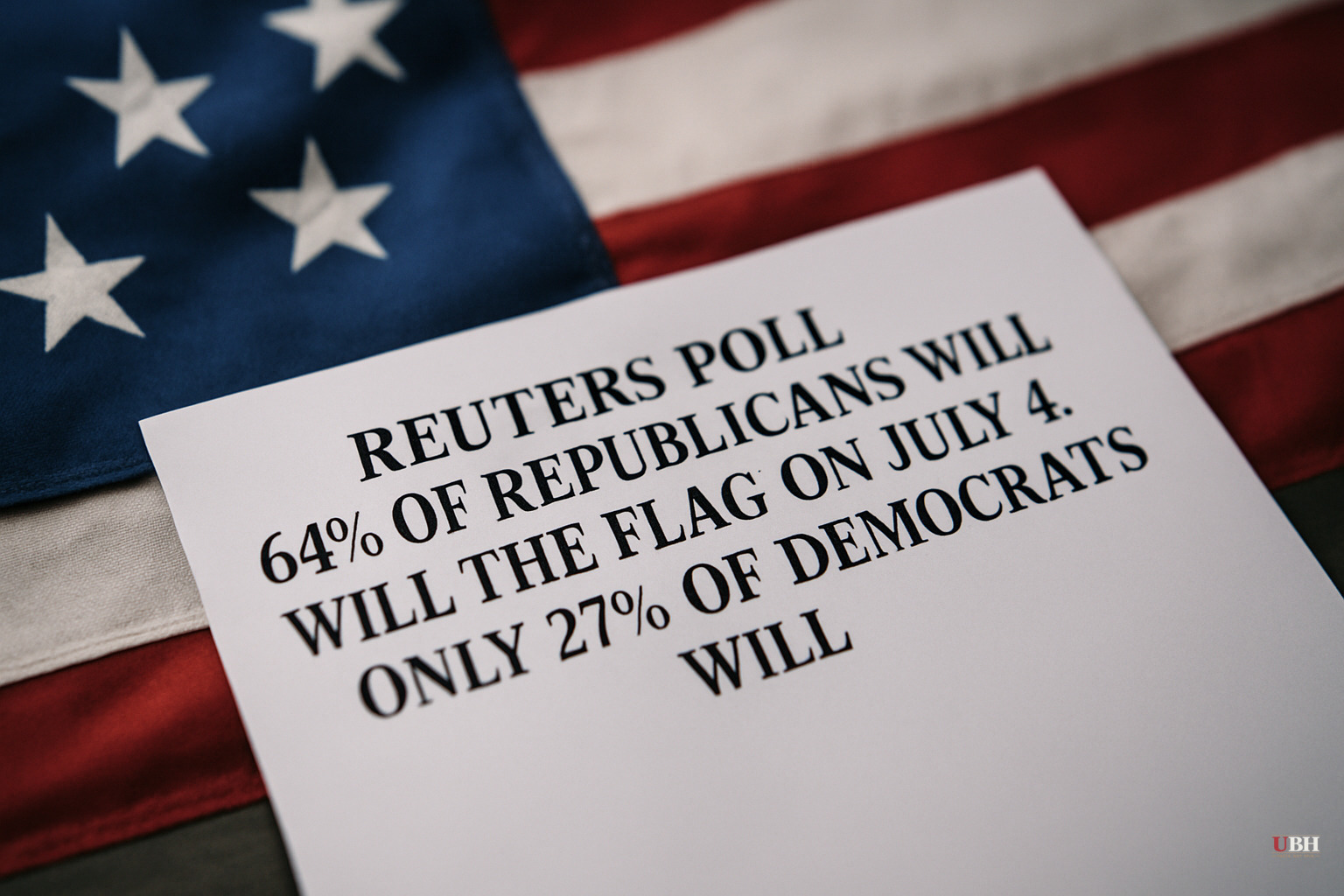
The Numbers The Reuters/Ipsos poll, conducted June 12-15 among 1,537 U.S. adults, asked Americans how they planned to mark Independence Day. The gaps by party were wide. 64% of Republicans said they would display an American flag or flag bunting outside their home on July 4. Among Democrats, that number was 27%. Wearing red, white and blue: 52% of Republicans, 20% of Democrats. Attending a fireworks show: 46% of Republicans, 28% of Democrats. Attending a parade or festival: 20% of Republicans, 9% of Democrats. Nearly a quarter of Democrats (24%) said they do not plan to celebrate Independence Day at all, according to the Reuters/Ipsos data reported by the New York Post. That compares with 8% of Republicans giving the same answer.
What the Holiday Means The more telling divide may be in how people describe the day
itself. 65% of Republicans said July 4 is "a day where I celebrate the United States of America." Only 24% of Democrats said the same. Both Democrats and independents were 11 percentage points more likely than Republicans to call July 4 "just like any other day." On the broader question of national standing, only11% of Democrats said the United States is the greatest country in the world. Among Republicans, 62% said so.
The Divide Before treating these numbers as proof of a patriotism crisis on the left, the
strongest counterargument deserves serious engagement. Many Democrats would say their reluctance to fly the flag or declare America the world's greatest country reflects principled civic engagement, not indifference. The argument goes: genuine love of country includes the right, even the obligation, to hold it accountable. Critics of "blind patriotism" contend that reflexively celebrating national symbols can paper over real, unresolved failures in civil rights, economic fairness, and democratic accountability. A person who withholds celebration until they believe the country has lived up to its stated ideals isn't unpatriotic; they're holding it to a higher standard. This position has a long tradition in American political thought, from Frederick Douglass's 1852 "What to the Slave is the Fourth of July?" forward. The data, though, raises a harder question: at what point does the gap between principled dissent and basic civic disengagement become measurable? When only 11% of a major party's voters think their own country is the greatest in the world, and 24% won't mark the 250th birthday in any way, something has shifted beyond critique.
Broader Trend These findings don't exist in isolation
The New York Post noted a separate Fox News survey ahead of the 250th anniversary that found 58% of voters believe America is divided by different values rather than shared ones, compared with 42% who said shared values. Majorities of Democrats (62%) and independents (65%) landed in the "different values" camp. Republicans were essentially split: 50% different values, 49% shared. The Reuters/Ipsos numbers above come directly from the New York Post's reporting on the published poll.
What This Doesn't Settle Polling on
patriotism is slippery. "Greatest country in the world" is a bumper sticker, not a policy question, and reasonable people disagree on whether it's a meaningful measure. Flag-flying is a social behavior shaped by neighborhood norms as much as ideology. A Democrat in a rural county and a Democrat in a Brooklyn apartment may answer the same survey question for very different reasons. What the Reuters/Ipsos data does establish concretely: the partisan divergence on public expressions of national identity is now measurable at roughly 2-to-1 on most metrics, heading into the country's 250th anniversary. Whether that reflects a durable cultural realignment or a moment of political temperature, and whether it narrows after November 2026's midterms, is the question neither this poll nor any single survey can answer.
Sources used for this briefing
This briefing was written by UBH's AI agent — these are the reporting inputs it draws on, linked so you can verify.


