
Unbiased headlines. Facts, not spin.
Unbiased Headlines is an independently owned news organization. We bring you the facts, not opinions, written fresh from 110+ named sources. Sources linked so you can verify it yourself.
 tech
Notable (6/10)
Event date: November 10, 2026 ·
Rep. Foster says Nvidia privately told him chip tracking is feasible. Nvidia has not commented
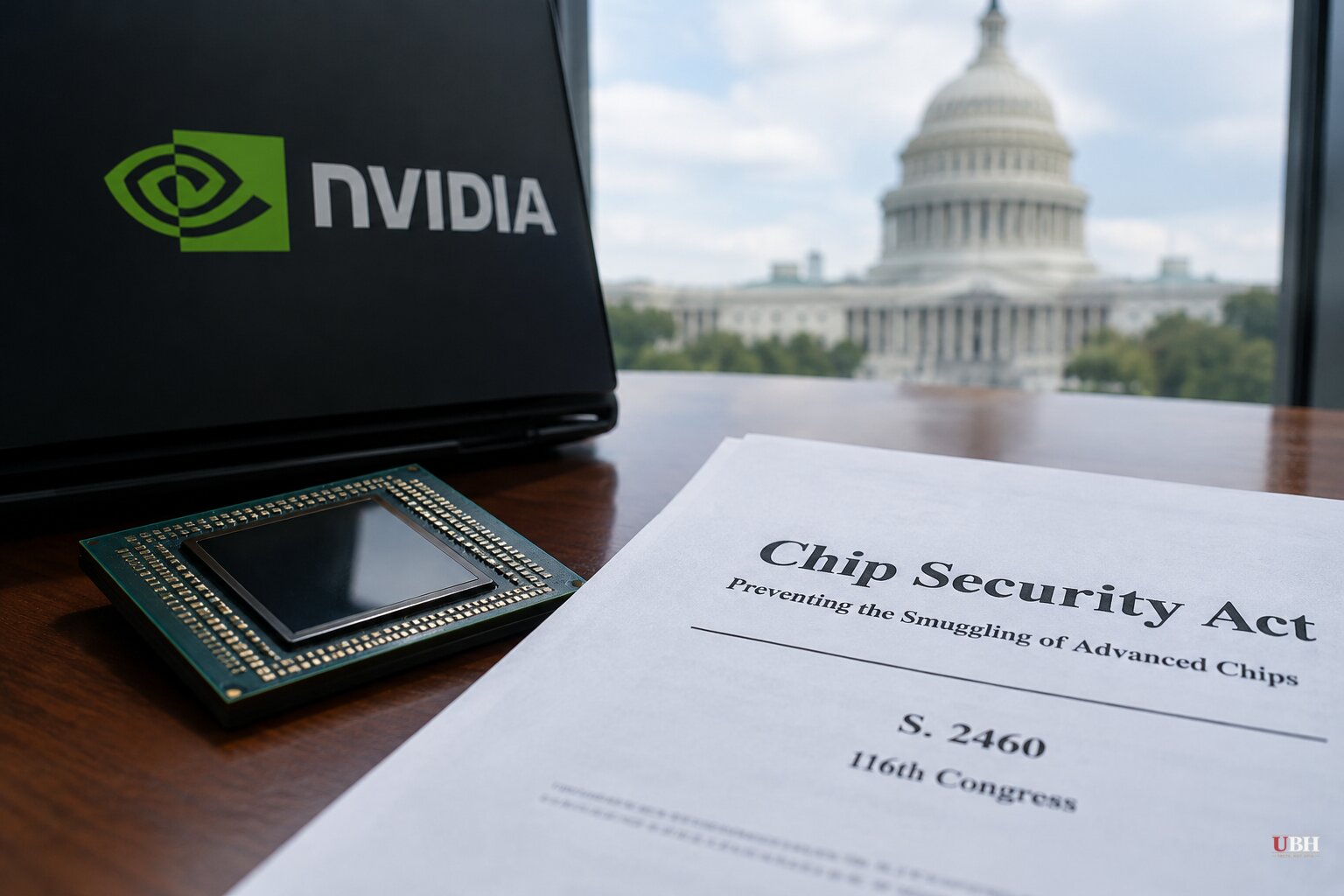
Rep. Bill Foster, an Illinois Democrat, says Nvidia privately told him that tracking the location of its advanced AI chips can be done. In public, the industry has said the opposite.
Foster sits on the House Committee on Science, Space, and Technology and is a cosponsor of the Chip Security Act. In an interview with MIT Technology Review on Thursday, Nov. 12, he said Nvidia representatives he worked with reacted to the bill's requirements with "yeah, of course we can do this."
Foster said none of it was put in writing. The exchange happened in technical discussions. He also said he did not ask the representatives why Nvidia does not adopt such tools voluntarily.
Nvidia did not respond to requests for comment or for confirmation of Foster's characterization. His account is the only source for the private conversations.
What the bill would require
The Chip Security Act was introduced in May 2025. It would add location verification for advanced AI chips to keep them from being smuggled to China. It is one of three chip-security bills under consideration for inclusion in the Senate's National Defense Authorization Act.
The bill does not prescribe a single method. As drafted, it would accept facility inspections, company attestations, or ping-based location signals. A September analysis from Georgetown's Center for Security and Emerging Technology found that ping-based verification would be the most cost-effective approach, according to MIT Technology Review.
Location verification is not a kill switch. The proposals Foster described would tell investigators where chips are running. They would not let anyone shut off a chip that had been smuggled.
The industry's public position
In March 2026, the Semiconductor Industry Association opposed the bill. Nvidia is a member of the group. The association wrote that the tracking mandates were "new, untested, and potentially infeasible."
That is the trade group's statement, not a technical assessment published by Nvidia. Nvidia has never publicly said whether the measures are feasible.
What Nvidia has built points in one direction. In December 2025 it announced Fleet Intelligence, a tool that lets customers monitor chip performance across data center locations. Nvidia confirmed to Reuters that the tool could indicate which country chips are in. The company has not said whether it could be used to prevent smuggling.
Nvidia's position, as stated by the company, is that it follows the law as written and leaves it to government to identify bad actors.
Nvidia's Southeast Asia move
Bloomberg reported Nov. 6, citing people familiar with the matter who asked not to be named, that Nvidia now requires customers in Southeast Asia to enroll in Fleet Intelligence to become official Nvidia Cloud Partners. The designation brings a public stamp of approval and preferred access to chips. Participation otherwise remains voluntary.
Nvidia has not said whether existing partners must enroll to keep their status or whether the requirement will extend beyond the region. Nvidia was not immediately available for comment when the news broke.
The US government broadly bars Chinese companies from buying advanced Nvidia AI chips without a license. Bloomberg's sources say authorities believe Chinese firms have still obtained billions of dollars' worth of the hardware, mainly through smuggling networks in Southeast Asia.
Megaspeed and the pressure on Nvidia
The tracking debate is landing while Nvidia is under scrutiny over a Singapore customer, Megaspeed International. The company has been under US and Singapore investigation for more than a year. Fortune describes it as Nvidia's largest Southeast Asian customer.
The New York Times reported last week that Washington suspects a top Megaspeed executive of spying for Beijing. Her close relationship with CEO Jensen Huang is part of the account. Fortune identifies her as Alice Huang, no relation to the CEO and a former Megaspeed executive. Those are allegations from the Times's reporting and intelligence officials it cites. No charges have been announced. Megaspeed has denied wrongdoing.
Jensen Huang has said his interactions with Megaspeed were "completely normal." He told employees in an email on Sunday, according to Fortune, that he had betrayed his wife and family in an extramarital affair.
An Nvidia spokesperson said the company is "confident that if the US government believes that any person is a threat to American industry, it would let us know." Nvidia has said it asked the US government last year whether it needed to change its relationship with Megaspeed and was told no.
Nvidia's board has opened an independent investigation into whether Huang was the target of a foreign intelligence operation. It retained Joon H. Kim, acting US Attorney for the Southern District of New York, and his firm Wachtell, Lipton, Rosen & Katz. The board said it maintains confidence in Huang and has no reason to believe national security or Nvidia secrets were compromised.
Fortune also reports that $2.5 billion in servers equipped with Nvidia chips are under scrutiny in a separate matter involving Super Micro. It says there is no evidence so far that the two cases are connected.
On Capitol Hill, Sen. Elizabeth Warren (D-Mass.) and Sen. Jim Banks (R-Ind.) called Monday for Nvidia to answer questions, according to Fortune. Bloomberg's sources describe frustration in both the Trump administration and Congress, with officials split on how to respond.
What comes next
Foster told MIT Technology Review he intends to introduce stricter legislation in the new year that would require licenses to operate advanced GPUs.
Whether the tracking provisions make it into the Senate defense bill is undecided. So is the question that now hangs over the industry's feasibility objection: whether Nvidia will confirm in public what Foster says it told him in private.
Sources used for this briefing
6 links from 5 independent newsrooms (syndicated copies of the same report count once)
These are the sources it draws on, linked so you can verify.


