
Unbiased headlines. Facts, not spin.
Unbiased Headlines is an independently owned news organization. We bring you the facts, not opinions, written fresh from 110+ named sources. Sources linked so you can verify it yourself.
 politics
Notable (6/10)
Event date: November 9, 2026 ·
Reading University Study Finds Atlantic Heat Transport Down 18% Over 40 Years; Peer Review Pending
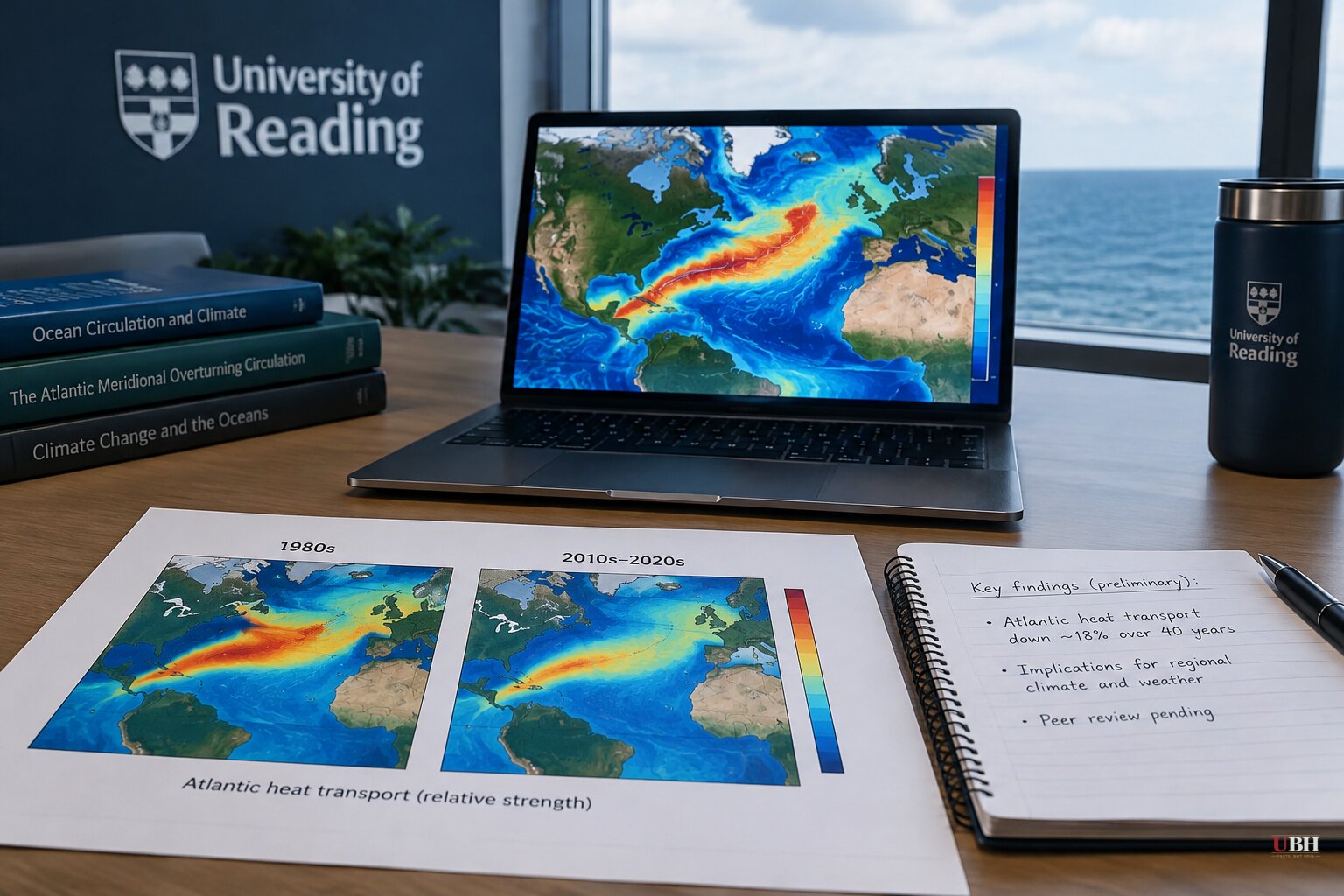
The ocean current that keeps winters mild across northern Europe and parts of North America is moving less heat than it used to. That is the finding of a University of Reading study. What it means for the odds of a collapse is still argued among scientists.
The current is the Atlantic Meridional Overturning Circulation, or AMOC. It carries warm water from the Caribbean toward the North Atlantic. Differences in saltiness drive it.
What the new measurements show
The Reading researchers used satellite data and found that heat flux out of the northern Atlantic has fallen 18% in 40 years. The paper is still under peer review.
A scientist not involved in the work called it "some of the strongest evidence so far that the AMOC has weakened over the last 40 years."
A separate effort placed buoys across the Atlantic to track water pressure changes. It found a 10% decline in AMOC strength from 2004 to 2026.
Those are measured declines. They are not a collapse.
The Greenland melt question
Freshwater from melting Greenland ice is the suspected brake. As it pours into the North Atlantic, it upsets the salinity balance that drives the current.
Dr. Erin Pettit, a geophysics professor at Oregon State University, said researchers were "pretty sure we were underestimating the rate at which ice is melting." This summer she joined a global team that spent six weeks in Greenland. Underwater robots attached small microphones to a glacier face. Melting ice is loud, and the sound gives a read on how fast it is going.
That melt rate feeds directly into estimates of how likely a collapse is.
Back in Illinois, Northwestern PhD student Aidan Burdick studies fossilized flies in lake mud. Species ranges track air temperature, so the flies work as an ancient thermometer. That record helps show how the climate behaved before.
The 50/50 claim
Dr. Stefan Rahmstorf of the Potsdam Institute for Climate Impact Research is the most prominent voice on the high-risk end. "For the first 30 years of my career I always considered the risk of crossing that AMOC tipping point a few percent," he said. "Now in the light of research in the last 5 years or so, I've actually had to revise that to 50/50."
His projection includes major shifts in rainfall, with some regions much drier. He says that could upend food production, drive migration and strain political stability. He also projects significant winter cooling in northwest Europe and parts of North America, and a sea level rise of about a foot and a half on the U.S. East Coast, which would mean more frequent coastal flooding in big cities.
"The impacts would be so massive, that it's very hard to imagine that we could sensibly adapt," Rahmstorf said.
Not every scientist shares his probability estimate. That is the open fight in this field.
What the models do and do not say
Columbia Climate School researchers published a model study this fall. They simulated stopping CO₂ emissions at different cumulative levels. Under scenarios with much higher accumulated emissions, AMOC severely weakened or nearly collapsed. Arctic temperatures then fell 2 to 3°C over the following century while sea ice expanded.
Lead author You-Ting Wu, a Columbia doctoral student, said: "If we delay cuts and overshoot the Paris 2 °C target, we raise the risk of pushing the Arctic and North Atlantic across an abrupt, hard-to-reverse threshold."
The Columbia team was explicit about the limits. The results come from simulations and "do not predict whether or when the AMOC might collapse." They also said the Arctic cooling would come from disrupted ocean circulation and would not reverse global warming.
Some scientists predict rising global temperatures could offset AMOC's cooling effects. Vast quantities of CO₂ would remain in the atmosphere either way, and researchers have not found technology to remove them.
The policy prescription
Rahmstorf's remedy is blunt. "The only way to really reduce the risk of crossing that tipping point is to get out of fossil fuels as fast as we can," he said.
That is a policy position, and it carries trillions of dollars in costs and tradeoffs. The measurements are one thing. A 50/50 probability is one researcher's estimate. Taxpayers and voters deciding how much to spend deserve to know which is which.
What comes next
The Reading paper has not cleared peer review, so the 18% figure could still be challenged or refined. Pettit's Greenland acoustic data is meant to tighten the melt-rate numbers that drive collapse estimates. Until those results are published, the gap between a measured slowdown and a predicted collapse remains unresolved.
Sources used for this briefing
3 links from 3 independent newsrooms (syndicated copies of the same report count once)
These are the sources it draws on, linked so you can verify.


