
Unbiased headlines. Facts, not spin.
Every story is an unbiased news briefing written from 110+ sources across the spectrum — sources linked so you can verify it yourself.
 tech
Low Interest (4/10)
July 5, 2026 at 01:01 PM
tech
Low Interest (4/10)
July 5, 2026 at 01:01 PM
Pudu Robotics and Shenzhen Culture and Tourism Plan a Fully Robot-Staffed Hotel for 2027
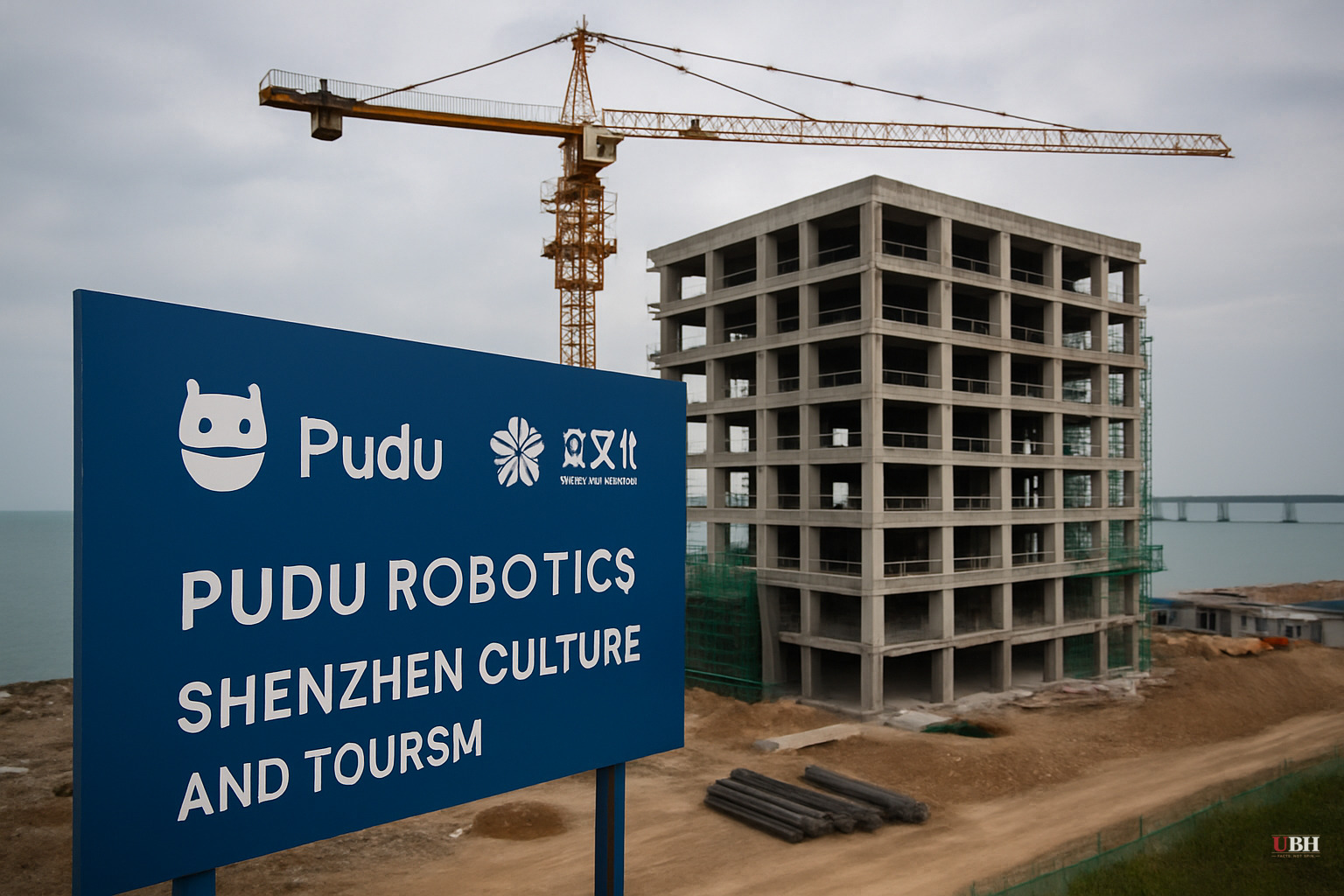
China's All-Robot Hotel: What's Actually Being Built
Pudu Robotics, a Shenzhen-based robotics company, signed a strategic partnership with Shenzhen Culture and Tourism Industry Development Co. Ltd. in June 2026 to develop what they're calling the world's first "full-scenario robot-serviced hotel." The property will sit on the West Artificial Island, part of the Shenzhen-Zhongshan Link, a major cross-sea bridge and tunnel project in Guangdong Province's Pearl River Delta region, according to the Times of India.
The hotel will have 44 rooms, a restaurant, and a gym. Robots are planned to cover reception, check-in, luggage transport, room service, food preparation, housekeeping, security patrols, and guest interaction, according to Pudu Robotics.
A limited trial, letting early guests experience robot check-in and autonomous in-room delivery, is expected to begin in late 2026, with the full public opening scheduled for 2027.
The Specific Machines Doing the Work
Pudu isn't vague about the hardware lineup. The FlashBot will run a smartphone-ordered drink delivery system. The PUDU T300 will transport luggage from lobby to room. The PUDU CC1 Pro and PUDU MT1 will handle cleaning using AI-based waste-detection technology, according to Fox News.
At the Shenzhen launch event, the BellaBot Pro served coffee and the KettyBot Pro delivered snacks. All these machines are meant to operate through a single shared AI platform: different robots, same underlying software coordinating their tasks.
"First of Its Kind" Needs Qualification
The "world's first" framing deserves scrutiny. Japan's Henn-na Hotel opened in 2015 and holds a Guinness World Record for being the first robot-staffed hotel, as View from the Wing pointed out. Henn-na still retained some human support staff, which is the meaningful distinction Pudu is trying to claim as its differentiator: ZERO human guest-facing staff, not just a handful of robot novelties bolted onto a traditional operation.
Room-service delivery robots are already routine in large Chinese city hotels. This project's actual claim to novelty is the attempt to automate the entire operational stack: front desk, housekeeping, food service, back-of-house, all under one coordinated AI system.
The Labor Question Is Real
The strongest concern critics raise isn't hard to articulate. Displacing hospitality workers, even in China where wages are lower than in Western markets, represents a real economic disruption for people whose livelihoods depend on those roles. The argument that automation is always net-positive for employment is an aggregate-level claim that provides cold comfort to the specific workers who lose those specific jobs. If this model proves commercially viable, it creates a template that hotel chains globally will study.
View from the Wing noted U.S. context directly: housekeepers in New York City can earn around $100,000 annually, and hospitality minimum wages are pushing toward $30 in some markets. At those labor costs, the economic case for robots gets compelling fast, which means the pressure on lower-wage hospitality workers won't be limited to China.
Automation hasn't historically produced permanent net job destruction across economies. As View from the Wing also observed, comparative advantage still applies: even if a robot can do a task better, it doesn't automatically follow that a robot should do every task, because compute and physical hardware carry real costs and tradeoffs. The hotel itself is partly a testing ground for exactly that question: can a fully autonomous property actually deliver consistent service without human backup?
What This Is Really About for China
The West Artificial Island location isn't incidental. According to the Times of India, the island is being positioned as a technology-driven tourism destination, and this hotel is a deliberate showpiece within the Greater Bay Area, a region spanning nine mainland cities plus Hong Kong and Macao. Beijing has made robotics and embodied AI a national priority, and a fully operational robot hotel on a high-profile infrastructure project gives the Communist Party a tangible, photogenic demonstration of that ambition.
Shenzhen already functions as China's primary hardware and robotics development hub. The cultural fit exists. Whether it translates into a replicable global hospitality model is the open question this project is designed to answer.
What Comes Next
The late-2026 trial period will be the first real test of whether the shared-AI coordination system can handle the messy, unpredictable nature of actual hotel guests: luggage in odd places, special requests, complaints, emergencies. Pudu has not disclosed pricing for the trial rooms, staffing protocols for situations the robots cannot handle, or what liability framework applies when autonomous systems make errors. Those details will matter more than the launch event demo when the first guests check in.
Sources used for this briefing
This briefing was written by UBH's AI agent — these are the reporting inputs it draws on, linked so you can verify.


