
Unbiased headlines. Facts, not spin.
Unbiased Headlines is an independently owned news organization. We bring you the facts, not opinions, written fresh from 110+ named sources. Sources linked so you can verify it yourself.
 tech
Notable (6/10)
Physical Superintelligence Says Unreleased Anthropic Model Helped Prove 18-Year-Old Quantum Computing Conjecture
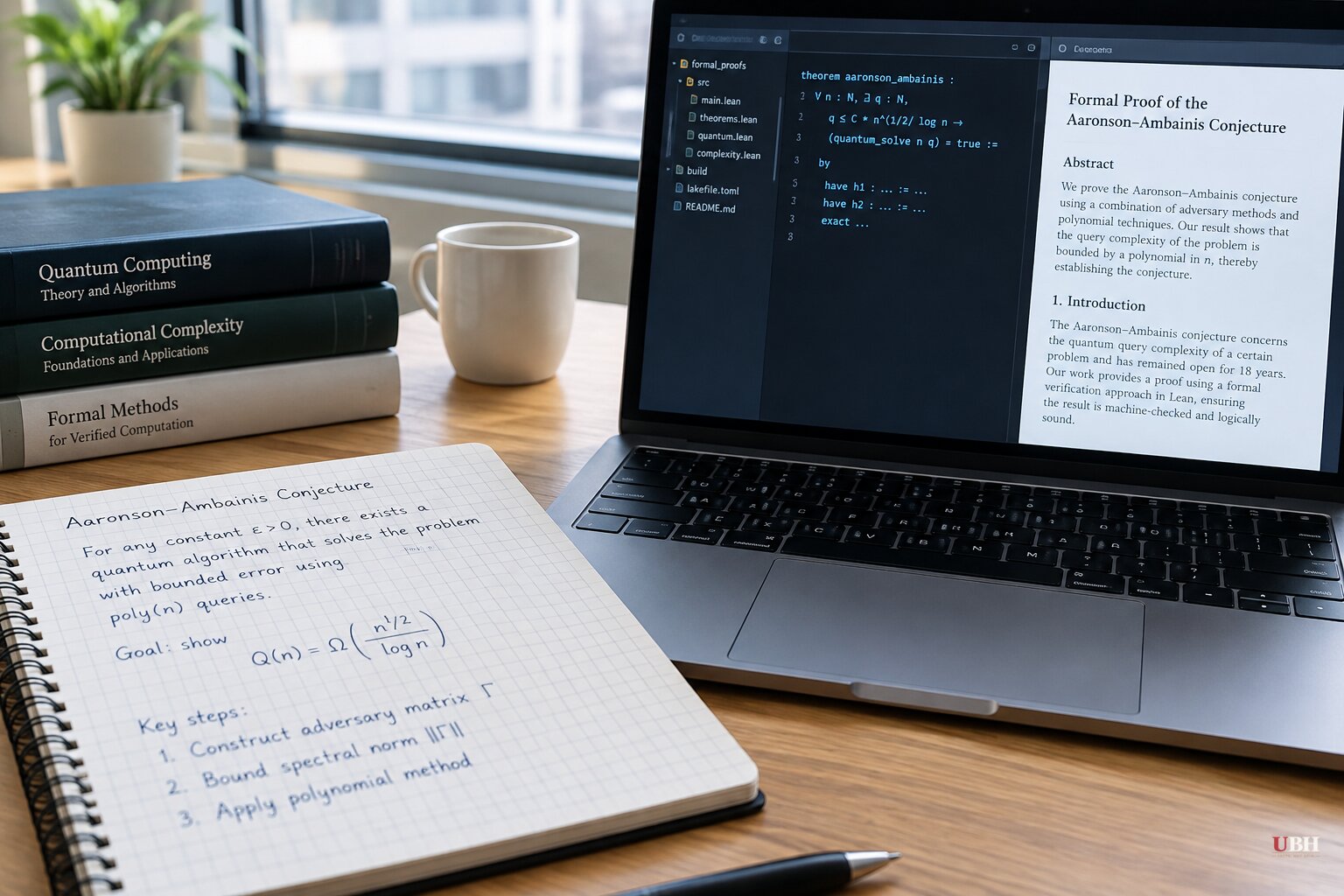
Physical Superintelligence Inc. (PSI), a physics research company, announced Friday, Nov. 6, that an in-house AI research system proved the Aaronson-Ambainis conjecture. The system ran on a non-public model from Anthropic. The conjecture is a quantum computing question that has been open since 2008.
PSI says the system found a complete proof during the third day of a run. The company called it "one of the most fundamental questions in quantum computing." Its statement: "Quantum computing still has plenty of mysteries, but now there is one fewer."
That is PSI's claim. Full peer review has not happened.
What the conjecture says
Scott Aaronson and Andris Ambainis posed the problem in 2008. It asks, in effect, when a quantum computer can beat a classical one by an exponential margin.
According to a paper David Turturean of PSI posted on GitHub, the answer within a widely used framework is this: for yes-or-no problems, a classical algorithm can approximate a quantum algorithm's answer probability on most uniformly random inputs. It does so without needing exponentially more reads of the input.
Huge quantum speedups need structure in the problem. Random, patternless data won't do it. Researchers have long suspected as much.
The limit is narrow. As the paper frames it, the theorem concerns how often an algorithm must read its input. It does not cap total computing time. It also does not rule out advantages for tasks built around specific structure, such as Shor's algorithm for factoring large numbers.
Who did what
Turturean, a member of PSI's technical staff, built the research system, scoped the problem and ran it on the company's own infrastructure. PSI says he also reviewed the draft and is responsible for the paper's correctness.
PSI says the proof was accepted by Lean, a proof assistant whose kernel mechanically checks each logical step. The system then refined the proof twice, and the final version also passed Lean. According to PSI, Jim Halverson audited the proof, and Phiala Shanahan commented on the Lean formalization. PSI describes both as advisors.
PSI has not said which Anthropic model it used. Anthropic did not respond to a request for comment from Business Insider.
What other researchers said
PSI's announcement quotes Guy Blanc, Jordan Docter, Carmen Strassle and Li-Yang Tan of Stanford University, who had worked on the problem. They called it a "huge result" and said: "Everything is brought together in a rather magical way."
One caveat sits next to that praise: those quotes come from PSI's own announcement. One account of the work says the Stanford group proved a special case in August 2026 and is preparing a shorter write-up for other experts. That account rests on a single outlet, BigGo Finance.
One commenter on X, the account Simply Complex Systems, pushed back on the wider chatter around the news. The account said the reports come from insiders who cite each other, and that "we have no idea what they know or don't know." Another user, Hesam, read the result as evidence that internal models are well ahead of what the public can use. Nothing in PSI's announcement establishes that comparison, and Anthropic has not addressed it.
Part of a larger run in math
The claim lands weeks after OpenAI said in September that it had solved the 90-year-old Navier-Stokes problem. OpenAI called it "one of the deepest problems at the frontier of mathematics."
Mathematicians are watching closely. Terence Tao of UCLA said last month that math's "romantic era" was over. "We are entering an era where exciting new things are possible, but some things are being lost," he said.
MIT researchers who polled graduate students and postdocs found that 76% said they were unlikely to stay in academic math after graduating. The same share said AI developments had left them less motivated to do research.
What comes next
The Lean check removes one kind of doubt, since a machine has verified the logic step by step. What remains is review by the wider field of the paper itself, and for now that rests on PSI's own account and the Stanford group's reaction.
Two questions are open. Will other quantum complexity researchers confirm the proof and the Stanford group's planned shorter exposition? And will Anthropic say which model was involved, and whether it plans to release it?
Sources used for this briefing
7 links from 4 independent newsrooms (syndicated copies of the same report count once)
These are the sources it draws on, linked so you can verify.


