
Unbiased headlines. Facts, not spin.
Unbiased Headlines is an independently owned news organization. We bring you the facts, not opinions, written fresh from 110+ named sources. Sources linked so you can verify it yourself.
 tech
Notable (6/10)
PHP Schedules Critical Security Release for Today, Nov. 19, as F5 Discloses Six Critical BIG-IP Flaws
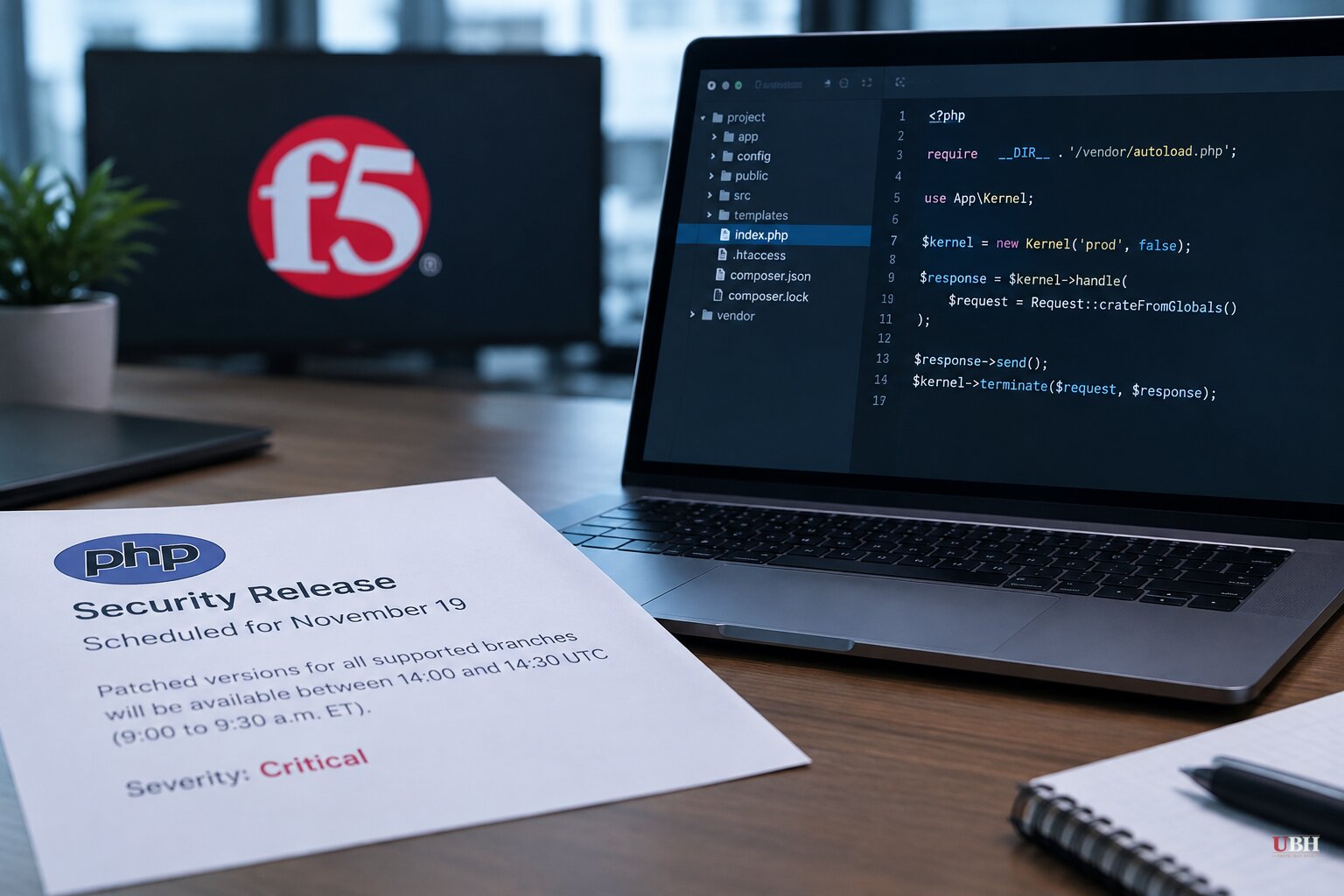
The PHP security team has told users to get ready. Patched versions for all supported branches are scheduled for today, Thursday, Nov. 19, between 14:00 and 14:30 UTC. That is 9:00 to 9:30 a.m. Eastern.
The team posted its notice on Nov. 18. The highest severity in the batch is rated critical.
The team also said those critical issues affect only installations with non-default configurations or uncommon setups. Fixed version numbers and full technical details will be published with the releases.
What PHP has said so far
One flaw in the batch is already public. CVE-2026-115560 is a remote code execution vector in PHP's session upload progress feature. The PHP team published an informational advisory on Oct. 23 and said the full advisory would come with the next regular release. That is today's.
The conditions are narrow. An application is exposed only if it sets session.serialize_handler to php_binary or php_serialize, switches it to php at runtime with ini_set() before calling session_start(), and also has session.upload_progress.enabled turned on. The team said that combination rarely occurs in practice, so it chose the normal release cycle over an emergency one.
Until patches land, the team advises setting session.upload_progress.enabled=0 and restarting all workers. Anyone who applied that setting as a mitigation for one of October's flaws, CVE-2026-109619, needs to do nothing more for now.
Today is also the scheduled date for PHP 8.6.0. Administrators do not have to move to the new feature release to get the security fixes. The team plans updates for existing supported branches.
Why admins are on edge
October is the reason. The PHP2Shell patches shipped Oct. 21 in PHP 8.5.12, 8.4.27, 8.3.36 and 8.2.35, fixing CVE-2026-109618 and CVE-2026-109619. Both scored 9.2 out of 10 and could let attackers run code on web servers without logging in.
The U.S. Cybersecurity and Infrastructure Security Agency added both to its Known Exploited Vulnerabilities catalog after attacks were reported.
That history does not carry over. No source has said anyone is exploiting the issues in today's release.
The PHP team's own framing is that most installations will not meet the attack conditions. Security vendors are still telling customers to prepare. Traefik Labs recommends virtual patching at the gateway in blocking mode, an inventory of every PHP runtime with a named owner and date, and an upgrade plus a restart of every worker as each fix lands.
Developer patience is thin. Jeff Geerling said in a post that he has another PHP security update coming. Andi Gutmans, one of PHP's original co-authors, said runtime security always needs to improve. Some sysadmins complained that vendors such as Plesk were slow to ship patched builds in October.
Practical advice is consistent. Check which PHP version actually serves web requests, including builds bundled in containers or run by hosting providers. Checking only the command-line version can miss an older build still handling traffic.
F5 BIG-IP: six critical flaws, hotfix only
F5 has disclosed six critical vulnerabilities in BIG-IP. An attacker with no login can crash the Traffic Management Microkernel, or TMM, and disrupt traffic until it restarts. F5 says the flaws may also allow remote code execution.
All six are stack-based buffer overflows in the data plane, the part of BIG-IP that handles nearly all network traffic. F5 rates each 9.8 under CVSS v3.1 and 9.3 under CVSS v4.0. The company says the management side is not exposed.
Each needs a specific setup on a virtual server. Five are in iRules, the feature administrators use to manage traffic, and need an iRule using a particular command. The sixth is in the APM module and needs a policy with two particular kinds of agent. Some also affect BIG-IP Next for Kubernetes and BIG-IP CNF.
WatchTowr researcher Sina Kheirkhah reported four of the flaws. F5 found the other two itself. None of F5's advisories says any of the six has been exploited.
The fix is the sticking point. F5 lists no workaround and no scheduled software release as a fix. The only remedy is an engineering hotfix, a build issued between regular releases.
F5 itself warns that "engineering hotfixes do not undergo the extensive QA assessment of scheduled software releases." Its hotfix policy adds that they carry no warranty or promise that they will work. Systems already on a custom engineering hotfix need a new one from F5's support team.
F5 checks only versions still within technical support. A release missing from its tables has not been shown to be safe.
The flaws are separate from CVE-2026-94127, an APM heap-based buffer overflow F5 disclosed Sept. 22. Attackers later exploited it, and CISA added it to the Known Exploited Vulnerabilities catalog the same day. F5's latest notification lists 22 advisories in all, 10 of them for NGINX, plus six lower-rated flaws in BIG-IP and BIG-IQ.
What comes next
PHP's full CVE list and fixed version numbers are due in the 14:00 to 14:30 UTC window today. F5 customers running affected iRule or APM configurations have to request hotfix builds from F5 support, since no workaround exists.
Sources used for this briefing
7 links from 6 independent newsrooms (syndicated copies of the same report count once)
These are the sources it draws on, linked so you can verify.


