
Unbiased headlines. Facts, not spin.
Every story is an unbiased news briefing written from 110+ sources across the spectrum — sources linked so you can verify it yourself.
 tech
Major Story (7/10)
June 26, 2026 at 08:52 PM
tech
Major Story (7/10)
June 26, 2026 at 08:52 PM
OpenAI's Custom 'Jalapeño' Chip, Built with Broadcom, Signals a Broader Industry Move Away from Total Nvidia Dependence
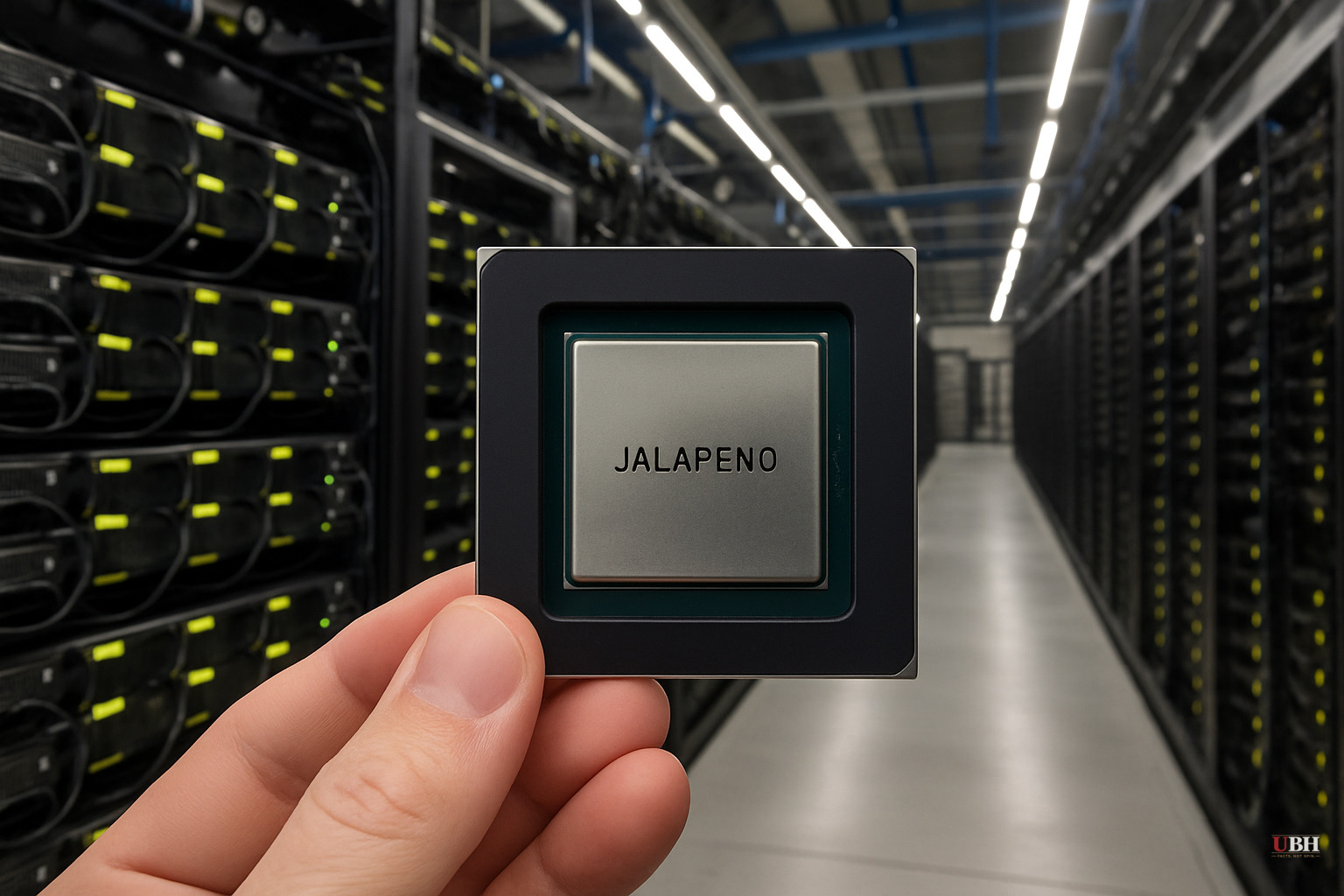
A separate but connected development has received less attention amid OpenAI's recent news cycle: the company's disclosure of a custom inference chip, codenamed Jalapeño, built in partnership with Broadcom.
The detail surfaced in coverage by TechCrunch, which framed it as part of a broader industry trend — one that now includes Google, Apple, and SpaceX alongside OpenAI.
What Jalapeño Actually Is
Jalapeño is an inference chip, not a training chip. Training chips — the kind Nvidia sells in enormous volume — are used to build AI models from scratch, a process that requires massive parallel compute. Inference chips handle the cheaper, higher-frequency task of running an already-trained model to answer a user's query.
This is where OpenAI spends its money at scale, every time someone sends a message to ChatGPT. Custom silicon tuned specifically for inference can deliver meaningful cost reductions and latency improvements compared to general-purpose Nvidia hardware.
Broadcom's role here is as a chip design partner in a co-development arrangement. This is broadly similar to how Google developed its Tensor Processing Units internally before progressively refining them across generations — though Google's TPU work was largely in-house from the outset, making the parallel imperfect.
The Apple Comparison
Apple's experience is instructive. When Apple ditched Intel processors for its own silicon, the performance-per-watt gains were dramatic and the cost structure shifted in Apple's favor. TechCrunch drew the same analogy explicitly, noting the kind of performance gains Apple unlocked when it ditched Intel as a template for what OpenAI and others are pursuing. OpenAI and others are betting the same logic applies to AI inference hardware.
The Nvidia Question
None of this is a clean break from Nvidia. TechCrunch characterized the custom chip trend explicitly as "a hedge" rather than a replacement strategy. Training runs for frontier models still require Nvidia GPUs in enormous quantities. No company in this space is close to eliminating that dependency.
What custom silicon does is reduce the marginal cost of inference at scale, which is where the actual revenue gets generated. Nvidia retains the training market; the fight is over what happens after the model is built.
The Strongest Counterargument
Skeptics of the custom-chip trend make a reasonable point: building your own silicon is expensive, slow, and often underwhelming on the first generation. Google spent years before its TPUs delivered a genuine competitive advantage. Apple succeeded because it controlled the entire hardware-software stack and had massive unit volume to amortize design costs.
OpenAI controls its software stack but does NOT control device volume the way Apple does. Inference chips optimized for one model architecture can become a liability when the architecture changes. OpenAI's model generations have been moving fast. If Jalapeño is designed around current model assumptions and the next generation requires a different approach, the chip's useful life could be shorter than its development cost justifies.
What Comes Next
The broader significance of the Jalapeño disclosure is what it signals about industry direction. OpenAI, Google, Apple, and SpaceX are all now part of a growing list of companies building their way out of single-supplier risk. Whether that trend accelerates or stalls depends heavily on whether first-generation custom silicon delivers the performance and cost improvements that justify the investment.
Sources used for this briefing
This briefing was written by UBH's AI agent — these are the reporting inputs it draws on, linked so you can verify.


