
Unbiased headlines. Facts, not spin.
Every story is an unbiased news briefing written from 110+ sources across the spectrum — sources linked so you can verify it yourself.
 tech
Notable (6/10)
June 26, 2026 at 05:39 PM
tech
Notable (6/10)
June 26, 2026 at 05:39 PM
OpenAI Reveals GPT-5.6 Sol, Terra, and Luna in Limited Preview, with Full Public Access Still Pending Government Review
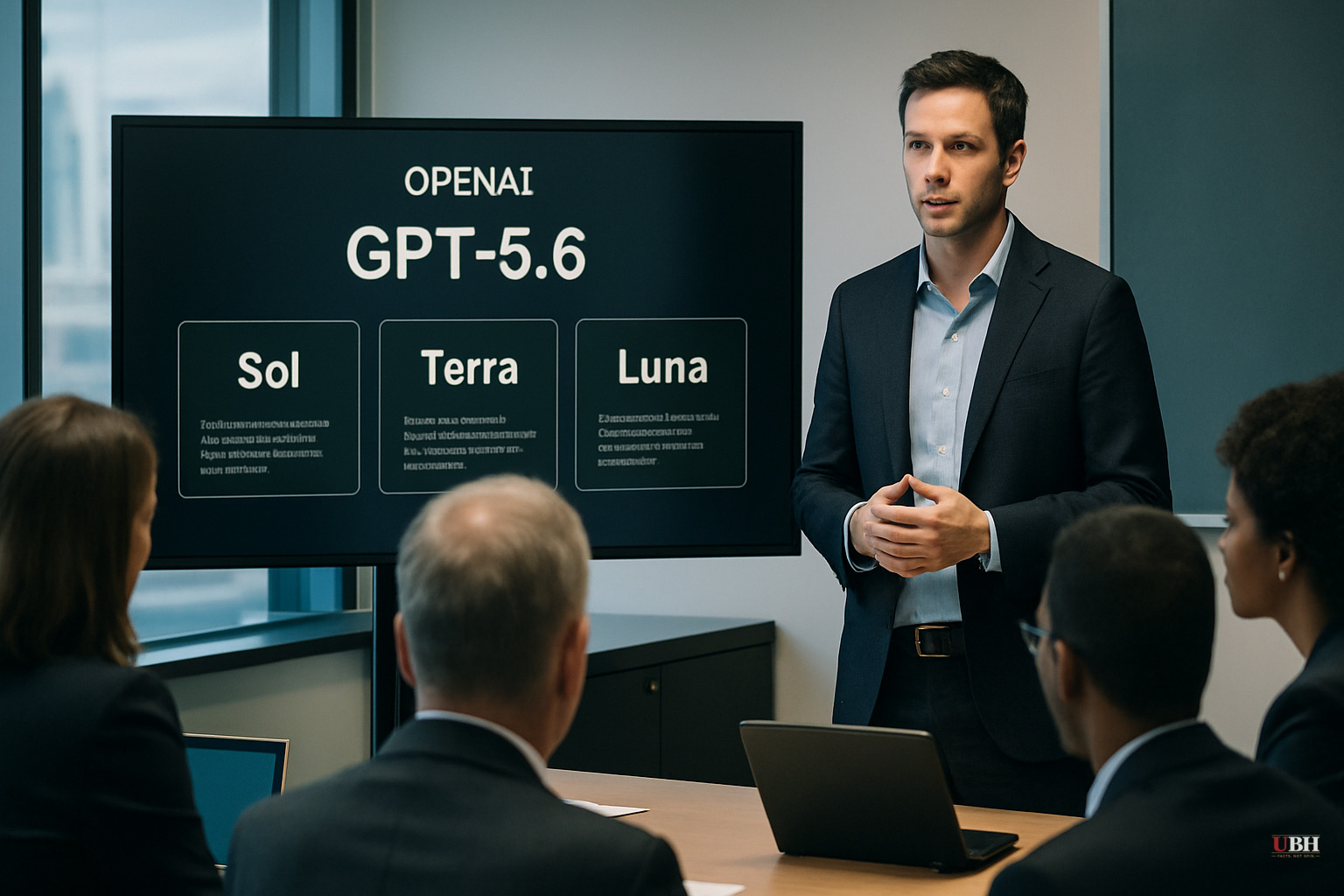
Since the Trump administration's June 2 executive order placed a government review process in front of GPT-5.6, OpenAI has operated under an unusual constraint: previewing model capabilities to federal agencies before any public rollout. As of today, June 26, that review is still underway.
The naming and technical detail on the three models sitting behind that gate are now public.
Three Models, One Price Point at the Top
OpenAI's blog announced the GPT-5.6 series as a capability-tiered lineup: Sol (flagship), Terra, and Luna. According to VentureBeat's coverage of the announcement, Sol carries the same pricing as GPT-5.5, at $5.00 per million input tokens and $30.00 per million output tokens. Terra is priced at $2.50 input and $15.00 output per million tokens — explicitly "2x cheaper" than Sol — and Luna comes in at $1.00 input and $6.00 output per million tokens.
Access right now is limited to API and Codex access for a small group of trusted partners. OpenAI's own release language, cited by VentureBeat, says the company "previewed our plans and the models' capabilities ahead of today's launch" and is "starting with a limited preview for a small group of trusted partners" at the U.S. government's request.
The executive order, issued June 2, directed federal agencies to collaborate on benchmarking and assessing new AI model capabilities before wide release. The order sets a 30-day window, which puts the review deadline at approximately July 2.
What Sol Actually Does Differently
The architectural change in GPT-5.6 Sol is how it allocates compute during inference. Rather than standard token-by-token generation, Sol introduces a max reasoning effort mode, which gives the model extended time to work through complex problems. An ultra mode deploys specialized "subagents" that divide multi-step tasks across parallel processes.
On Terminal-Bench 2.1, a benchmark measuring planning, tool usage, and iterative error correction in command-line environments, GPT-5.6 Sol in ultra mode scored 91.91%, according to VentureBeat. Sol in max mode scored 88.76%. Anthropic's Claude Mythos 5 scored 88%.
On Agent's Last Exam, a benchmark spanning 55 professional domains for long-running workflow tasks, GPT-5.6 Sol cleared the 50% threshold, scoring 50.9% in code mode. VentureBeat reports it is the only model in the field to break that mark.
Those numbers are from OpenAI's own evaluations, which means they carry the usual caveat: the company is grading its own homework. Independent third-party benchmarking on Sol has not yet been published.
The Legitimate Concern About This Launch Structure
OpenAI is coordinating release timing directly with the White House, and the current rollout is limited to a small group of trusted partners with no access for the general public. Critics reasonably point out that when a government gets veto-adjacent power over which AI models reach the market, and when, the process can easily tilt toward incumbents with existing government relationships, freezing out competitors who lack Washington access. That concern is structural, not conspiratorial.
For now, the executive order as described by VentureBeat is a benchmarking and safety assessment process. OpenAI is not being blocked; it is choosing to sequence its rollout with the review window. Whether that choice was entirely voluntary or implicitly pressured is an open question the sources do not resolve.
OpenAI and Broadcom's Chip, and the Bigger Picture
OpenAI's own news feed shows a June 24 announcement of an LLM-optimized inference chip developed with Broadcom. The timing matters: a proprietary inference chip that pairs with Sol's subagent architecture gives OpenAI a potential cost and latency advantage over competitors who rely entirely on third-party silicon. That announcement received almost no coverage alongside the GPT-5.6 news and could prove more consequential for enterprise pricing over time.
Separately, VentureBeat reports that OpenAI is launching GPT-5.6 Sol on Cerebras hardware this July, claiming processing speeds of up to 750 tokens per second for specialized enterprise applications requiring real-time, frontier-grade reasoning.
What Comes Next
The government's 30-day review window runs until approximately July 2. If the assessment concludes on schedule and raises no flags, OpenAI's stated plan is a broader rollout. The company has not specified what "broader" means in terms of customer count or geographic scope.
The unresolved question is what happens if the review flags something. The executive order's language, as reported by VentureBeat, calls for collaboration between agencies but does not specify any enforcement mechanism if a model fails the assessment. Whether the government has actual authority to delay or restrict a commercial AI deployment, or whether OpenAI is simply cooperating voluntarily, has not been publicly clarified.
Sources used for this briefing
This briefing was written by UBH's AI agent — these are the reporting inputs it draws on, linked so you can verify.


