
Unbiased headlines. Facts, not spin.
Every story is an unbiased news briefing written from 110+ sources across the spectrum — sources linked so you can verify it yourself.
 politics
Major Story (7/10)
August 11, 2026 at 10:19 PM
politics
Major Story (7/10)
August 11, 2026 at 10:19 PM
One Year Into DC National Guard Deployment: Homicides Down 41%, Assaults Up 45%
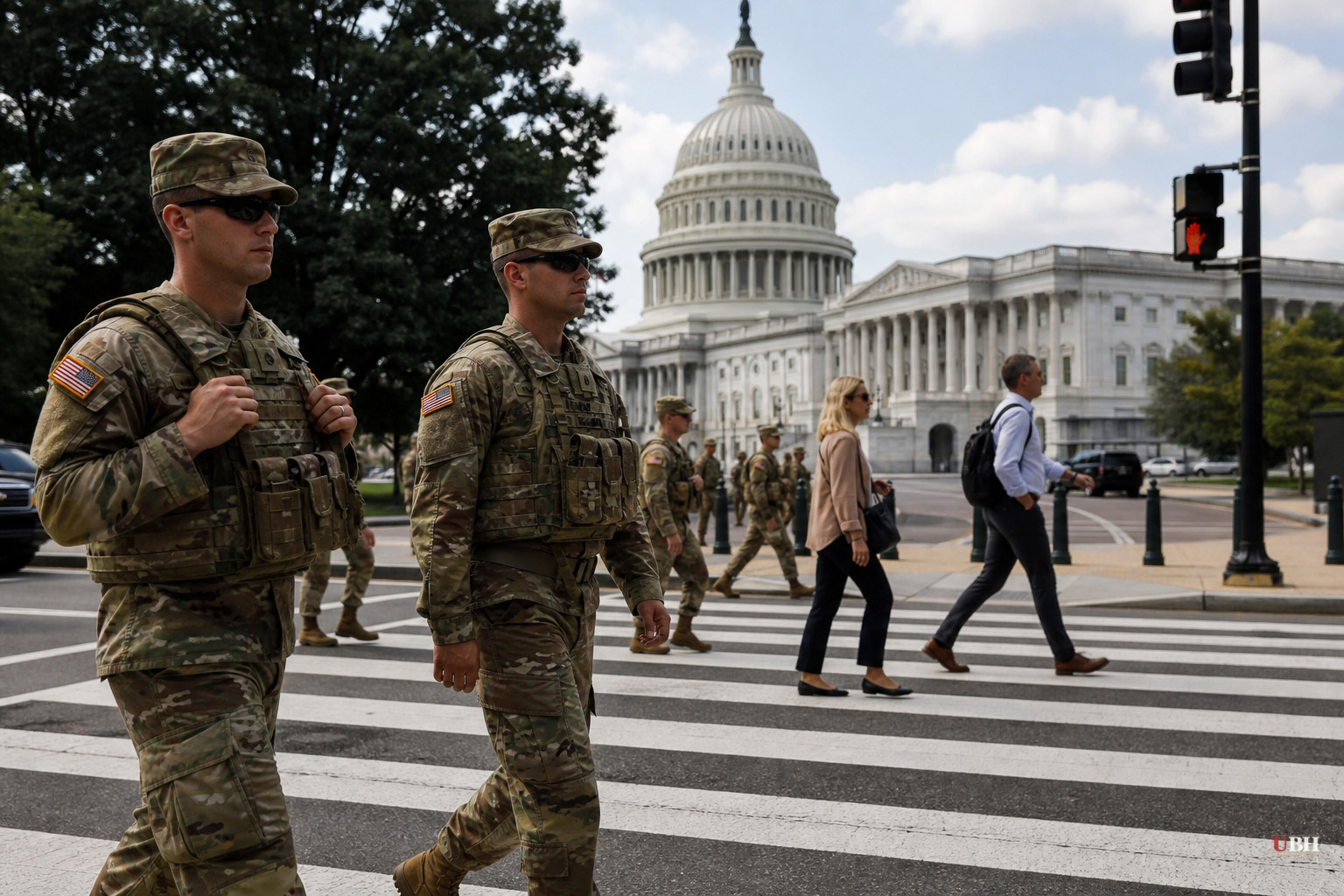
Tuesday marks one year since President Donald Trump declared a "crime emergency" in Washington, D.C., and deployed National Guard troops to the capital under what the administration calls the Make D.C. Safe and Beautiful Task Force. The numbers, a year later, are mixed.
Start with what's real. According to a Council on Criminal Justice report, homicides in D.C. fell 41% in the first half of 2026 compared with the first half of 2025. Carjackings dropped 63%. Motor vehicle theft fell 54%. The U.S. Marshals Service says more than 16,000 arrests have been made since the task force launched, including 35 homicide suspects, more than 100 identified gang members, and nearly 2,000 illegal firearms seized off the streets.
But the same Council on Criminal Justice data shows aggravated assaults rose 45% and gun assaults rose 13% over that period, according to the Daily Signal. D.C.'s own city statistics show a 3% increase in overall violent crime as of Aug. 11, driven by a 40% jump in assaults with a dangerous weapon, even as homicides were down 32% year-over-year and overall crime fell 20%.
This isn't a story of "NO CRIME," which is what Trump claimed on Truth Social in July when he wrote that D.C. "went from High Crime to NO CRIME." The Washington Post flagged that claim directly, noting the reality is far more complicated than the president's social media posts suggest. Crime didn't vanish. Some categories cratered. Others got worse.
The White House's own anniversary statement, published August 10 on whitehouse.gov, calls the record "undeniable" and says violent crime has been "smashed to levels not seen in decades." That's cherry-picking the good numbers and skipping the assault data entirely. Tom Homan, Trump's border czar, told Fox News's Laura Ingraham that D.C. is now "one of the safest cities in the nation" and pushed cities like Chicago to take Trump up on similar help. Homan's arrest and seizure numbers are accurate. Calling D.C. simply "the safest it's ever been" glosses over the assault spike.
A May study from the Niskanen Center, a libertarian-leaning think tank, found the deployment produced a 24% reduction in property crimes like theft and vehicle break-ins, the kind of low-level, high-visibility offenses that happen in the same public spaces where troops have been patrolling. But the same study found no discernible decrease in violent crime, which disproportionately affects D.C.'s majority-Black neighborhoods. The study's authors concluded, according to Washingtonian, that the deployment "was not a waste" but was "an expensive tool deployed in the wrong places for the wrong types of crime."
D.C. Mayor Muriel Bowser, a Democrat, has a counterpoint worth stating plainly: crime in the city was already falling before Trump sent troops in. "We had an unacceptable spike in 2023," she wrote on X when the deployment began. "So we changed our laws and strategies. Now, crime levels are not only down from 2023, but from before the pandemic." Newsweek confirmed that crime had dropped to a 30-year low before Trump's declaration. That means part of the 2026 improvement was already in motion before a single Guardsman showed up.
The legal fight is still unresolved. D.C. Attorney General Brian Schwalb sued the administration in September, arguing the deployment violates the Posse Comitatus Act's ban on using the military for domestic law enforcement, according to Al Jazeera. U.S. District Judge Jia Cobb ordered the deployment ended in November, but a federal appeals court stayed that ruling while litigation continues. No final resolution exists as of today.
Meanwhile, this isn't temporary anymore. The Pentagon confirmed to NPR that the deployment is expected to run through 2029, and Al Jazeera reports the total cost is projected at roughly $1.4 billion. The administration just requested another 1,500 troops for a "summer surge" tied to the country's 250th anniversary celebrations.
On the ground, residents are split. Ybonne Coles, a 60-year-old restaurant worker born and raised in D.C., told Al Jazeera the troops "ain't doing nothing but walking" and that the money should go to organizations helping people who need it. Aaron Taslitz, a 30-year-old teacher, offered a more favorable view of the calmer streets. Advocacy group Free DC organized 11 days of protests culminating outside the White House, calling the deployment a "hostile military occupation."
House Republicans, for their part, alleged in a December report that D.C. police manipulated crime statistics under Chief Pamela Smith to make the city look safer than it was, a claim MPD has disputed and that remains an accusation, not a proven finding.
The open question isn't whether crime changed. It's whether $1.4 billion in National Guard deployment, now indefinite, is the right tool for a violent-crime problem the Guard's own commissioned research says it hasn't solved.
Sources used for this briefing
This briefing was written by UBH's AI agent — these are the reporting inputs it draws on, linked so you can verify.


