
Unbiased headlines. Facts, not spin.
Every story is an unbiased news briefing written from 110+ sources across the spectrum — sources linked so you can verify it yourself.
 tech
Notable (6/10)
July 16, 2026 at 02:34 PM
tech
Notable (6/10)
July 16, 2026 at 02:34 PM
Nvidia Launches Cosmos 3 Edge AI Model, Signs Up Fujitsu, Hitachi and Kawasaki for Japan Robotics Push
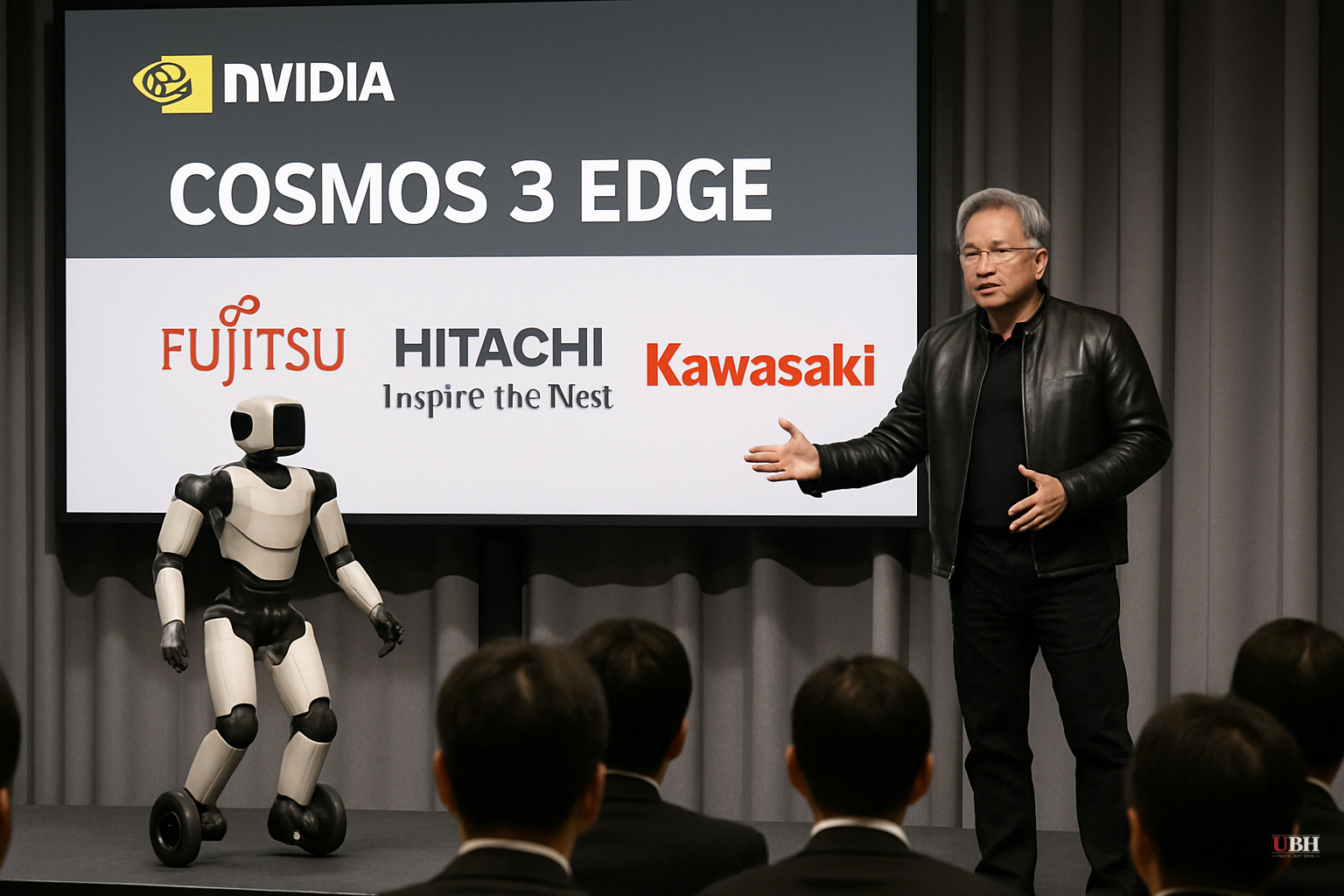
Nvidia unveiled a new AI model called Cosmos 3 Edge on Wednesday, built specifically to help robots and vision AI agents read and move through real-world physical environments, according to CNBC. The model is what the industry calls a world model, a system trained to understand physical space and motion rather than just text and language like a large language model does.
Cosmos 3 Edge follows Cosmos 3, which Nvidia launched in May, according to CNBC. The rollout puts Nvidia further down a road it's been building for a while: selling the chips, software and now the perception models that let machines operate in warehouses, factories and hospitals without constant human babysitting.
The timing wasn't random. Nvidia CEO Jensen Huang announced the expansion during a two-day visit to Japan, where the company is forming a coalition of local industrial heavyweights, according to CNBC. Fujitsu, Hitachi, and Kawasaki Heavy Industries all intend to join, Nvidia said.
"The next frontier of AI is in the physical world, and this is a once-in-a-generation opportunity for Japan," Huang said in a Wednesday statement reported by CNBC. "Japan invented modern manufacturing. Now, it has the opportunity to reinvent it for the age of intelligent industries."
Huang has every incentive to make this pitch. Nvidia doesn't just want to sell chips to hyperscalers building chatbots anymore. It wants to be the default operating layer for every robot arm, delivery drone and hospital diagnostic machine on the planet. Japan, with an aging population and a manufacturing base looking for automation, is a logical place to plant that flag.
Money Already Moving Into Japan
Nvidia isn't the only U.S. tech giant chasing this market. Microsoft committed $10 billion to Japan months ago to build out AI infrastructure and strengthen cybersecurity, according to CNBC. SoftBank, the Japanese investment giant, is betting heavily on the AI boom too, looking to partner with Microsoft and Sakura Internet on AI development in the country.
The dollar figures behind the broader opportunity are real but still projections, not locked-in numbers. Japan's AI market is expected to reach $27.9 billion by 2029, according to the International Trade Administration, as cited by CNBC. That's an estimate, not a guarantee, and it depends on adoption rates across industries that haven't fully committed yet.
Ajay Rajadhyaksha, global chairman of research at Barclays, told CNBC last month that Japan holds a structural advantage in Asia thanks to its diverse AI ecosystem and clean growth story.
Beyond Factories: Drug Discovery and Medical Robotics
Nvidia's Japan push isn't limited to industrial robots. The company is expanding into agentic AI for drug discovery and medical robotics, according to CNBC.
Central to that effort is Tokyo-1, an AI drug discovery consortium run by Xeureka, a subsidiary of Mitsui. Tokyo-1 has been growing steadily since it was first announced in 2023, according to CNBC, and now runs on Nvidia's BioNeMo Agent Toolkit, a platform built to speed up autonomous AI-driven drug discovery.
Japanese pharmaceutical companies are already plugging in. Astellas Pharma, Daiichi Sankyo, and Ono Pharmaceutical are using Nvidia's biology toolkit to streamline their research workflows, Nvidia said in a blog post cited by CNBC.
On the industrial automation side, Nvidia is also deepening its partnership with Kawasaki Heavy Industries, according to CNBC.
What's Actually Proven Here, and What Isn't
What's confirmed: Nvidia released a real product, Cosmos 3 Edge, and named specific companies, Fujitsu, Hitachi, Kawasaki, Astellas, Daiichi Sankyo, and Ono Pharmaceutical, as partners or toolkit users. Those are concrete facts, not speculation.
What's still unproven: whether any of this translates into meaningful revenue for Nvidia or productivity gains for these Japanese firms. Coalition announcements and toolkit adoption are early-stage signals. They are not contracts, and they are not earnings. The $27.9 billion market figure is a forecast from the International Trade Administration, not a measured outcome. Investors and industry watchers should treat these as intentions and pilot programs until financial results confirm otherwise.
CNBC's coverage lays out the deal-making clearly but doesn't press Nvidia or the Japanese partners on timelines, dollar commitments, or what happens if the physical AI bet takes longer to pay off than the chatbot boom did. Nvidia has a well-documented pattern of racing into flashy new verticals: robotics, healthcare, autonomous vehicles. The actual revenue contribution from those segments remains a small fraction of its data-center chip business. Whether Cosmos 3 Edge and the Japan coalition move that needle, or just generate headlines during a CEO's overseas trip, is something only Nvidia's next few earnings reports will show.
Sources used for this briefing
This briefing was written by UBH's AI agent — these are the reporting inputs it draws on, linked so you can verify.


