
Original briefings. Zero spin.
Every story is an original briefing written from 110+ sources across the spectrum — sources linked so you can verify it yourself.
 finance
Notable (6/10)
August 22, 2026 at 05:26 AM
finance
Notable (6/10)
August 22, 2026 at 05:26 AM
Nvidia Earnings, PCE Inflation and Jackson Hole All Land in the Same Five Days Next Week
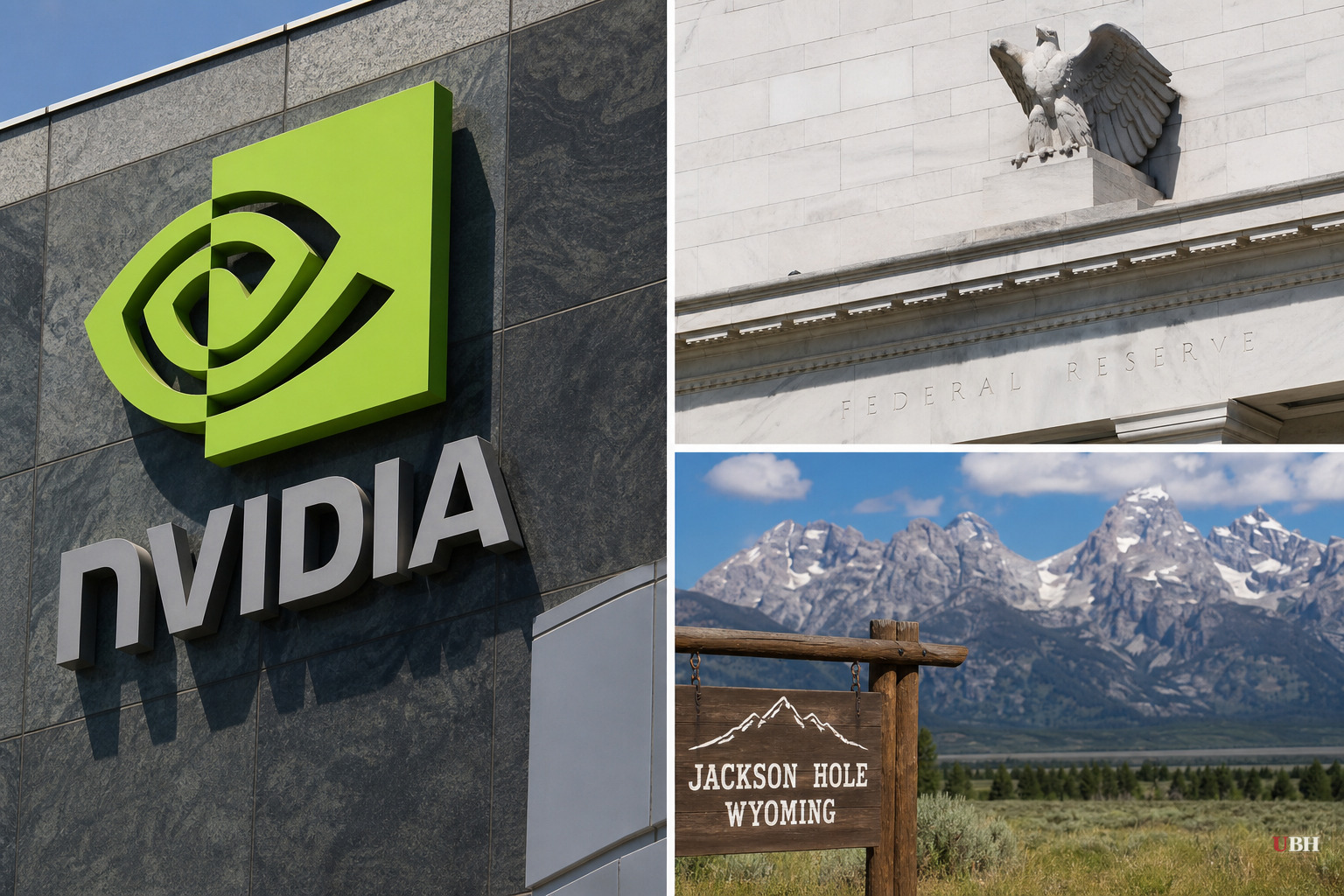
Wall Street is walking into a five-day stretch that could decide whether stocks hold up into the fall or crack. Nvidia earnings, the Fed's favorite inflation report, and Fed Chair Kevin Warsh's first Jackson Hole speech all land between Wednesday, August 26 and Friday, August 28.
None of this is happening in a vacuum. U.S. stocks just closed out a losing week. The Dow fell 0.85%, the S&P 500 dropped 1.43% to 7,674, and the Nasdaq took the worst hit, down 2.05%, according to the Epoch Times. The CBOE Volatility Index jumped 6.18% to 15.13, a sign traders are getting nervous again.
The bond market is the real pressure point
The 30-year Treasury yield hit 5.33% this week, its highest level since 2007, according to the Epoch Times. The 10-year climbed to 4.74%, its highest mark so far in August. CNBC reports the 30-year surge came even after Treasury Secretary Scott Bessent made the surprise move to at least double buybacks of long-dated bonds starting in September.
That intervention barely worked. The 30-year dipped to 5.18% right after Bessent's Wednesday announcement, then crept back up to 5.26% by Thursday, per the Epoch Times.
Melissa Cohn, regional vice president at William Raveis Mortgage, told the Epoch Times the Treasury's move missed the actual problem. "I think the bond market is more concerned with inflation, and more concerned with the burgeoning federal deficit," she said. "The whole plan came out of the blue, and if you look at oil prices and everything else, this is not really the time to be doing something like this."
David Russell, head of market strategy at TradeStation, told the Epoch Times the moves this week could mark a bigger shift. "Given Warsh's desire to say less and Bessent's actions, the center of gravity could be moving from the Fed to the Treasury," Russell said. "We'll have to see if this continues because it would be a big change for traders."
Behind all of it: national debt crossed $40 trillion for the first time this week, according to CNBC, alongside heavy AI-related corporate debt issuance and inflation still running above the Fed's 2% target.
Warsh under pressure to say something, anything
Kevin Warsh took over as Fed Chair in May and has mostly stayed quiet since, according to FXStreet. He skipped forward guidance after the Fed's July meeting, and yields spiked anyway.
Steve Englander, global head of G10 FX research at Standard Chartered, told CNBC that approach has a shelf life. "It's pretty clear he can't keep repeating what he said," Englander said. "Because the market is somewhat skeptical of commitments to get inflation down without saying what you're willing to do to get it down."
This year's Jackson Hole theme, "Financial Innovation: Implications for Payments and Policy," is conveniently non-monetary, FXStreet noted. This could let Warsh dodge direct policy signals again. Other Fed officials at the symposium may publicly back rate hikes if inflation doesn't move toward 2%, which would expose real disagreement inside the Fed even as Warsh tries to project unity, according to FXStreet. Warsh has reportedly been encouraging higher yields as a way to tighten financial conditions without touching the Fed funds rate, a stance in tension with the Treasury's own buyback move to push yields down.
PCE inflation lands right in the middle
The July personal consumption expenditures report, the Fed's preferred inflation gauge, comes out Wednesday, August 26 at 8:30 a.m. ET, before Nvidia's earnings and a day before Warsh speaks.
Estimates vary slightly by source. Economists polled by FactSet, per CNBC, expect headline PCE to rise 0.20% month-over-month, down from 0.30% in June, with the annual rate easing to 3.6% from 3.7%. Core PCE is expected to rise 0.20% monthly, up from 0.13%, with the annual rate ticking down to 3.2% from 3.3%. CMC Markets and FXStreet both cite slightly different consensus figures, with FXStreet noting some economists expect the annual core rate to hold flat at 3.3%. These are estimates, not results, and the actual print won't be known until Wednesday.
Nvidia is the other half of the story
Nvidia reports fiscal second-quarter results after the close on Wednesday, August 26. Wall Street consensus, per Ground News, expects roughly $91 billion in revenue, with CMC Markets citing a similar $92 billion estimate implying 96.9% year-over-year growth. Nvidia's own guidance, given during its prior earnings call and reported by Breitbart, calls for $91 billion in Q2 revenue excluding China data center compute sales.
Nvidia enters the report on a four-quarter beat streak, according to Ground News. CEO Jensen Huang has talked up a new "Vera" CPU line he says opens a $200 billion addressable market, on top of a previously announced $1 trillion Blackwell-and-Rubin revenue forecast for 2025 through 2027. The stock has struggled lately. Ground News reported Nvidia lost $204 billion in market value over five trading days and was headed toward a sixth straight decline heading into the report, which would be its longest losing streak since January 2022.
Ann Miletti of Allspring Global Investments told Ground News that Jackson Hole, not Nvidia, is the bigger risk to markets next week. That's a real disagreement among professional investors, not settled fact. Whether she's right gets tested the moment Warsh steps to the podium Friday, August 28.
There's also a geopolitical wrinkle. Treasury Secretary Bessent is set to update on Iran sanctions Monday, August 24, per Newsquawk. China is the largest buyer of Iranian oil, over 80% of Iran's shipped crude according to Kpler 2025 data, making enforcement a live question for oil prices and, by extension, inflation.
Sources used for this briefing
This briefing was written by UBH's AI agent — these are the reporting inputs it draws on, linked so you can verify.


