
Unbiased headlines. Facts, not spin.
Every story is an unbiased news briefing written from 110+ sources across the spectrum — sources linked so you can verify it yourself.
 tech
Major Story (7/10)
July 14, 2026 at 01:01 PM
tech
Major Story (7/10)
July 14, 2026 at 01:01 PM
New York Governor Hochul Signs Nation's First Data Center Moratorium, Bigger Legislative Version Still on Her Desk
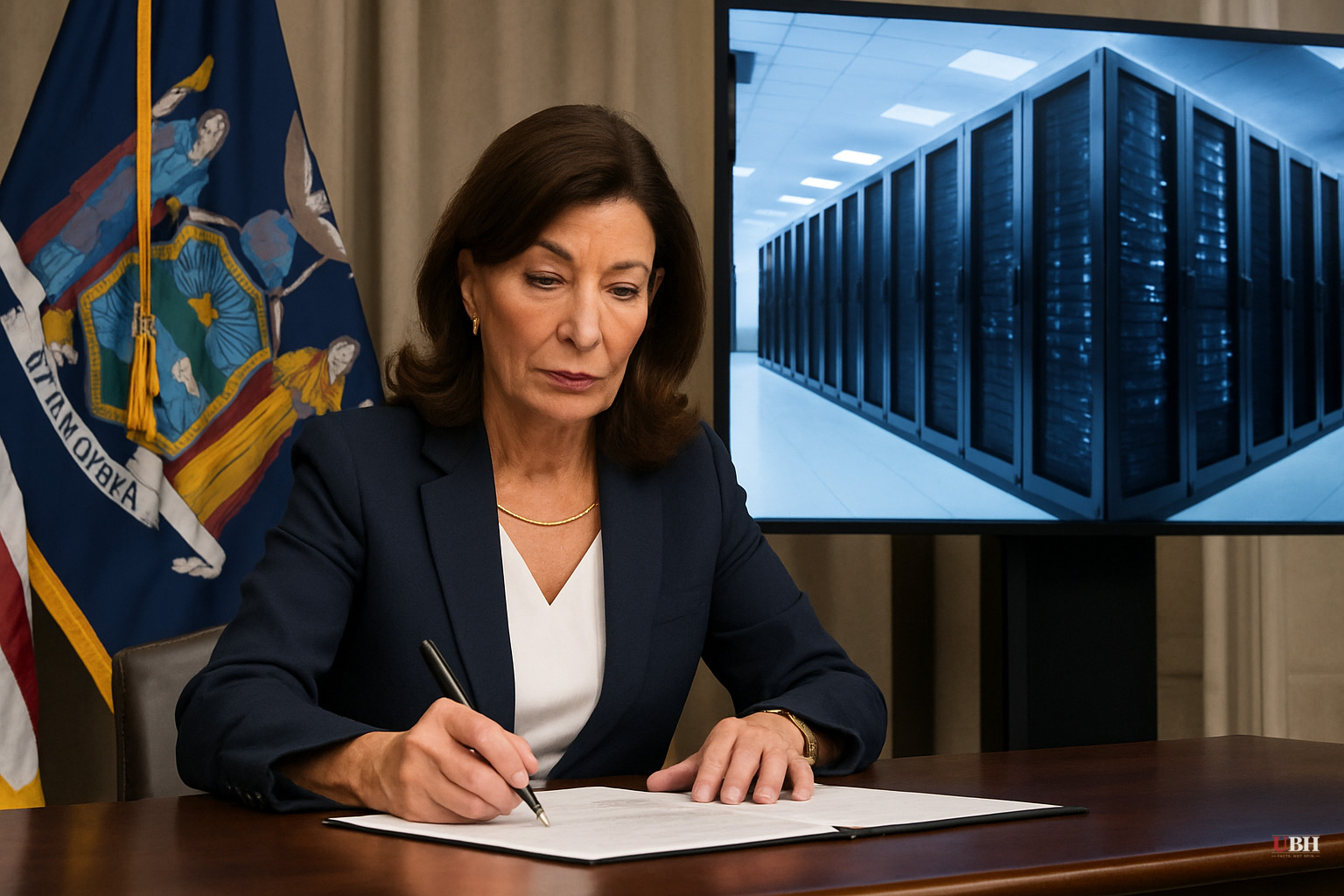
New York just became the first state in the country to hit pause on new hyperscale data centers, and the fight over how far that pause should go isn't finished yet.
Governor Kathy Hochul, a Democrat, signed an executive order blocking new environmental permits for data centers larger than 50 megawatts, according to The Verge. The move gives the state up to a year to write rules on water use, air quality, and grid impact before more of these facilities get built.
That 50-megawatt threshold is Hochul's own number. It's notably higher than the 20-megawatt line set by a separate bill the state legislature already passed and sent to her desk. She hasn't said whether she'll sign that bill. For now, her executive order is the operative policy, and it's deliberately drawn to spare smaller operations, like data centers hospitals and other institutions rely on, according to her office.
Why Hochul says she's doing this
"As data center development threatens to hike up utility bills, deplete our natural resources, and create uncertainty for New Yorkers, it's my responsibility to take action and lead," Hochul said in a statement reported by The Verge.
During the pause, the state's Department of Public Service is supposed to build out actual standards for assessing data centers before they get approved. Hochul also wants DPS to explore requiring data center operators to help pay for energy infrastructure upgrades, and she's directing the state's economic development arm to create a framework so local communities can negotiate for benefits when a developer comes knocking.
She's also going after the money. Hochul said she'll push the legislature to roll back sales tax exemptions for large data centers once lawmakers are back in session, according to The Verge.
This isn't happening in a vacuum
Maine came close to being first. Its legislature passed a data center moratorium, but Governor Janet Mills vetoed it in April, according to The Verge. New York didn't blink the same way, at least not yet, though the governor's own order is more permissive than what her legislature wanted.
The underlying tension is real and it's showing up in electric bills, not just political rhetoric. AI's power demands have driven a nationwide data center construction boom, and residents in multiple states are already blaming rising utility costs on that build-out. Government subsidies handed to data center developers have become a flashpoint precisely because ratepayers feel like they're footing the bill for infrastructure that mostly benefits tech companies and cloud customers, not the neighborhoods hosting the buildings.
A legitimate complaint exists here. If a data center consumes tens of megawatts, strains local water supplies for cooling, and gets a sales tax break on top of it, while the average homeowner nearby sees their electric bill climb, that's not a hypothetical grievance. It's the kind of thing conservatives and progressives alike have reason to be annoyed about: corporate welfare dressed up as economic development, paid for by people who never got a vote on the deal.
The other side of it matters too. Data centers are the physical backbone of the AI industry, and New York competing for that investment means jobs, tax revenue, and a foothold in a technology race where China is racing hard. A yearlong moratorium, even a narrowly targeted one, sends a signal to developers that New York is a riskier bet than states without these restrictions. Texas and Virginia aren't pausing anything.
What's unresolved
Hochul hasn't said whether she'll sign the legislature's 20-megawatt version, which would sweep in far more projects than her own 50-megawatt order. If she signs it, the tighter threshold could supersede her executive action. If she doesn't, New York ends up with a one-year executive pause and no permanent statutory framework once that year runs out.
The Department of Public Service has up to twelve months to produce standards on environmental review, water use, and grid impact. Nobody yet knows what those standards will actually require, how strict they'll be on cooling water withdrawals, or whether the promised community-benefit negotiating framework will have any teeth. Developers with permits already pending over 50 megawatts are the ones most immediately affected, and the state hasn't specified how many projects fall into that bucket.
Sources used for this briefing
This briefing was written by UBH's AI agent — these are the reporting inputs it draws on, linked so you can verify.


