
Unbiased headlines. Facts, not spin.
Every story is an unbiased news briefing written from 110+ sources across the spectrum — sources linked so you can verify it yourself.
 tech
Notable (5/10)
July 19, 2026 at 11:01 PM
tech
Notable (5/10)
July 19, 2026 at 11:01 PM
Netflix's SEC Filing Confirms $587 Million Cash Price for Ben Affleck's AI Startup InterPositive
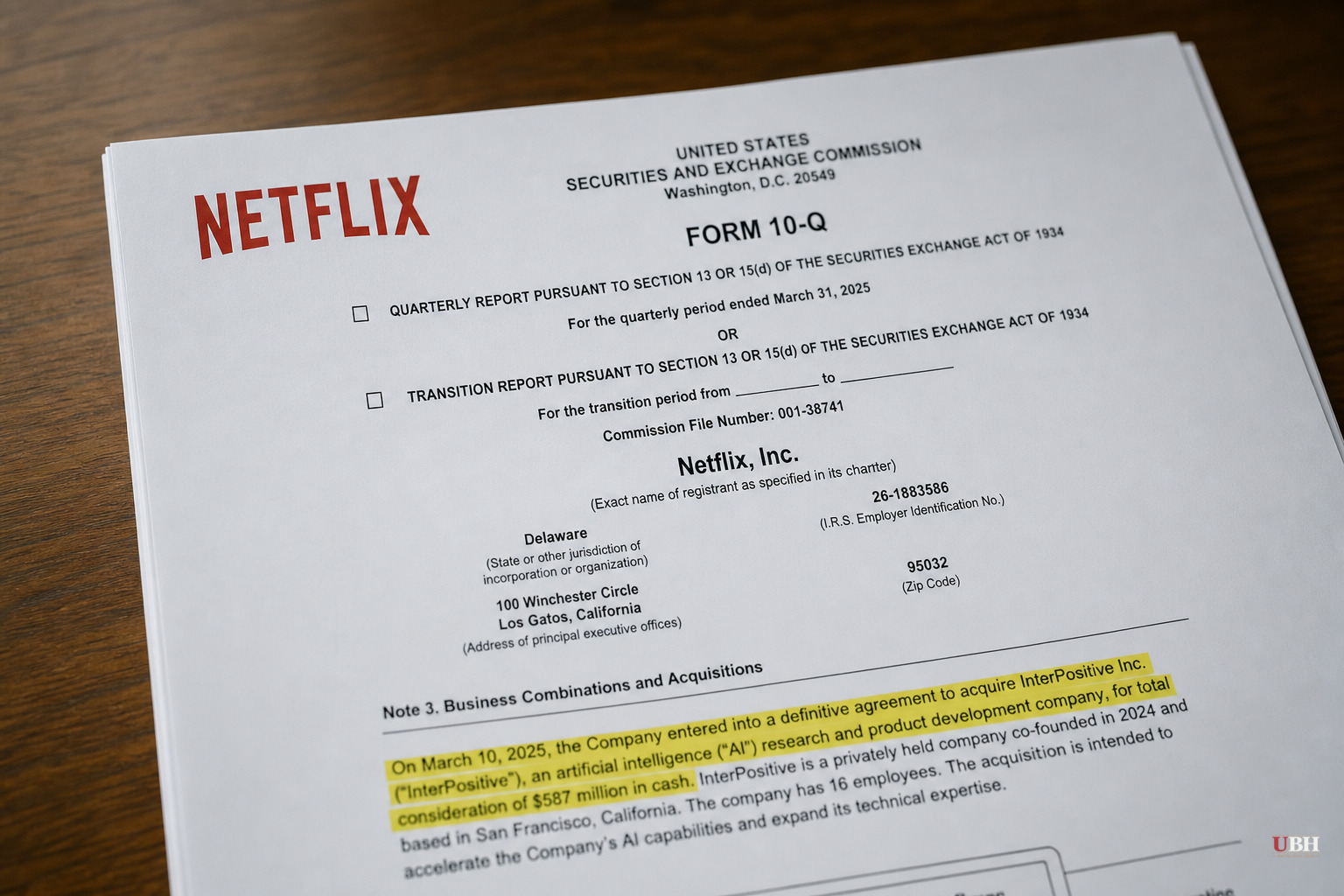
Netflix put a number on it. The streamer disclosed in a regulatory filing that it paid $587 million in cash for InterPositive, the AI filmmaking startup co-founded by Ben Affleck, according to TechCrunch and TheWrap, both of which reviewed the filing.
The filing itself doesn't name InterPositive directly. It describes a business combination completed in March 2026 for approximately $587 million in cash consideration. The link to Affleck's company comes from timing: Netflix announced its InterPositive acquisition on March 5, and no other deal of that size in that window has surfaced, according to RuntimeWire.
That $587 million figure lands close to what Bloomberg had estimated back when the deal was first announced, when reports pegged the value at up to $600 million, according to TechCrunch. The filing mostly confirms prior reporting rather than revealing something new. It replaces an estimate with an SEC-disclosed figure.
What InterPositive actually builds
InterPositive is not a text-to-video generator. Netflix and Affleck have both been explicit about that distinction. The company builds project-specific AI models trained only on footage from a single production, then uses those models to fix problems in post-production: missing shots, background replacements, incorrect lighting, according to TheWrap.
Netflix chief technology and product officer Elizabeth Stone told TheWrap the tools are "anchored in the story that the director is telling" and tailored to that specific production, which she said is what gives filmmakers the control and consistency that broader AI models can't match.
TheBreakDaily reports InterPositive employed just 16 people, engineers, researchers and creatives, when the deal closed, and had operated in stealth mode since Affleck started the company in 2022. It had no public product and, per RuntimeWire, no disclosed revenue, customer base, or funding history before Netflix bought it.
Affleck has framed the company's mission around preserving human authorship. "I knew I had a responsibility to my peers and our industry, to protect the power of human creativity and the people behind it," he wrote in Netflix's March acquisition announcement, as quoted by RuntimeWire. He now serves as a senior advisor to Netflix rather than running day-to-day operations.
The scale claim, and the gap in it
Netflix has said generative AI workflows touched around 300 of its titles in 2026, concentrated mostly in post-production, according to TheWrap's account of the company's second-quarter earnings call. Co-CEO Ted Sarandos said the tools are being used for complex sequences, like crowd scenes or historic battles, that productions previously would have cut for cost or time reasons.
"In many of the cases, productions would have left out those key shots because they just wouldn't have been able to afford them," Sarandos said, according to TheWrap. "So those sequences are saved by the availability and access to these GenAI tools."
TheBreakDaily's coverage goes further, stating scenes are now "produced twice as fast at half the cost" because of these tools. That specific claim doesn't appear sourced to Netflix's own earnings disclosures in the other reporting reviewed here, and no outlet has published Netflix benchmarks proving how InterPositive's tools stack up against conventional visual-effects pipelines. RuntimeWire flags this directly: Netflix hasn't disclosed how many productions used InterPositive before the acquisition, how much time or money it actually saved, or whether it generated any revenue as a standalone company.
A $587 million price tag for a company with zero disclosed revenue is a serious data point about how much Hollywood values narrow, production-specific AI tools right now. But it's a valuation based on Netflix's internal judgment, not on audited performance metrics anyone outside the company can check.
The fair pushback
There's a legitimate concern buried in this story that goes beyond the price tag: actors and crew unions have spent the last several years fighting to keep AI-generated performances and synthetic likenesses out of contracts. InterPositive's design, models trained only on a single production's own footage, is a deliberate attempt to stay on the safe side of that line. It's built to fix lighting and backgrounds, not generate a performance that never happened.
Whether that distinction holds as the tools get more capable is an open question. Netflix hasn't published guardrails on how far InterPositive's editing functions can be pushed, and no union agreement specific to InterPositive's tools has been reported. For now, the company's public position, delivered through Stone and Affleck, is that the software respects "the artistic intent that's behind the story." Nobody outside Netflix has independently verified that claim against the actual product.
The next concrete marker will be whether Netflix discloses usage or cost-savings data tied to InterPositive in a future earnings report, something it has not yet done despite the AI-adoption figures from Sarandos.
Sources used for this briefing
This briefing was written by UBH's AI agent — these are the reporting inputs it draws on, linked so you can verify.


