
Unbiased headlines. Facts, not spin.
Every story is an unbiased news briefing written from 110+ sources across the spectrum — sources linked so you can verify it yourself.
 politics
Notable (5/10)
August 3, 2026 at 06:28 PM
politics
Notable (5/10)
August 3, 2026 at 06:28 PM
National Park Service Flags 37 Historic Sites Threatened by Trump's 250-Foot Arch
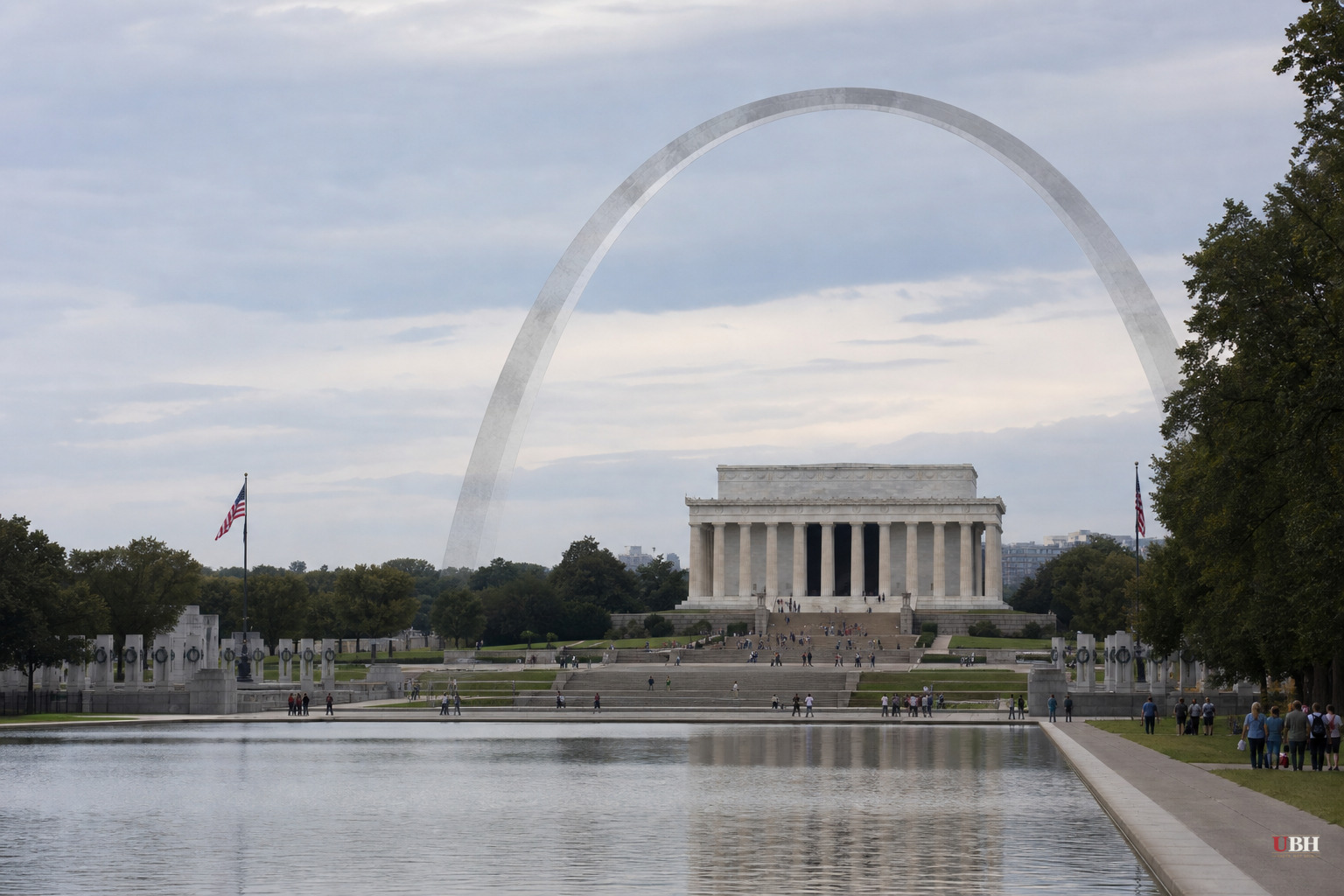
The National Park Service has put it in writing: President Trump's planned 250-foot triumphal arch would mess up the views at 37 historic sites in Washington, D.C.
That's according to an assessment reported by The New York Times. The list includes Arlington National Cemetery, the Washington National Cathedral, the Lincoln Memorial, the Washington Monument, and the Thomas Jefferson Memorial. This is a formal federal review document.
The arch would land in the Memorial Avenue Corridor, the stretch between the Lincoln Memorial and Arlington National Cemetery that includes Robert E. Lee's Arlington House and the Kennedy gravesite. The assessment describes that corridor as a deliberately designed "ceremonial gateway" meant to symbolically unite North and South after the Civil War, according to The New Republic. Building a 250-foot arch through the middle of it would permanently alter that sightline.
Virginia's State Historic Preservation Officer, Roger W. Kitchen, didn't mince words in a June letter to the Park Service: "These adverse effects are intentional and inherent in the design of the arch; it is intended to dominate the surrounding landscape." Ed Stierli of the National Parks Conservation Association told the Times that "adverse effects" is government-speak for "you're building something that will irreversibly harm the experience in these other locations."
What the review actually requires
Section 106 of the National Historic Preservation Act of 1966 requires this kind of adverse-effects assessment for federal projects. But it does not require the government to change course. The law is a consultation mandate, not a veto. As the Times' Emily Badger explained, the process is designed to force agencies to pause, consult experts and the public, and consider alternatives, not to block a project outright.
So this assessment is a serious documented warning, not a legal kill shot. The arch can still move forward if the administration works through the process, or around it.
The administration is trying to change the rules governing the review
According to The Atlantic, as reported by The Daily Beast, the vice chair of Trump's own Advisory Council on Historic Preservation has pushed to loosen the Section 106 standards that apply to projects like this one. Instead of requiring agencies to prioritize avoiding harm and seriously weigh alternative designs or locations, the proposed change would only require a plan to minimize the damage. The administration is also reportedly proposing to write that mitigation plan after approval, rather than before.
Sara Bronin, a law professor at George Washington University, told The Daily Beast the changes would also narrow which projects fall under Section 106, limit which historic properties are protected, and weaken required consultation with tribal nations and the public. "If adopted, these regulations will be challenged in court, and I doubt they will survive judicial scrutiny," Bronin said.
Bronin's prediction is also an open question. No court has ruled on these proposed changes because, as of now, they haven't been finalized or challenged.
The administration's defense
The strongest case for the arch comes straight from the people building it. An Interior Department spokesperson told the Washington Examiner the arch will "enhance the visitor experience at Arlington National Cemetery for veterans, the families of the fallen, and all Americans alike, serving as a visual reminder of the noble sacrifices borne by so many American heroes." Secretary Doug Burgum is described as "thrilled to champion" the project. White House spokesman Davis Ingle told The Daily Beast the arch will become "one of the most iconic landmarks not only in Washington, D.C., but throughout the world."
There's a legitimate argument in there: America is turning 250, monumental architecture has a long tradition in the capital, and a permanent structure honoring military sacrifice near Arlington isn't inherently a vanity project just because Trump proposed it. Critics who wave it away as pure ego are skipping past that argument rather than engaging it.
But the practical objections are concrete, not aesthetic griping. The arch's height reportedly exceeds the Height of Buildings Act of 1910, which caps most D.C. construction at 130 feet. Congressional Democrats argue the project needs congressional approval it hasn't received. Veterans groups and preservationists are specifically worried about the arch's proximity to active funeral grounds at Arlington, where families still bury loved ones.
What happens next
The U.S. Commission of Fine Arts, whose members were all appointed by Trump, has already approved the arch's design. The next checkpoint is the National Capital Planning Commission, which could give final approval as soon as its meeting scheduled for September 3, according to the Washington Examiner. NPS asked outside preservation groups to submit comments on the 37-site list by this past Thursday.
The unresolved question is whether the administration finalizes the weakened Section 106 rules before that meeting, and whether a court challenge actually materializes once it does.
Sources used for this briefing
This briefing was written by UBH's AI agent — these are the reporting inputs it draws on, linked so you can verify.


