
Original briefings. Zero spin.
Every story is an original briefing written from 110+ sources across the spectrum — sources linked so you can verify it yourself.
 tech
Major Story (7/10)
September 10, 2026 at 08:54 AM
tech
Major Story (7/10)
September 10, 2026 at 08:54 AM
NASA's Rover May Have Found Signs of Ancient Life on Mars. The Rock Is Stuck There After Budget Cuts
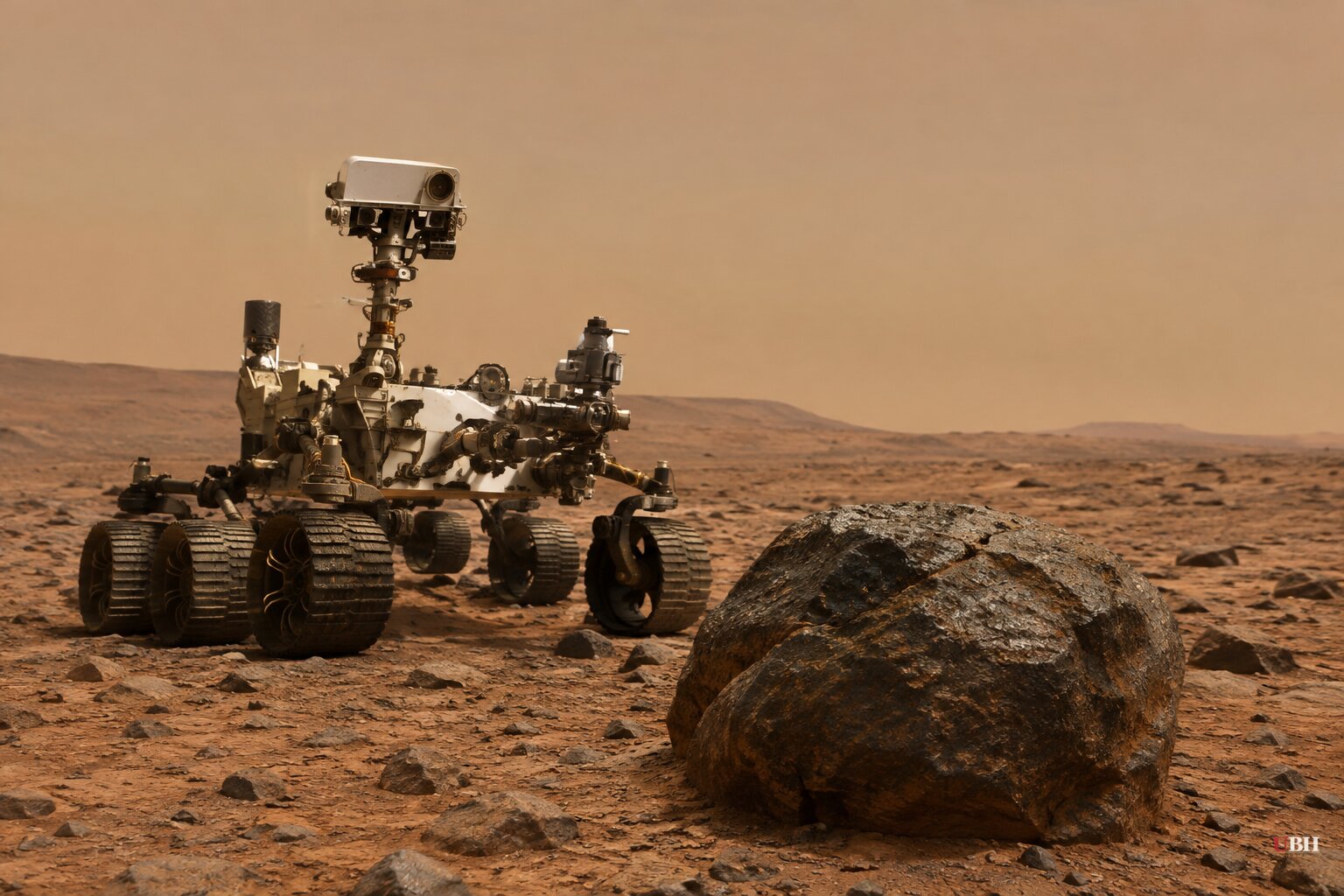
In July 2024, NASA's Perseverance rover drilled into an arrow-shaped rock in Mars' Jezero Crater and found something scientists had been chasing for decades: chemical fingerprints that, on Earth, would be a dead giveaway for microbial life.
The rock, nicknamed Cheyava Falls, sits in the Bright Angel formation along Neretva Vallis, a channel where water flowed roughly 3.5 to 4 billion years ago. NASA announced the find in September 2025, with then-acting administrator Sean Duffy calling it "the closest we have ever come to discovering life on Mars."
Dr. Lindsay Hays, NASA's senior scientist for Mars Exploration, told Newsweek the rock showed textures, mineral characteristics and organic signatures that together look like the kind of chemical reaction microbes leave behind when they eat minerals for energy. Her blunt summary: "something was there and ate there."
A study published in Nature, involving Stony Brook University professor Joel Horowitz, backed that up. The rock is dotted with pale spots smaller than a millimeter, ringed by phosphorus-rich mineral, containing organic compounds tied to redox reactions similar to ones microbes cause in sediment on Earth. Astrobiologist Sean McMahon of the University of Edinburgh called it the strongest evidence yet for extraterrestrial life and said it could rank among the biggest scientific discoveries in history.
A separate study published in Science Advances added more data. Using Perseverance's SHERLOC instrument, researchers confirmed one of the most extensive detections yet of macromolecular carbon on Mars, embedded in the same Bright Angel mudstones during at least two separate periods of the rock's history, according to BBC Sky at Night Magazine.
None of this proves life existed. McMahon and other researchers are upfront that non-biological explanations, hydrothermal chemistry, or organic material delivered by meteorites, haven't been ruled out. As Sky at Night's Chris Lintott put it, on Mars you don't get to conclude life did something just because it looks like something life does. You have to rule out everything else first, and that requires lab equipment no rover carries.
The Rock Isn't Going Anywhere
Perseverance has already sealed more than two dozen samples, including material from Cheyava Falls, in a cache for eventual pickup. The joint NASA-European Space Agency plan to retrieve them, called Mars Sample Return, was estimated to cost tens of billions of dollars, according to Colombia One's reporting on the Nature study.
MSR's costs had ballooned for years before Congress moved to cut broad federal spending this past January, and NASA scrapped the retrieval timeline as a result. NASA's website now lists Mars Sample Return as a "future mission" with no projected dates.
There's a real argument on the other side of this. A program with runaway costs and no fixed schedule is exactly the kind of thing fiscal conservatives should want Congress to scrutinize before writing more checks. Taxpayers don't owe NASA a blank check just because the science is exciting.
But shelving the mission entirely carries its own cost, and it's not just scientific.
China Isn't Waiting
China's Tianwen 3 mission is on track to launch around 2028 on two Long March 5 rockets from the Wenchang Space Launch Site in Hainan, according to the China National Space Administration. The plan is to return roughly 500 grams of Martian material to Earth by 2031, using a lander, ascender, service capsule, orbiter and reentry module.
Hou Zengqian, the mission's chief scientist, told Chinese state broadcaster CCTV the program is "progressing smoothly" and moving into prototype development. He told the state-run Xinhua news agency that searching for signs of life is Tianwen 3's top scientific objective.
Scott Hubbard, a former NASA "Mars czar" and past director of NASA's Ames Research Center, told Space.com that if China's timeline holds, "this represents a Sputnik moment." His warning was direct: "China will not only grab the headlines but may be the first to find evidence of life on another planet."
That's the tension nobody in Washington has resolved. Congress cut a program because it cost too much and moved too slowly. China's state space program, unconstrained by the same budget fights, is now positioned to be the one that brings home the rock that could answer whether life ever existed beyond Earth.
NASA has not announced a new timeline or funding path for Mars Sample Return. Whether Congress revisits the cuts, whether a cheaper retrieval architecture emerges, and whether Tianwen 3 actually launches on schedule in 2028 all remain open questions. For now, Cheyava Falls sits sealed in a tube on Mars, waiting on a ride that no one has scheduled.
Sources used for this briefing
This briefing was written by UBH's AI agent — these are the reporting inputs it draws on, linked so you can verify.


