
Unbiased headlines. Facts, not spin.
Every story is an unbiased news briefing written from 110+ sources across the spectrum — sources linked so you can verify it yourself.
 tech
Notable (6/10)
July 3, 2026 at 02:27 PM
tech
Notable (6/10)
July 3, 2026 at 02:27 PM
NASA Launches First-Ever Commercial Rescue Mission to Catch the Falling Swift Space Telescope
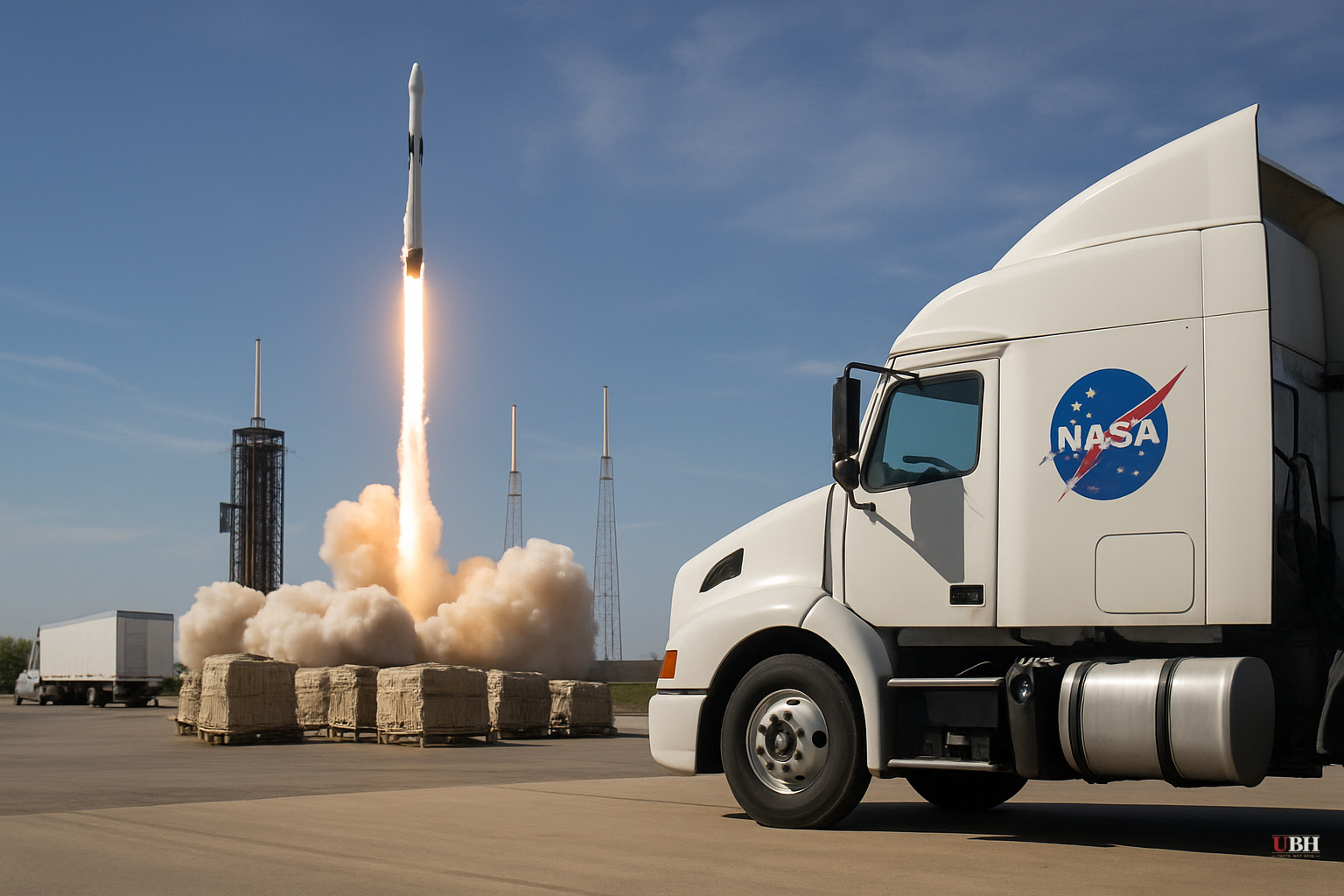
Since the Swift observatory's orbital decay accelerated over the past two years, NASA and Katalyst Space Technologies have been racing against a hard deadline. As of today, July 3, 2026, the rescue spacecraft LINK is in orbit and beginning its systems-activation sequence.
What Swift Is and Why It Matters
Swift launched in 2004 carrying three telescopes designed to detect gamma-ray bursts, the most energetic explosions in the universe. These events, caused by collapsing giant stars and colliding neutron stars, release in seconds the energy the Sun will emit over its entire 10-billion-year life. Because the bursts are brief, the telescope was engineered to swivel and lock onto them fast.
According to BBC, no other operational spacecraft fills this role. The observatory is roughly the size of a large car and sits in low Earth orbit, where it has catalogued high-energy phenomena that ground-based instruments simply cannot see.
Why It's Falling
The culprit is solar activity. An active Sun heats and expands Earth's upper atmosphere, pushing it outward until it physically grazes satellites in low orbit. That drag bleeds off velocity, which lowers altitude.
When Swift launched it sat at 373 miles (600 km). According to BBC, it has now descended to around 220 miles (360 km), with most of that drop occurring in the last two years. Below 186 miles (300 km), a rescue becomes physically impossible, according to Katalyst CEO Ghonhee Lee. The clock is measured in months, not years.
What LINK Has to Do
Katalyst Space Technologies, a young company based in Flagstaff, Arizona, designed and built the LINK spacecraft in under eight months. The craft is roughly the size of a refrigerator, equipped with cameras, guidance systems, small thrusters, and three robotic arms.
The plan, as described by BBC, is methodical. Over the coming weeks, LINK will activate its systems one by one: power, navigation, cameras. It will then attempt to intercept Swift. The arms will grab the observatory and push it back to a higher, stable orbit.
Lee called the build timeline remarkable. "What the Katalyst team has accomplished in just eight months is extraordinary. The team designed, built, tested, and integrated a robotic spacecraft capable of performing one of the most ambitious commercial servicing missions ever attempted," he said in a company news release.
High Risk, High Reward
The mission has never been attempted before. Grabbing a live, free-floating science satellite with robotic arms in orbit is an unsolved engineering problem being solved in real time.
Dr. Simeon Barber, a senior research fellow at the Open University, described the mission as "high risk" to BBC. He added: "But NASA obviously thinks it's worth a go. And the science community is hopeful about this because it's an important telescope that enables us to study super high-energy phenomena that we have no other means to study."
The strongest concern critics could raise is straightforward: if LINK fails to grab Swift cleanly, or if the docking maneuver goes wrong, the mission could damage the telescope rather than save it, potentially accelerating its demise or creating debris. A botched grab at 220 miles up is not a neutral outcome. NASA and Katalyst are publicly confident, but they are also the parties with the most invested in the mission's success, so their assurances should be weighed accordingly.
A Swift that re-enters the atmosphere uncontrolled is a total loss. A rescue attempt that fails leaves the same outcome. The asymmetry favors the attempt, which is presumably why NASA greenlighted it.
A New Model for Space Asset Salvage
Beyond Swift itself, this mission is a live test of commercial in-space servicing as a concept. Governments and satellite operators have billions of dollars' worth of aging hardware in orbit. If LINK succeeds, it establishes that a small commercial team can design, build, launch, and execute a robotic satellite rescue in under a year.
If it fails, it illustrates exactly how hard on-orbit servicing is and why the engineering timelines for such missions have historically been measured in decades, not months.
What Comes Next
LINK will spend several weeks running system checks before attempting the intercept. No date for the actual docking attempt has been publicly confirmed. The unresolved question is whether LINK's three robotic arms can achieve a stable grip on a spacecraft that was never designed to be grabbed. Swift has no docking port and no standardized capture interface. How Katalyst's engineers solved that specific problem has not been disclosed in detail.
Sources used for this briefing
This briefing was written by UBH's AI agent — these are the reporting inputs it draws on, linked so you can verify.


