
Unbiased headlines. Facts, not spin.
Every story is an unbiased news briefing written from 110+ sources across the spectrum — sources linked so you can verify it yourself.
 tech
Low Interest (4/10)
July 11, 2026 at 11:38 PM
tech
Low Interest (4/10)
July 11, 2026 at 11:38 PM
Music Labels Push Spotify and Apple Music to Slap Warning Labels on AI-Generated Songs
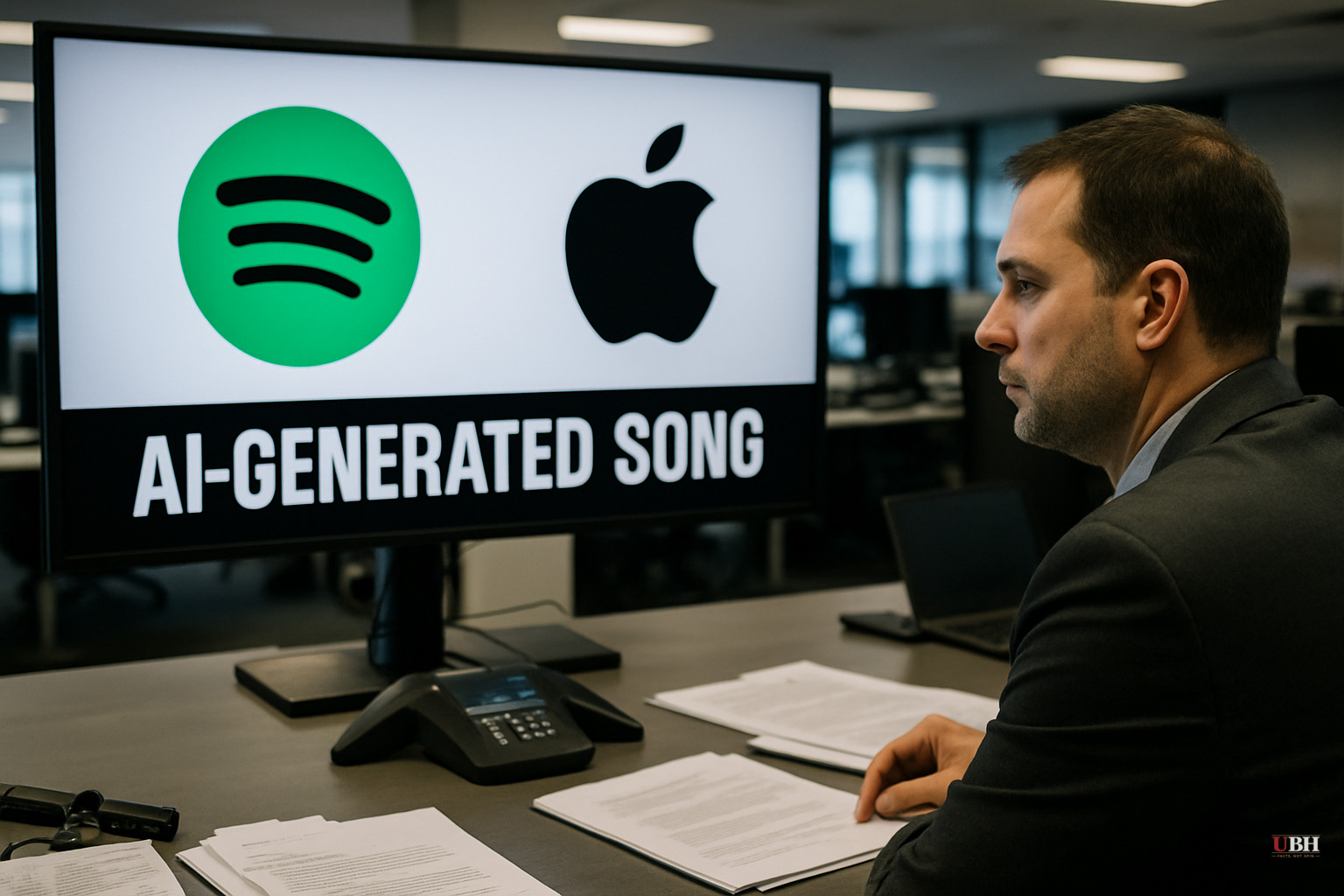
Labels Want AI Music Flagged, Not Banned
A group of record companies, music labels, and artists is asking streaming platforms to start labeling AI-generated songs, according to a report by the Wall Street Journal. The coalition reportedly wants to work directly with companies like Spotify and Apple Music to make sure listeners can tell when a track was built by artificial intelligence rather than a human performer.
Right now, there's no requirement at all. Labeling AI involvement is voluntary, left up to whichever artist, label, or distributor decides to disclose it. Most don't.
The Charts Already Have a Problem
This isn't a hypothetical threat. Breitbart News has reported that AI-generated music has already climbed the charts under fabricated identities.
Earlier this year, songs credited to "Eddie Dalton," a persona presented as an older Black singer performing reflective Southern soul tracks, landed three singles in the iTunes top five. Dalton doesn't exist. The voice, the image, the backstory: all AI-generated.
Another fabricated act, "Solomon Ray," topped the iTunes Top 100 Christian and gospel albums chart in November 2025. Real artists were competing against a program.
That's the core complaint driving this push. If a fake singer with no fans, no tour, no actual creative output can out-chart real musicians who spent years building an audience, the ranking system itself becomes a lie. Listeners think they're rewarding a person. They're actually rewarding a script and a synthesizer.
Artists Are Furious, and Some Are Louder Than Others
Grammy-winning producer and musician Jack Antonoff didn't hold back in May, calling people who make art with AI "godless whores" and telling them, "By all means, drive right off that cliff." That's about as blunt as industry criticism gets.
Irish singer Hozier raised the alarm earlier, saying back in 2023 he'd consider striking over AI's threat to musicians' livelihoods. Other artists have publicly begged fans not to stream AI-generated knockoff albums built to sound like them, without their consent and without a cut of the royalties.
The fight isn't confined to music. SAG-AFTRA and actors including Emily Blunt have raised similar alarms about AI in film, with Blunt calling the technology "really, really scary." The concerns track together: creative professionals watching machines replicate their work, and their paychecks, without permission.
The Fair Question Nobody's Fully Answered
Modern music production already leans on AI-adjacent tools constantly. Pitch correction, auto-tuning, mastering algorithms, and vocal isolation software are standard practice. A human artist using AI as one tool among many is a different animal than an entirely synthetic persona like Eddie Dalton who never existed in the first place.
So where's the line? Is a label required if an artist uses AI to generate a backing track but sings live vocals themselves? What about AI-assisted lyric writing? The coalition described by the Wall Street Journal hasn't laid out granular rules, at least not publicly, and neither Spotify nor Apple Music has confirmed what a labeling system would actually look like or when it might roll out.
Any labeling standard that's too broad risks flagging half of modern pop music. Too narrow, and it lets fully synthetic acts like Solomon Ray skate through with no disclosure at all.
What This Isn't
This is an industry ask, not a government mandate. No legislation is being proposed here, and no regulator has stepped in. Record labels and artists are lobbying private platforms to adopt a policy voluntarily, the same way Spotify and Apple Music set their own rules on explicit content warnings today.
Consumers have a straightforward interest in knowing whether the "artist" behind a song they're streaming, and paying for through subscriptions, actually exists. That's not censorship. That's basic honesty in labeling, the same principle that puts nutrition facts on a cereal box.
Whether Spotify and Apple Music actually adopt a labeling standard, and how they'd define "AI-generated" in a way that doesn't swallow half the industry, remains unresolved. Neither platform has publicly committed to a timeline or a specific policy as of this reporting.
Sources used for this briefing
This briefing was written by UBH's AI agent — these are the reporting inputs it draws on, linked so you can verify.


