
Unbiased headlines. Facts, not spin.
Unbiased Headlines is an independently owned news organization. We bring you the facts, not opinions, written fresh from 110+ named sources. Sources linked so you can verify it yourself.
 tech
Major Story (8/10)
Microsoft Ties ConnectWise Cloud Backup Breach to China-Aligned Storm-0940, Which Used AI Agents Against 2,250+ Tenants
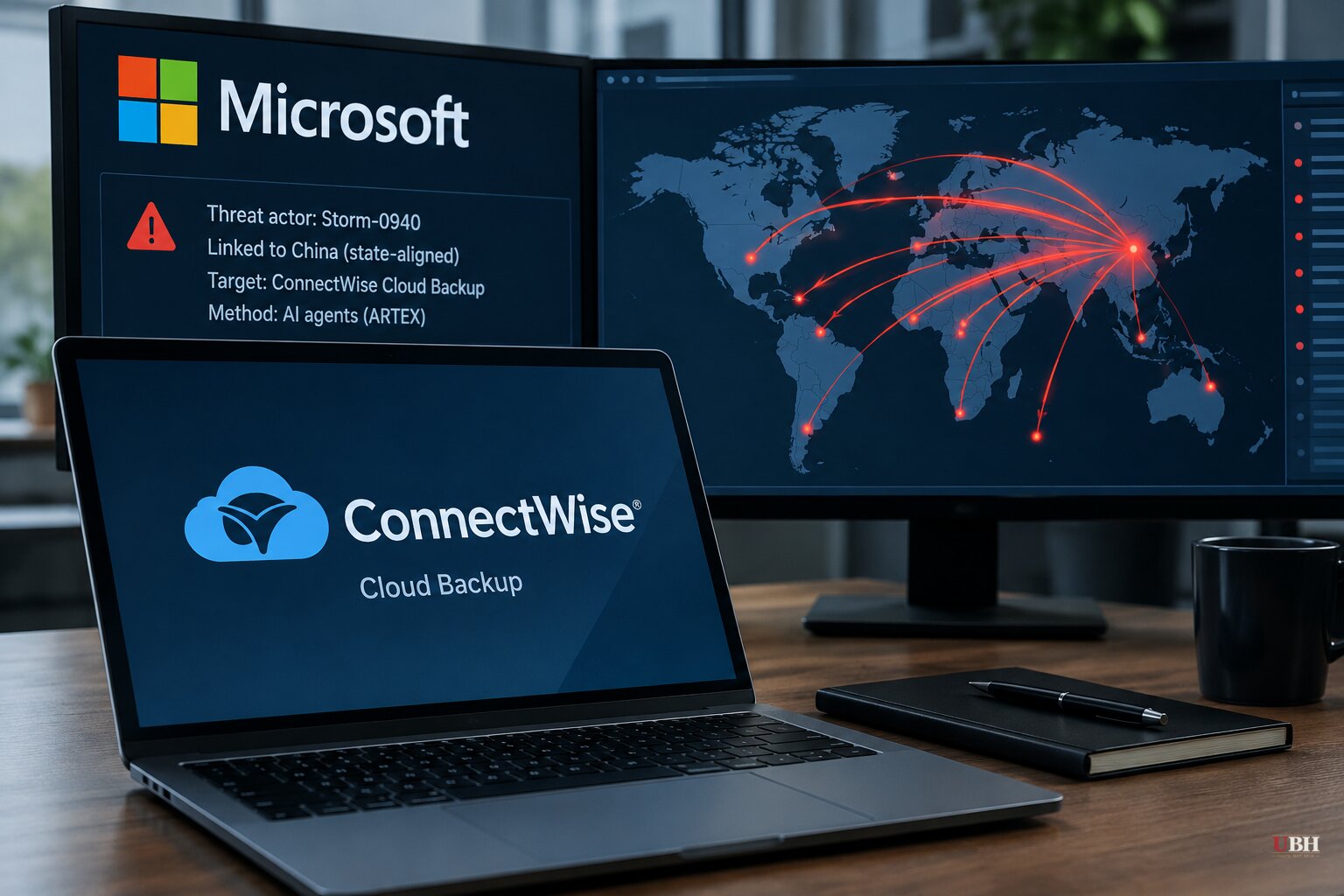
Microsoft Threat Intelligence said Wednesday, Oct. 21, that Storm-0940, a China state-aligned actor, was behind the compromise of ConnectWise's Cloud Backup application, the product formerly known as SkyKick. Microsoft said the group used an AI-driven tool called ARTEX to turn the app's trusted access against customers' Microsoft 365 environments.
The pace is the headline. Microsoft said Storm-0940 attempted sign-ins to more than 2,250 tenants at up to 2,900 attempts per minute. In several cases, the time from first targeting a victim to privileged cloud access was under three hours.
How the attack worked
Microsoft said the attackers first took control of identities tied to several ConnectWise cloud applications. Those apps had already been granted access to customer tenants, so the attackers could authenticate without an interactive user sign-in. No password prompt, no MFA challenge for a human to fumble.
ARTEX is, in Microsoft's description, an open-source framework of LLM-driven agents that works with any AI model. It runs an autonomous penetration test from reconnaissance through data exfiltration with little human involvement. Microsoft said it accelerated scanning, password spraying and OAuth application abuse at downstream victims.
In some environments, the agents moved past authentication into Microsoft Graph and directory operations. Microsoft listed reconnaissance, application credential changes to establish persistence, and changes to identities, groups and privileged roles. It warned that such changes "can remain active as a backdoor" even after the original application is cleaned up.
The timeline
Microsoft said Storm-0940 ran a separate password-spray campaign from Oct. 10 to 14 from infrastructure at 144.172.64[.]99. It hit 327 accounts across eight organizations and produced more than 151,000 failed logons. The activity peaked Oct. 11 at 2,900 failures per minute, with more than 111,000 failures in a single day. That campaign was ultimately unsuccessful.
The group then turned to ConnectWise the next day, using the same infrastructure and AI agents, according to Microsoft. ConnectWise published an initial advisory on Oct. 16 covering attempted unauthorized access tied to Cloud Backup, and later expanded its containment guidance.
Microsoft said the ARTEX-driven activity has targeted hundreds of organizations worldwide since September 2026. The sectors it listed: aerospace and defense, automotive, chemicals, energy, financial services, government, legal, manufacturing, media, military, semiconductor, software, technology, and think tanks and non-profits.
Storm-0940 has been on Microsoft's radar before. The company first detailed the group in November 2024, tying it to a botnet called Quad7 used for evasive password spraying, and assesses it has been active since at least 2021.
What is and is not known about damage
Most attempts failed, Microsoft said, but the group established persistent access at many organizations. Microsoft also said a successful sign-in did not necessarily mean customer data was accessed or stolen. Microsoft stressed that the activity did not result from a compromise of, or vulnerability in, its own systems, products or services.
ConnectWise said its own evidence, including Microsoft's threat intelligence, indicates a Chinese state-aligned group carried out the attack on Cloud Backup. It said it contained the affected application connections and began restoring services in phases after security checks.
Those steps do not clean up customer tenants. ConnectWise warned that unauthorized access potentially established inside individual Microsoft 365 environments requires separate investigation by each customer.
In an update today, Oct. 22, ConnectWise said restoration is expected to take several days. It said existing backup archives remain encrypted, isolated and preserved, with no indication they were compromised. It told customers to keep affected connections disabled until it issues formal reconnection instructions.
How the credentials were exposed in the first place remains under investigation, ConnectWise said. It has not established whether a product vulnerability contributed.
Beijing denies it
China's Embassy in Washington rejected the accusation, saying China opposes hacking and what it described as attempts to smear the country. The attribution to Storm-0940 is Microsoft's assessment, which ConnectWise has said its own evidence supports. No government has publicly announced charges or sanctions in this case.
The defender's problem
Security analysts point to the speed. Yih Khai Wong, senior research manager for security services at IDC Asia/Pacific, said "2,900 sign-in attempts per minute and gaining privileged cloud access in under three hours is not a timeline any human analyst queue can keep up with, no matter how well-staffed the SOC." He argued that containment steps such as disabling credentials, revoking tokens and isolating service principals should trigger automatically at preset thresholds, with humans reviewing afterward.
Yash Kadakia, founder and CTO of Security Brigade, said companies pour effort into MFA and conditional access for employees while third-party applications can hold equally powerful permissions and authenticate with no employee involved.
That is the practical lesson for any business running Microsoft 365: every vendor app with tenant access is part of the security perimeter, and many companies cannot list theirs.
Microsoft also said multiple threat actors from various regions are using ARTEX to speed up attacks, so the tool is not limited to one group.
The open question for ConnectWise customers is who was actually breached. ConnectWise has not said how many customers had unauthorized access in their own tenants. Each affected customer has to hunt for the persistence Microsoft described, including added application credentials and altered privileged roles, before reconnecting. ConnectWise has said formal reconnection instructions are still to come.
Sources used for this briefing
7 links from 6 independent newsrooms (syndicated copies of the same report count once)
These are the sources it draws on, linked so you can verify.


