
Unbiased headlines. Facts, not spin.
Unbiased Headlines is an independently owned news organization. We bring you the facts, not opinions, written fresh from 110+ named sources. Sources linked so you can verify it yourself.
 tech
Major Story (8/10)
DeepSeek Raises About $15 Billion, Bloomberg Reports, Two Days After U.S. Civilian Ban Is Published
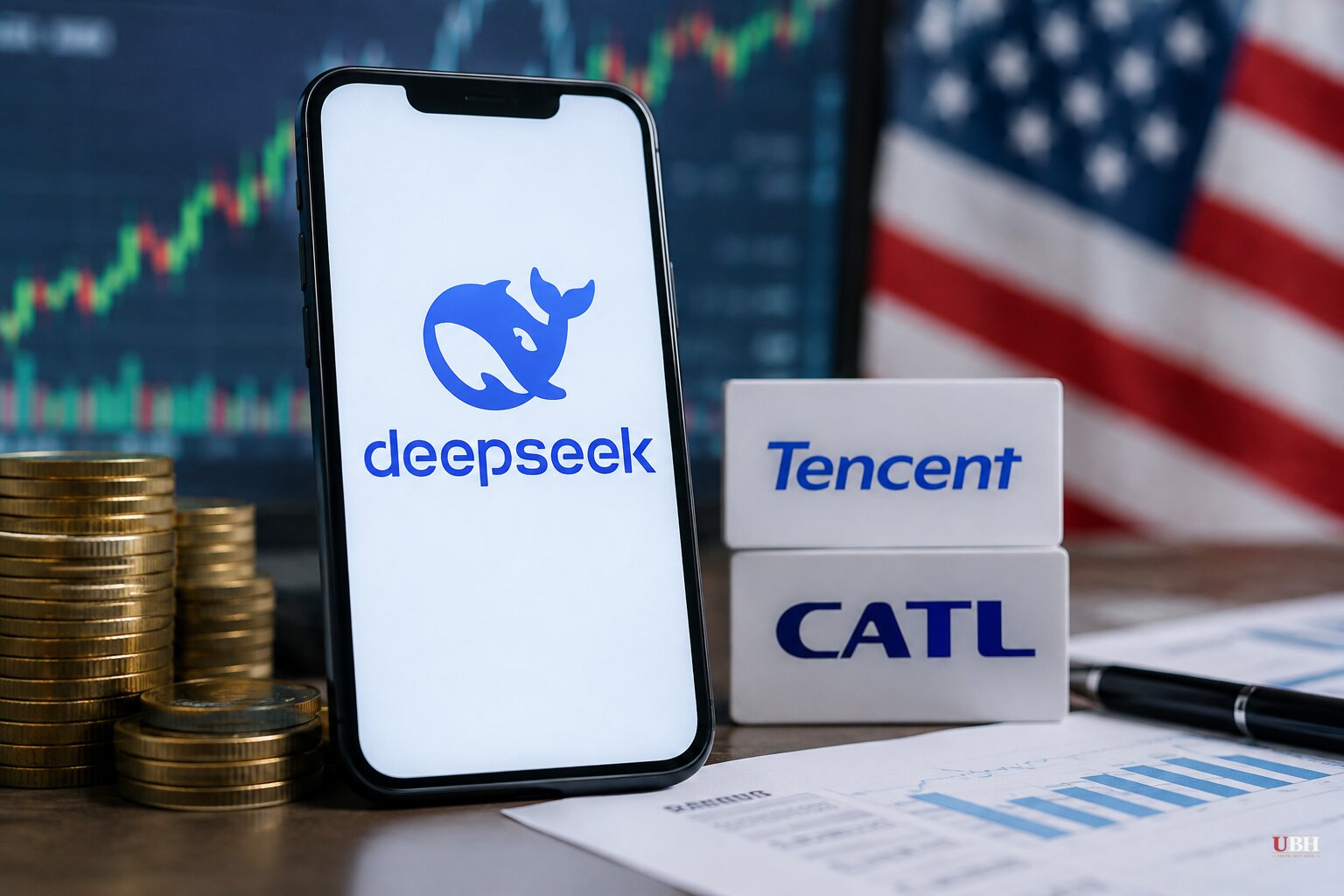
DeepSeek, the Hangzhou-based AI lab, has raised about 100 billion yuan, roughly $15 billion, in one of the largest funding rounds in Chinese history, according to Bloomberg. Battery maker Contemporary Amperex Technology (CATL) and WeChat operator Tencent were among the biggest investors, Bloomberg reported on Thursday, Oct. 22.
DeepSeek had not responded to requests for comment as of this writing.
The timing is notable. The Department of Homeland Security published its order against DeepSeek in the Federal Register on Tuesday, Oct. 20.
A target that kept growing
Bloomberg reports DeepSeek raised its financing goal at least twice during talks with investors, from 50 billion yuan to 80 billion yuan, before landing at 100 billion yuan. That is roughly double the initial target of about $7.4 billion.
This is not DeepSeek's first big check. It closed a first outside round of about $7 billion earlier this year at a valuation reported at roughly $50 billion. Reports in July and September put its valuation near $71 billion ahead of this latest raise.
It was also reported that a second round stalled for a time after comments attributed to founder Liang Wenfeng about the U.S.-China AI rivalry went viral.
Investors are expecting a payoff. DeepSeek has reportedly been preparing for a Chinese public listing as early as next year. Liang still holds an estimated 81.6% of the Chinese operating entity after the earlier round, according to ownership data analyzed by WireScreen.
The Chinese AI field is crowded with cash. Moonshot AI, maker of Kimi, secured $2 billion at a $20 billion valuation in May. Manus AI raised more than $500 million earlier this month. Zhipu AI and MiniMax, both listed in Hong Kong since January, carry market capitalizations of roughly $29 billion and $7.2 billion.
What the U.S. order actually does
Homeland Security Secretary Markwayne Mullin signed the order under the Federal Acquisition Supply Chain Security Act of 2018. It requires federal civilian agencies to remove DeepSeek products from their systems and bars new purchases from DeepSeek or its affiliates. It also covers third-party products or services "developed using DeepSeek implementations."
The notice does not define that phrase.
The order names Hangzhou DeepSeek Artificial Intelligence Co., Ltd., developer of the R1 and V3 models. DeepSeek's own privacy policy says it collects, processes and stores users' personal data in the People's Republic of China.
DHS has said "multiple threat vectors" could "result in the transfer of sensitive data to [China] if used by US government employees or vendors."
The scope is narrow. The order covers only what civilian agencies buy and run. It does not restrict private companies or the public. The Defense Department and intelligence community have their own separate authorities under the same law.
Contractors face direct exposure. A federal contract carrying FAR clause 52.204-30 bars the contractor from providing or using any product covered by a FASCSA order, unless the issuing official grants a waiver. An order issued after a solicitation applies to an existing contract only once the contracting officer adds it by amendment or modification.
Agencies can ask for an exception. Under the Federal Acquisition Security Council's regulations, the request must be in writing and give a compelling justification.
An 87-day gap
The order is dated July 24. DHS filed it for public inspection on Oct. 19, 87 days later, and it was published the next day. The council's rules leave public release to the issuing official.
An order signed in July cannot be a reaction to an October fundraise, and no source has tied the funding to the ban. DeepSeek's talks with investors ran for months, and the order stayed out of public view for most of that time.
What the sequence does show is that a federal procurement ban, whatever its security merits, has not slowed the flow of capital to the company.
Beijing pushes back
Chinese Foreign Ministry spokesperson Mao Ning said China "will resolutely safeguard the legitimate rights and interests" of its companies. "China consistently opposes the overstretching of the concept of national security," she said.
That is Beijing's position: that Washington is stretching a security rationale to hobble a commercial competitor. Washington's position, in DHS's words, is that DeepSeek's data handling creates a pathway for sensitive government data to reach China.
DeepSeek rattled U.S. markets in January 2025 when R1 launched. Its performance reportedly approached leading American chatbots, though the company claimed it had built the model at a fraction of the cost. Venture capitalist Marc Andreessen called it a "Sputnik moment." The company's data security, censorship and access to advanced chips have drawn scrutiny since.
What comes next
For federal contractors, the main unresolved issue is the undefined phrase "developed using DeepSeek implementations." Until DHS or the Federal Acquisition Security Council clarifies it, vendors that build on DeepSeek's open models cannot easily tell whether their products are covered. DHS directs questions to CISA's FASCSA Order Implementation Team.
DeepSeek, for its part, now has a war chest to spend on AI infrastructure and open models for domestic and international markets, as Bloomberg reports, while it prepares for a possible listing in China.
Sources used for this briefing
7 links from 6 independent newsrooms (syndicated copies of the same report count once)
These are the sources it draws on, linked so you can verify.


