
Unbiased headlines. Facts, not spin.
Every story is an unbiased news briefing written from 110+ sources across the spectrum — sources linked so you can verify it yourself.
 politics
Low Interest (3/10)
August 3, 2026 at 06:03 AM
politics
Low Interest (3/10)
August 3, 2026 at 06:03 AM
Michigan Poll Shows Buttigieg Leading Muddled 2028 Democratic Field at 24 Percent
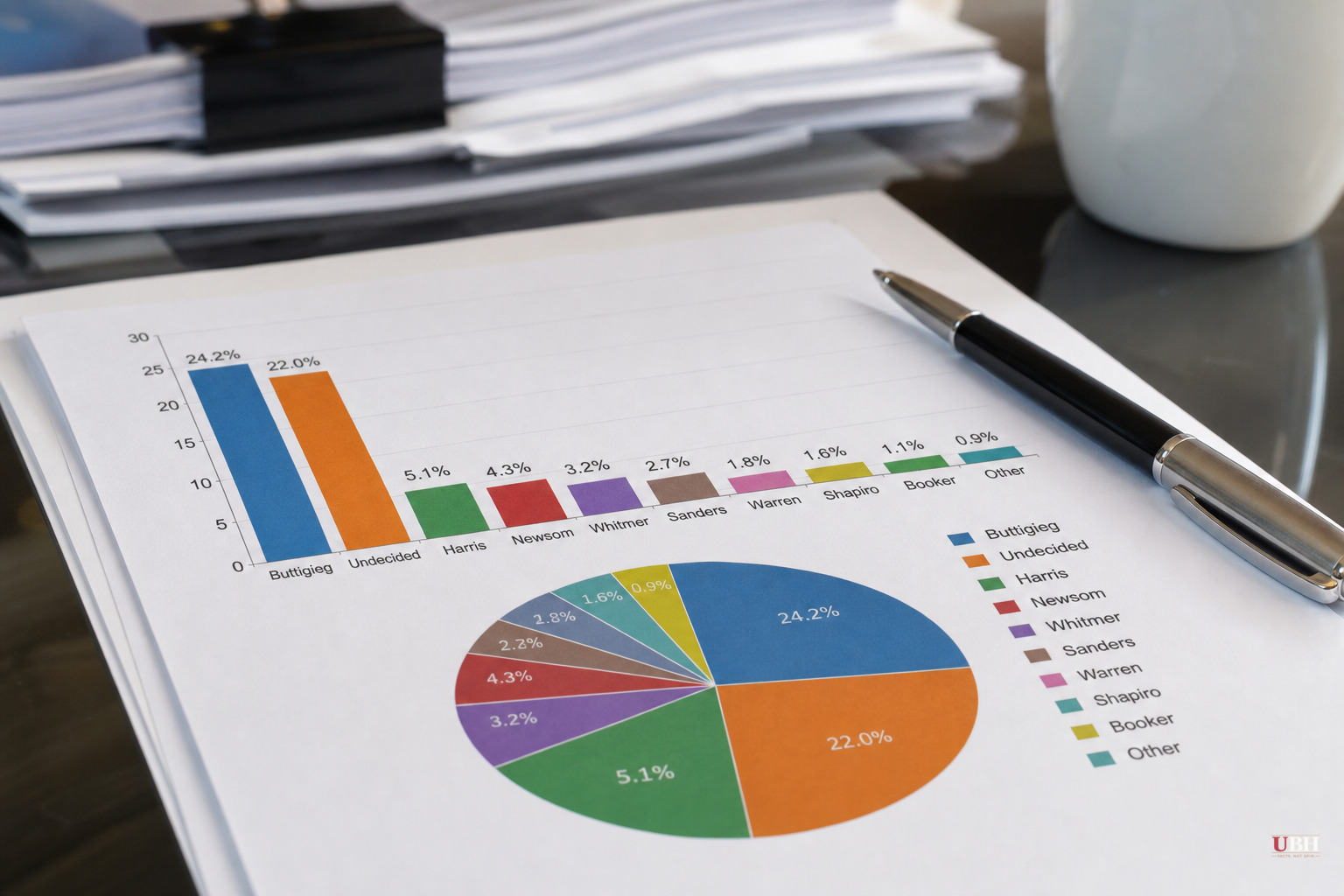
A new poll out of Michigan gives Pete Buttigieg the early edge in a Democratic Party still very much shopping for its 2028 nominee.
The Public Sentiment Institute surveyed 762 likely voters in Michigan between July 25 and July 29 and asked a simple hypothetical: if the 2028 Democratic primary were held today, who would you vote for? Buttigieg, the former transportation secretary, topped the list at 24.2 percent, according to TPSI. The poll carries a margin of error of plus or minus 4 percentage points at 95 percent confidence, Newsweek reported.
Georgia Senator Jon Ossoff came in second at 13.9 percent. Representative Alexandria Ocasio-Cortez followed at 10.7 percent, with California Governor Gavin Newsom close behind at 10.0 percent. Former Vice President Kamala Harris registered just 5.1 percent, trailing Illinois Governor JB Pritzker at 3.8 percent and Pennsylvania Governor Josh Shapiro at 3.6 percent, per Newsweek's reporting.
The number that deserves as much attention as Buttigieg's lead is the 21.7 percent who said they're undecided. That's a bigger share than every named candidate except Buttigieg himself. TPSI's own writeup made a point of not distributing those undecided voters onto the candidate list, arguing that doing so more than two years before the election "would be a fabrication dressed up as precision."
A poll asking about a primary that's still two-plus years away is measuring name recognition and vague favorability at least as much as it's measuring real voting intent. Buttigieg has been a national figure since his 2020 presidential run and his tenure as transportation secretary under President Biden. Ossoff and Ocasio-Cortez have high media profiles. Harris just lost a presidential election to Donald Trump in November 2024, which likely explains her soft number here, but nearly two years of distance from that loss and a still-large undecided bloc means this race is nowhere near settled.
Harris herself hasn't ruled out another run. Asked directly by Reverend Al Sharpton in April at the National Action Network's annual convention whether she'd run in 2028, Harris said, "I might. I am thinking about it." She's reportedly been in contact with progressive activists, pro-Palestinian organizers, and former aides as she weighs another campaign, according to Breitbart News.
Prediction markets tell a different story than the Michigan poll. Polls and betting markets measure different things. As of Saturday morning on Polymarket, Newsom led with a 19 percent chance of winning the nomination, followed by Ocasio-Cortez and Ossoff at 14 percent each, Harris at 9 percent, and Buttigieg and Shapiro tied at 5 percent. Kalshi showed a similar order: Newsom at 18 percent, Ossoff at 15 percent, Ocasio-Cortez at 13 percent, Harris at 9.3 percent, and Buttigieg at 5.5 percent. Newsweek noted these markets reflect trader expectations and speculation, not actual voter sentiment, and shouldn't be read as polling.
The same TPSI survey asked Michigan Democratic primary voters about campaign contributions from political action committees supporting Israel. The results were lopsided: 41 percent said accepting such money would make them "much less likely" to support a Senate candidate, and 14.8 percent said "somewhat less likely." Only 4.8 percent said "much more likely" and 2.7 percent said "somewhat more likely," while 36.7 percent said it made no difference. That's a roughly 55.8 percent to 7.5 percent split against, according to TPSI's own breakdown.
That finding lines up with public comments from Senator John Fetterman of Pennsylvania, who said in July that Democratic support for Israel would keep eroding. "It won't stop. In fact, if anything, it's going to accelerate," Fetterman said, according to Breitbart News, pointing to which candidates have been winning in the party recently.
On the Republican side, Trump commented in June on a possible 2028 ticket pairing Vice President JD Vance with Secretary of State Marco Rubio. "I think the two of them running together as a team would be very unbeatable," Trump said, according to Breitbart News. No formal Republican primary polling of comparable detail was included in this survey.
The 2028 primary calendar hasn't been set, no candidate has formally announced, and a poll taken from one state two-plus years out is a snapshot of name recognition more than a forecast. The next marker to watch is whether Harris makes a formal decision about running, and whether Buttigieg's early lead in early state-level polling translates into actual campaign infrastructure once the field starts to take real shape.
Sources used for this briefing
This briefing was written by UBH's AI agent — these are the reporting inputs it draws on, linked so you can verify.


