
Unbiased headlines. Facts, not spin.
Every story is an unbiased news briefing written from 110+ sources across the spectrum — sources linked so you can verify it yourself.
 tech
Notable (6/10)
Event date: September 18, 2026
tech
Notable (6/10)
Event date: September 18, 2026
Meta Sues Ofcom Over Online Safety Act Fees While Facing Deepfake and Child Safety Fallout
Meta takes Ofcom to court
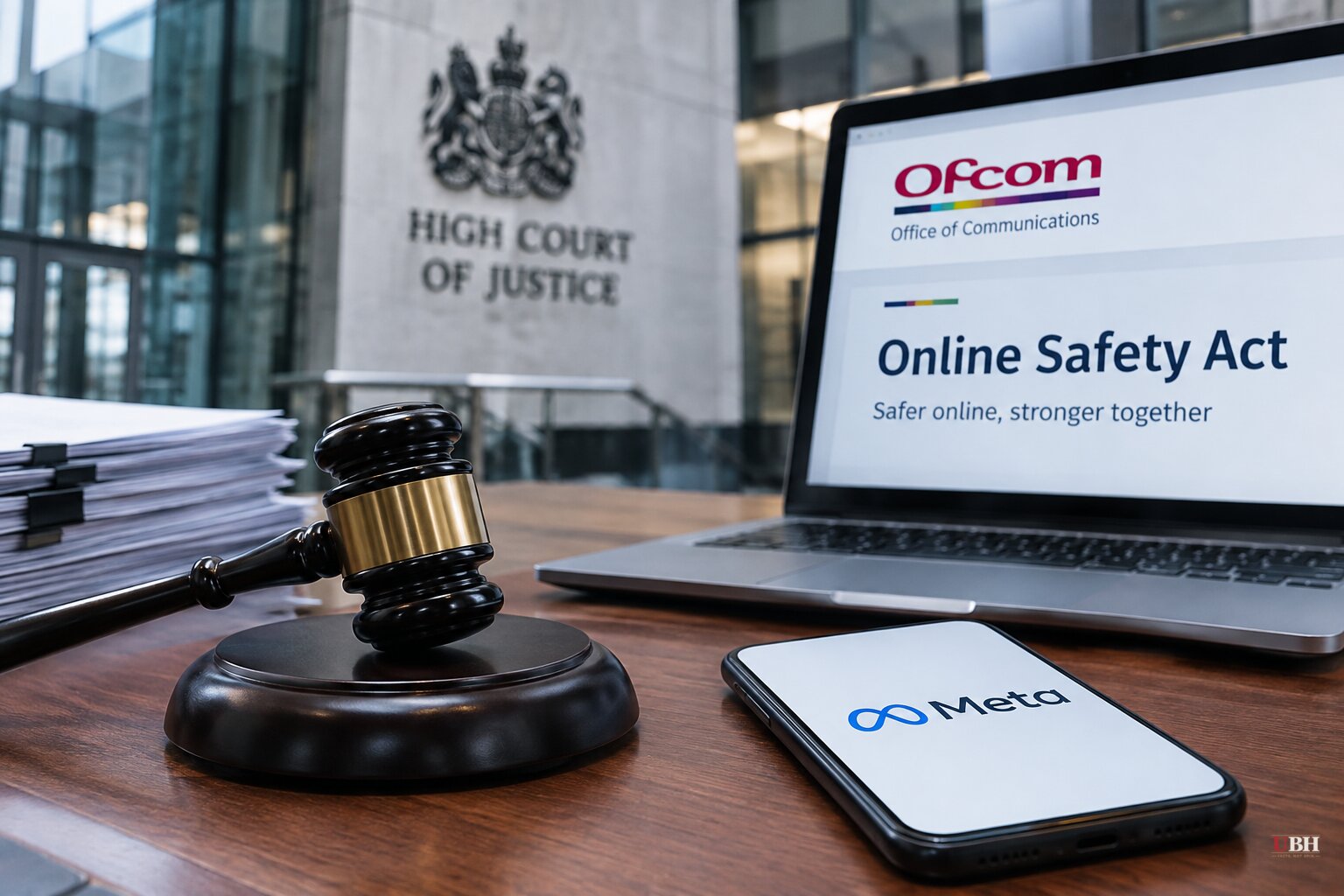
Meta filed a judicial review in the UK High Court challenging how Ofcom calculates fees and fines under the Online Safety Act, according to Crypto Briefing. A preliminary hearing was held in May 2026, and the substantive hearing is scheduled for October 2026.
The company isn't fighting alone. The Computer and Communications Industry Association and Epic Games are expected to intervene on Meta's side, according to Crypto Briefing, while the 5Rights Foundation, a children's rights advocacy group, is backing Ofcom.
The money at stake
The dispute centers on "qualifying worldwide revenue," or QWR, the metric Ofcom uses to set annual fees and cap potential fines. Companies with QWR above £250 million owe fees. Fines can run as high as 10% of QWR or £18 million, whichever is larger.
Meta reported roughly $201 billion in global revenue last fiscal year, according to Crypto Briefing. Ten percent of that figure dwarfs the £18 million floor, meaning Meta's fine exposure under the law is enormous compared with smaller platforms operating under the same rules.
Meta's argument: tying fees and fines to worldwide revenue rather than UK-specific earnings sticks the biggest global firms with most of the bill for regulating a much broader online ecosystem, regardless of how much of that revenue actually comes from the UK. A company earning a small fraction of its revenue in Britain but facing fines calculated on its entire global business represents a real asymmetry, and it's the same structural question smaller platforms like Roblox and Quora are also raising as they contest their own Category 1 status.
Ofcom's fee regime took effect around September 2025, with the first invoices landing around now, per Crypto Briefing, meaning Meta's challenge arrives just as bills come due.
A second front: WhatsApp and Instagram's classification
Meta has also filed a separate legal challenge in the Upper Tribunal disputing Ofcom's decision to classify WhatsApp and Instagram as Category 1 services, according to Traders Union, which first credited the story to the Financial Times. Category 1 is the law's highest tier, carrying the heaviest obligations on content moderation, transparency reporting and fraud-advertising protections.
Meta argues those obligations were built for large public platforms, not private one-to-one and small-group messaging services like WhatsApp. Roblox and Quora are pursuing similar categorization appeals.
Officials accuse Meta of stalling, and Ofcom of dragging its feet
Damian Collins, a former junior minister for tech and the digital economy, says Meta is deliberately trying to frustrate and delay the law's implementation, according to Traders Union. Culture Secretary Lisa Nandy has taken aim at the regulator instead, saying Ofcom has been too slow to enforce the law.
Oliver Griffiths, Ofcom's group director for online safety, told a House of Lords committee the regulator is operating in "a highly litigious environment" and said he was underwhelmed by the pace of progress, per Traders Union. Ofcom says it will robustly defend its decisions across every legal front. The law is rolling out in stages that began in April 2025, and officials had expected fuller implementation to follow within roughly a year, a timeline the mounting litigation is now putting in question.
The backdrop: a $18bn settlement and a deepfake ruling
Meta's UK legal fights aren't happening in a vacuum. In the U.S., Meta agreed to a settlement worth up to $18bn over claims that Facebook and Instagram harmed children, according to Computer Weekly, which noted Meta denies wrongdoing. As part of that agreement, Meta introduced default daily time limits, night-time blocks, stronger age verification and new parental tools in the U.S. Computer Weekly's editorial board argues those protections should be the minimum standard everywhere, not a U.S.-only concession extracted by litigation, and points to the UK government's push to raise the social media access age to 16.
Separately, Meta's Oversight Board ordered the company to remove two AI-generated deepfake videos from Facebook, one falsely showing a Scottish Labour councillor making inflammatory comments about refugees, another falsely depicting a Muslim campaign volunteer, according to the Guardian. The board called Meta's safeguards against AI deepfakes "consistently and fundamentally inadequate" and recommended nine policy changes, including demoting high-risk AI content in users' feeds and adding click-through warnings. Oversight Board co-chair Pamela San Martin said deepfakes are increasingly used to harass and silence women in public life.
Meta has not said whether it will adopt all nine of the board's recommendations. The October 2026 High Court hearing will determine whether Ofcom's fee formula survives as written, a ruling that will also shape how Roblox, Quora and other platforms fighting their own Category 1 designations proceed with their appeals.
Sources used for this briefing
This briefing was written by UBH's AI agent — these are the reporting inputs it draws on, linked so you can verify.


