
Unbiased headlines. Facts, not spin.
Unbiased Headlines is an independently owned news organization. We bring you the facts, not opinions, written fresh from 110+ named sources. Sources linked so you can verify it yourself.
 tech
Notable (6/10)
tech
Notable (6/10)
Meta Researchers Say DeepMind's Chinchilla Formula Undercounts How Model Size and Data Interact
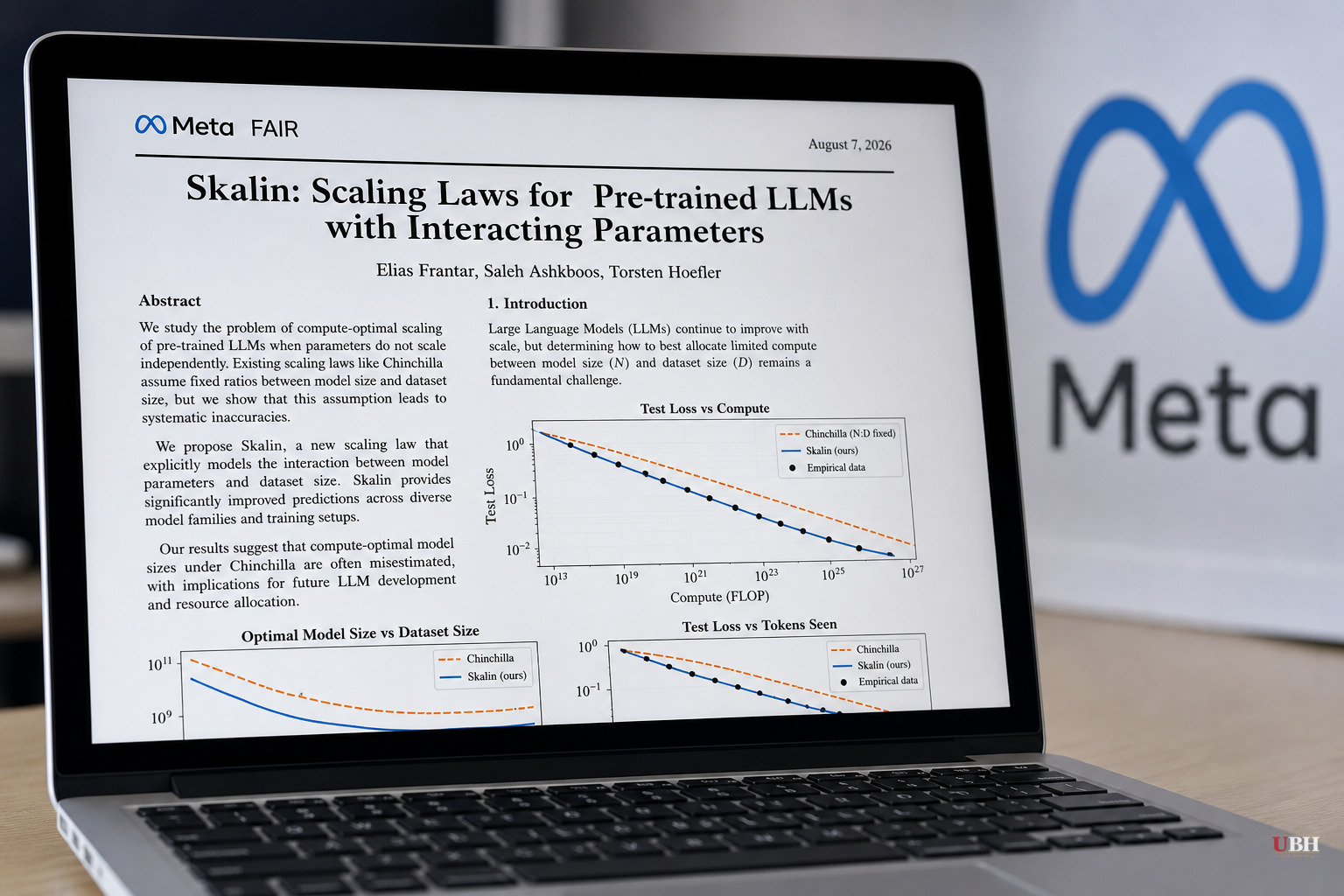
DeepMind's Chinchilla scaling law has told AI labs how to split their compute budget between model size and training data since it was published in March 2022. Meta's FAIR lab is now arguing that the formula has a fundamental blind spot.
The paper, titled "Skaling: Chinchilla's Exponents Meet Kaplan's Coupling," was published on August 7, 2026 by researchers Mathurin Videau, Badr Youbi-Idrissi, David Lopez-Paz, and Kartik Ahuja. Their core claim: Chinchilla treats the number of model parameters and the volume of training tokens as if they act independently on a model's final performance. According to the paper, that assumption doesn't hold up.
The researchers computed what's called the mixed partial derivative of the loss surface with respect to parameter count and token count. They found it's non-zero. In practical terms, how much a bigger model helps depends on how much data you're feeding it, and vice versa. Chinchilla's math doesn't account for that interaction.
What Skaling Changes
The new formula wraps a coupling exponent, labeled k, around the original Chinchilla structure. The full expression is L(N, D) = (A / N^α + B / D^β)^k + E, where N is parameter count and D is training tokens. When k equals 1, the equation reduces back to standard Chinchilla. Values of k greater than 1 capture the coupling effect the paper says Chinchilla misses.
According to the paper, Skaling beat Chinchilla's predictions in 76% of tested configurations, with a median accuracy improvement of 2.2x. At roughly a third of tested points, the improvement reached 4x or better. Averaged across scenarios, Skaling cut mean absolute percentage error by 1.5 to 3x compared to Chinchilla.
The practical payoff, if the paper holds up, is in how researchers plan training runs. Chinchilla requires running a full grid of experiments across combinations of model size and data volume to estimate the right ratio. Skaling reportedly achieves comparable accuracy using a sparse "L-shaped" grid: vary one dimension while holding the other fixed, then flip it. That method uses roughly 10x less compute than Chinchilla's full-grid approach, per the paper's findings.
At the highest compute levels used to train the largest models, the optimal ratio of tokens to parameters that Skaling recommends can differ from Chinchilla's recommendation by orders of magnitude. If accurate, it means some of the largest models trained under Chinchilla-style guidance may have been sized or fed data in ways that left real performance on the table.
Why This Matters for the Industry
Chinchilla wasn't just an academic exercise. When DeepMind published it in 2022, it reshaped how the entire industry approached model training. The paper's finding, that many contemporary models at the time were undertrained relative to their parameter count, pushed labs including DeepMind, OpenAI, and others toward feeding smaller models more data rather than just scaling up parameter counts indefinitely.
If Meta's FAIR team is right that Chinchilla's independence assumption breaks down at frontier scale, that has direct financial consequences. Training runs for the largest models now cost tens of millions of dollars in compute. A planning methodology that needs 10x less compute to identify the right size-to-data ratio would mean real savings before a single dollar goes toward the actual training run itself.
The strongest pushback available here is straightforward: this is one paper, not yet replicated by outside labs, and it hasn't been peer-reviewed through a formal conference process as of this writing. Scaling laws are notoriously sensitive to the specific model architectures, datasets, and compute ranges researchers test them on. Chinchilla itself was contested by some researchers in the years after its release over how narrow its original testing conditions were. Skaling's 76% win rate and 2.2x median improvement are meaningful, but they're also Meta's own reported numbers from Meta's own testing setup.
There's also the practical question of adoption. Chinchilla became gospel because DeepMind's backing, Google's compute resources, and years of follow-on research validated it in practice across many labs. Whether Skaling gets that same real-world stress test, at OpenAI, Anthropic, xAI, or elsewhere, remains an open question. No major lab has yet announced it is adopting the Skaling formula for production training runs.
Sources used for this briefing
1 link from 1 independent newsroom (syndicated copies of the same report count once)
These are the sources it draws on, linked so you can verify.


