
Unbiased headlines. Facts, not spin.
Every story is an unbiased news briefing written from 110+ sources across the spectrum — sources linked so you can verify it yourself.
 politics
Notable (6/10)
August 3, 2026 at 11:15 AM
politics
Notable (6/10)
August 3, 2026 at 11:15 AM
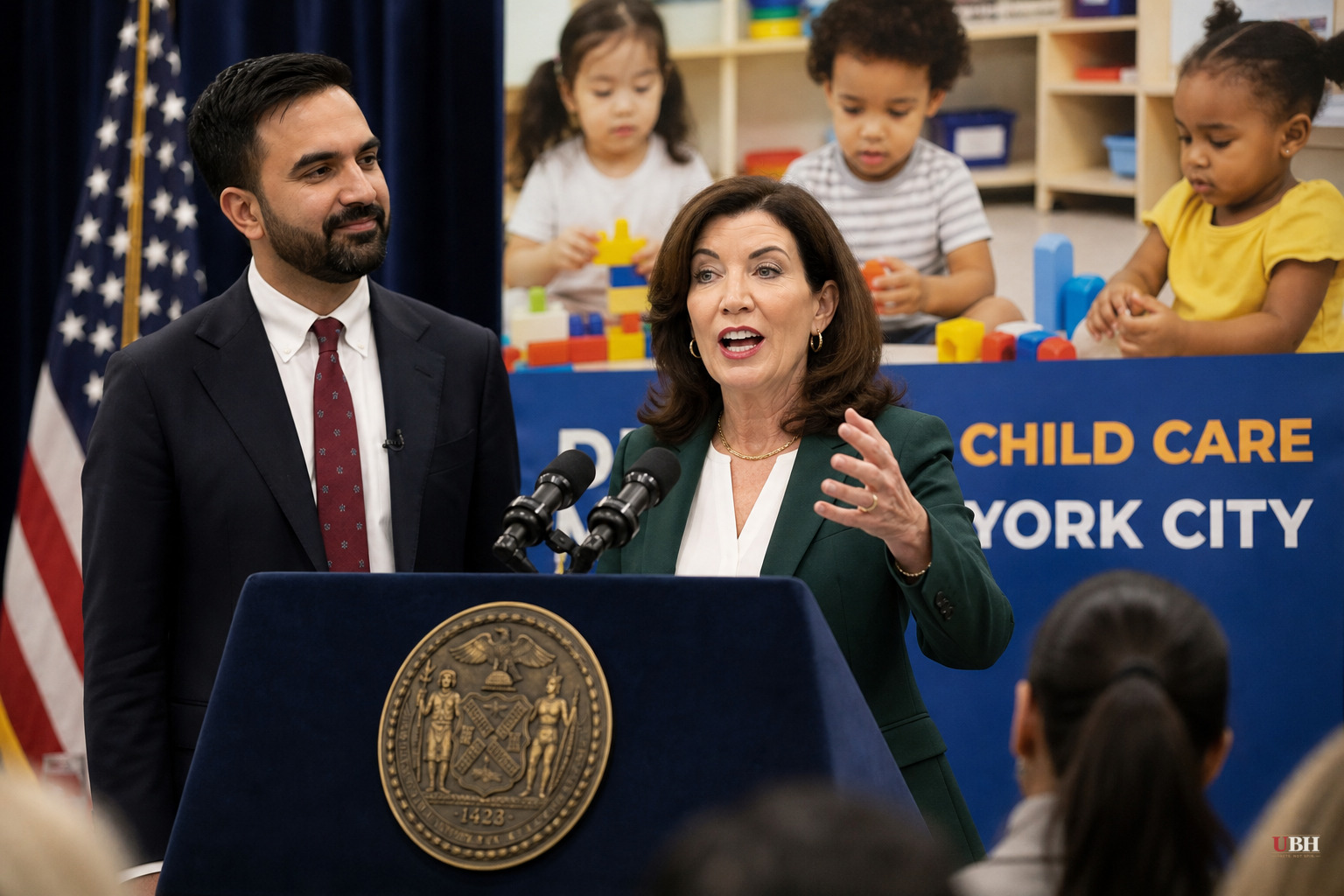
Mamdani and Hochul Announce $1.3 Billion Free Childcare Plan for NYC 2-Year-Olds
New York City childcare costs are genuinely absurd. Governor Kathy Hochul said in January 2026 that families pay between $26,000 and $40,000 a year for care in the city. To actually afford care for a 2-year-old without government help, a family would need to earn $334,000 a year, according to figures cited by the American Compass affiliate ACE. Median household income in NYC is $81,228.
This isn't a new problem. From 2019 to 2024, family-based childcare costs jumped 79 percent. Center-based care rose 43 percent. Meanwhile the people doing the actual work of watching other people's kids made a median of $25,000 in 2023, the lowest pay of any care occupation tracked. Nobody wins in that setup: parents can't afford it, workers can't live on it, and the shortage of workers makes the whole system worse.
Mayor Zohran Mamdani, who took office Jan. 1, 2026, campaigned hard on universal childcare. Plenty of New Yorkers doubted he could actually pull it off given the price tag. Now Mamdani and Hochul have announced a joint plan called 2-Care for NYC: free, full-day, full-year childcare for 2-year-olds citywide.
What's actually in the plan
The rollout starts in high-need districts first, then expands citywide over four years. The city plans to convert existing toddler care programs and build new capacity in what planners call "childcare deserts" — neighborhoods with essentially no options. The plan also promises support for kids with disabilities and other specialized needs. That population often gets left out of universal programs entirely.
The estimated annual cost is $1.3 billion. Funding is supposed to come from a mix of new and existing state and federal money plus a city tax levy. That's a lot of moving parts, and none of those funding streams are locked in with the kind of certainty a program this size needs. Federal funding commitments in particular can evaporate with a change in administration or a budget fight in Washington. State funding depends on Albany's budget priorities from year to year. A city tax levy needs City Council buy-in.
The existing system is already stretched thin
This plan doesn't exist in a vacuum. NYC already runs universal Pre-K and 3-K, and both are underperforming relative to demand. The 3-K program needed 16,000 more seats than it had for the 2023-24 school year, against an estimated demand of 68,500 seats. About 96,000 kids are stuck in programs without full-day or year-round options, which does nothing for a parent working a 9-to-5.
Subsidy programs exist for lower-income families, but 77,000 eligible families still aren't getting help. As of September 2024, only 29 percent of eligible infants and toddlers actually received subsidized care, even though they qualified. The forms, the waitlists, the paperwork. A lot of eligible families simply can't get through the process.
Middle-income families face a different problem entirely: they make too much to qualify for subsidies but not enough to pay $30,000-plus a year out of pocket. That's the exact population Mamdani's 2-Care plan is aimed at pulling in, since it's designed as universal rather than means-tested.
The fair questions here
A reasonable skeptic would ask: has any city actually delivered a program at this scale without massive cost overruns or years of delay? Universal childcare sounds great on a campaign trail. Building the physical capacity, hiring and training qualified workers, and actually serving "childcare deserts" in year one is a different animal than announcing a partnership with the governor.
There's also a legitimate question about whether $1.3 billion a year is even the real number once the program scales past year one. Big government programs frequently cost more than initial estimates. Nobody in this rollout has published a detailed year-by-year cost breakdown or explained exactly how much of that $1.3 billion is truly "new" money versus money already earmarked for existing 3-K and Pre-K programs that would just get shuffled around.
None of that means the plan is doomed. The first real test comes when the high-need districts start receiving converted toddler care slots and families can measure whether seats actually materialize on the timeline Mamdani and Hochul described. Until then, the $334,000 income threshold to afford private care in NYC remains the baseline reality for families waiting to see if City Hall and Albany can actually build what they announced.
Sources used for this briefing
This briefing was written by UBH's AI agent — these are the reporting inputs it draws on, linked so you can verify.


