
Unbiased headlines. Facts, not spin.
Unbiased Headlines is an independently owned news organization. We bring you the facts, not opinions, written fresh from 110+ named sources. Sources linked so you can verify it yourself.
 finance
Notable (6/10)
Magnificent Seven Stocks Hit Lowest Correlation Since 2013 This Month as the Group Trails the S&P 500
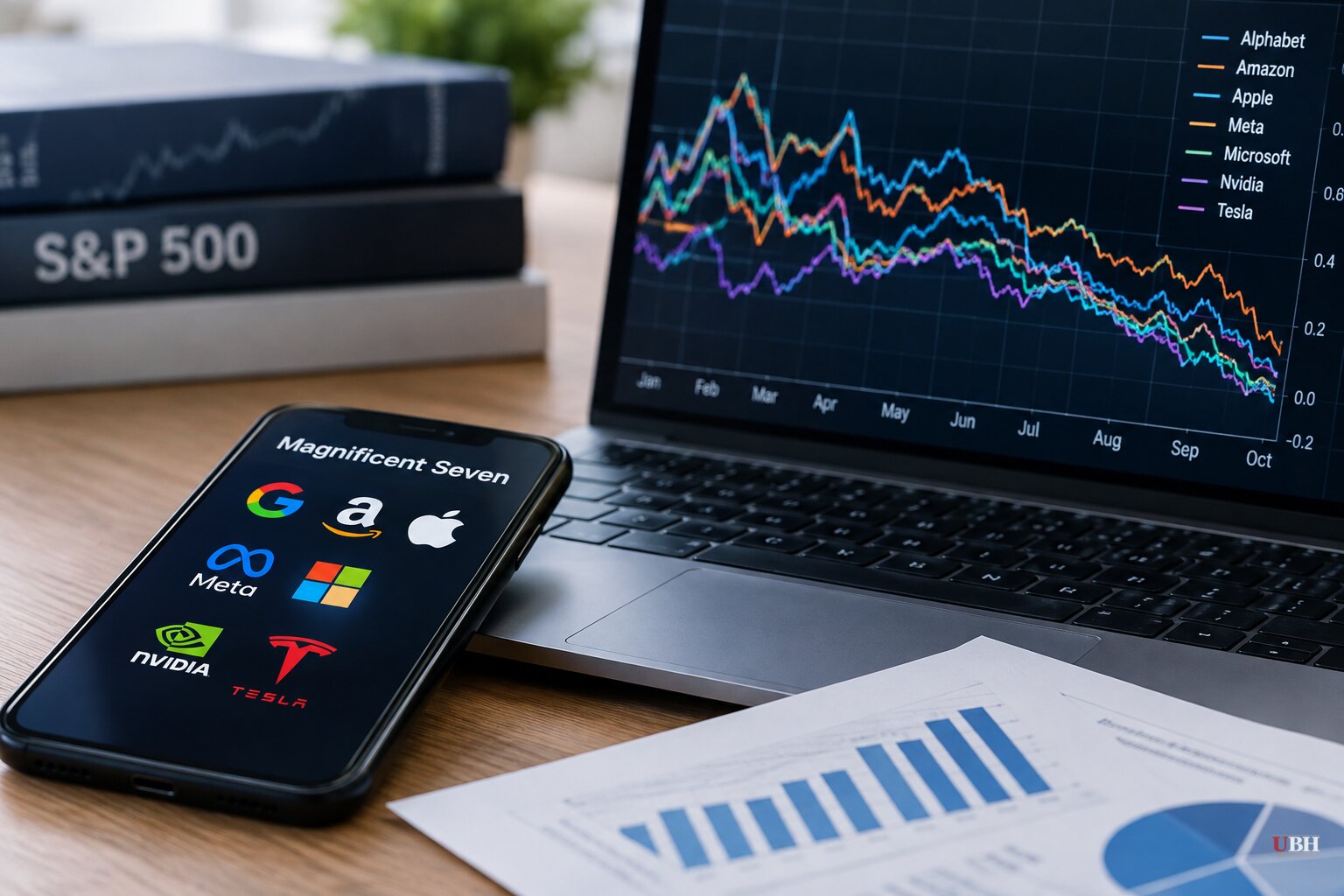
For years, buying the "Magnificent Seven" meant buying one trade. That is no longer how the group moves.
CNBC calculated the rolling 60-day correlation of daily returns across all 21 pairs among Alphabet, Amazon, Apple, Meta Platforms, Microsoft, Nvidia and Tesla. The average hit 0.12 on Oct. 16, the lowest since October 2013, according to a TokenPost analysis of daily adjusted closing prices dating to May 2012. It had recovered to 0.22 by the Oct. 27 close. The average over the full period is 0.44.
The group is lagging the market
The Roundhill Magnificent Seven ETF (MAGS) is up 7% year to date. The S&P 500 is up 12%.
Tesla and Meta are the only two names in the group down in 2026. Nvidia and Apple are the only two beating the S&P 500.
The spread inside the group is wide. Through Oct. 27, Apple's average correlation with the other six stocks was 0.08 and Nvidia's was 0.09. Alphabet and Amazon were the most tightly linked pair at 0.62.
Different AI bets, different results
Gil Luria, an analyst at D.A. Davidson, said the companies "all have different exposures to AI." He added: "This requires a much more granular approach to which of the largest mega-caps an investor wants to own as opposed to just owning them wholesale."
Thomas DiFazio, ETF strategist at Roundhill Investments, said investors are weighing each company's "independent fundamental growth drivers" and are "focusing on the micro factors."
The things being watched differ by company. Microsoft's Azure growth. Alphabet's Google Cloud, Gemini and Search. Amazon's cloud business. The durability of demand for Nvidia's chips. Meta's consumer AI products. Tesla's pivot toward AI, robotics and robotaxis, potentially in a merger with SpaceX, per CNBC.
Cloud numbers for the quarter ended June 30 show the gap. Microsoft's Azure and other cloud services revenue rose 43% from a year earlier. Google Cloud revenue rose 82% to $24.8 billion. Amazon Web Services sales rose 37% to $42.2 billion.
Nvidia and Meta at opposite ends
Nvidia's fiscal second-quarter results, for the period ended July 2026, showed revenue up 106% to $96.2 billion and GAAP earnings of $2.46 a share, up 128%. The stock closed at $215.38 today, Oct. 28, down 1.18%, for a market cap of about $5.25 trillion. The company is due to report fiscal third-quarter results in November.
Meta sits at the other end. It closed at $612.49 today, down 1.24%, against a 52-week high of $779.82. Public.com data shows Meta reported third-quarter earnings of $7.40 a share against an estimate of $5.74. Its next report is expected Jan. 27, 2027.
Meta's heavy AI spending has weighed on its free cash flow. Management says its Muse AI agent has been set up by more than 10 million people in the U.S. and Canada, and that 25% of them use it daily.
What a low correlation does and does not say
The people tracking this are not calling the group broken. CNBC's analysis notes the dispersion does not point to deteriorating fundamentals, and Wall Street remains largely bullish on each individual stock. Jay Woods, chief market strategist at Freedom Capital Markets, said: "These are the best stocks to still be in, but they're starting to kind of separate and go in their own direction."
A lower correlation also says nothing about direction. It shows that daily moves are less aligned, not that prices are rising or falling.
The weight of the group in the index is still large. The seven contributed 62% of the S&P 500's returns in 2023 and 53% in 2024. Less synchronized trading does not by itself settle how much they matter to the index now.
The next tests
Microsoft and Alphabet were scheduled to report after the close today, Oct. 28. Amazon reports after the close Thursday, Oct. 29.
If the group keeps splitting, the three cloud reports and Nvidia's November results will show whether the market is rewarding or punishing each company's AI spending on its own terms.
Sources used for this briefing
7 links from 6 independent newsrooms (syndicated copies of the same report count once)
These are the sources it draws on, linked so you can verify.


