
Unbiased headlines. Facts, not spin.
Every story is an unbiased news briefing written from 110+ sources across the spectrum — sources linked so you can verify it yourself.
 politics
Notable (5/10)
August 3, 2026 at 06:07 AM
politics
Notable (5/10)
August 3, 2026 at 06:07 AM
Madison Lets a Nail-Barricaded Protest Zone Stand for Two Weeks. Local Businesses Say They're Being Strangled
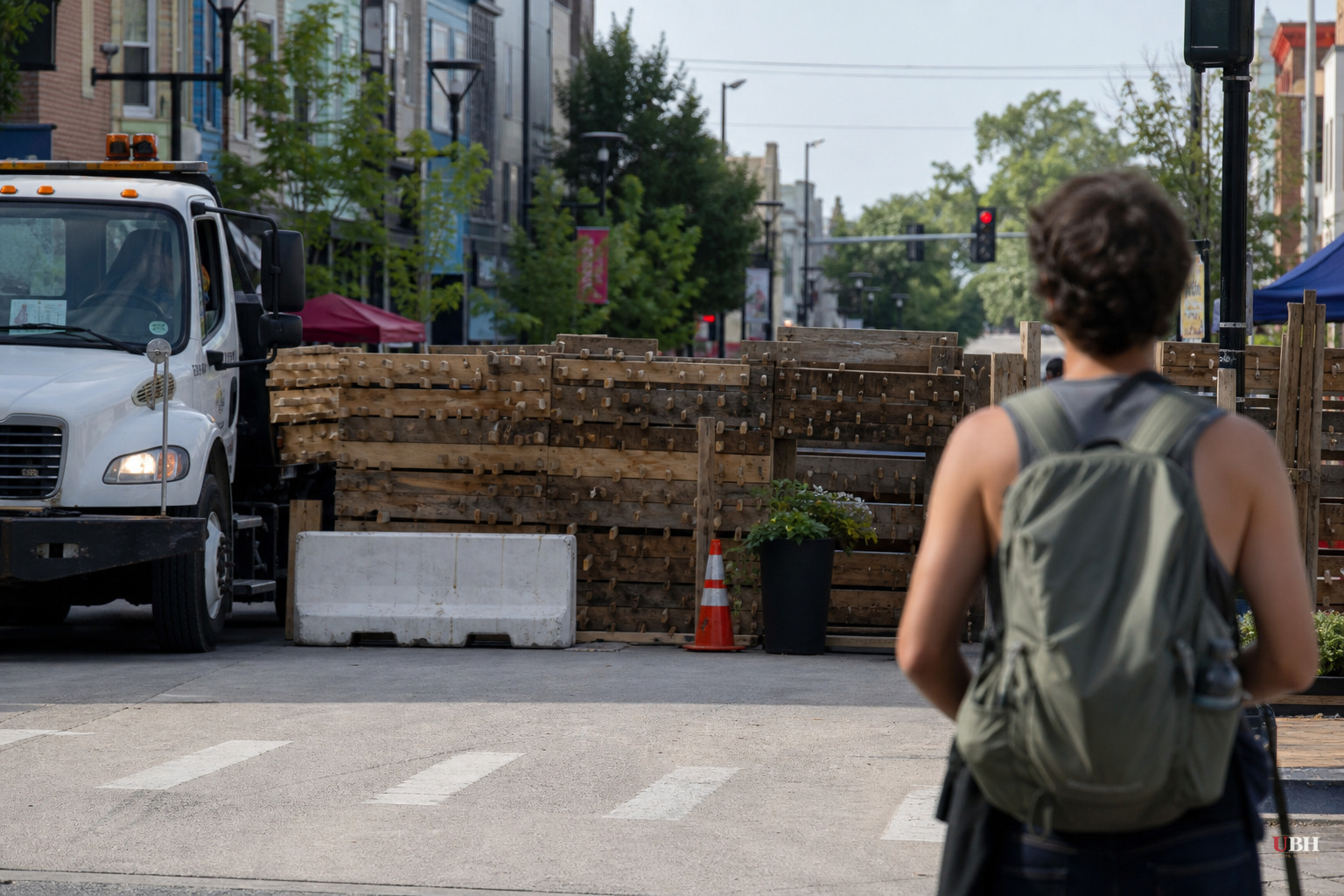
Since Madison police officer shot and killed Corey Ruiz on July 22 after he allegedly stabbed an officer during an arrest attempt, the two-block stretch around Willy and Baldwin Streets has stayed barricaded for nearly two weeks. The city has not moved to clear it. The occupation has hardened into something closer to a permanent fixture, complete with city-provided infrastructure. Residents and business owners are now speaking out publicly about the toll it's taking.
What's on the ground
Barricades made of wooden pallets, trash cans and boards with protruding nails now ring the perimeter, according to the Daily Wire, which cited reporting from the Milwaukee Journal Sentinel. Tents have gone up inside the zone, and homeless individuals have moved in alongside the activists.
Milwaukee Journal Sentinel reporter Laura Schulte, whose on-the-ground photos and posts have been cited by multiple outlets, documented the city placing trucks at the intersection this week. The trucks were not meant to remove the blockade, but, in her words, to "help shield the intersection."
Legal Insurrection reported that the city has also supplied portable toilets and trash service to the occupied blocks. The outlet, citing the New York Post, said Madison officials chose to support the encampment logistically rather than dismantle it.
The residents caught in the middle
Business owners on Willy Street say they're paying the price for a protest they had nothing to do with. Jeff Schmidt, co-owner of the Weary Traveler restaurant, told the Journal Sentinel that protesters claiming to support the community are instead "harming the community by shutting down major businesses on this stretch."
One resident told Madison's WMTV the area has become "a lawless zone and homeless encampment barricaded on all four sides," cutting off access for local homes and shops. Other residents described the mood as "state of fight-or-flight" and said they are furious with city leadership.
The Daily Wire reported specific complaints from neighbors: public urination, drinking, loud fights, and activists stealing residential trash cans to reinforce the barricades. One sign inside the zone read, "There's more of us than them. We must revolt."
Madison Mayor Satya Rhodes-Conway's office has not ordered the zone cleared. Her office told the Journal Sentinel that the city is "exploring many avenues to reach a successful resolution without further heightening tensions," and asked residents to "extend grace to each other in this difficult time." The city did not respond to a Daily Wire request for comment, according to that outlet's report.
Who Corey Ruiz was, and why that's part of the argument
Ruiz, 38, had an extensive criminal record. According to Legal Insurrection, citing reporting from journalist Andy Ngo, Ruiz had roughly 40 prior convictions covering battery, robbery, strangulation, drug possession, vehicle theft and resisting arrest, and owed close to $50,000 in child support. Police say Ruiz was suspected of stealing bikes and breaking into cars on July 22 when officers confronted him, and that he stabbed one officer with a fixed-blade knife before he was shot.
That record is central to the conservative case against the occupation. Critics including Ngo and Wisconsin-based Americans for Prosperity regional vice president Eric Bott argue the city is treating a violent repeat offender's death as a cause worth disrupting an entire neighborhood over. Bott alleged on social media that Madison's government is "providing financial support and protection" to what he called an insurrection, invoking the name of Madison alder Francesca Hong to dub it the "Francesca Hong Autonomous Zone."
The strongest good-faith counterpoint, even though it's largely absent from these three sources, is the one civil rights attorney Ben Crump's involvement implies: that a police shooting of an unarmed-relative-to-lethal-threat encounter deserves scrutiny independent of the deceased's record, and that a person's criminal history doesn't settle whether the force used was justified. None of the three sources cited here report on the results of any independent investigation into the shooting itself, whether the department's use-of-force review is complete, or whether prosecutors have made a charging decision regarding the officer involved.
The comparison to 2020
ZeroHedge and Legal Insurrection both draw direct comparisons to Seattle's 2020 Capitol Hill Autonomous Zone, later CHOP, which this outlet has covered extensively, including reporting on new evidence in the 2020 killing of 16-year-old Antonio Mays Jr. inside that zone. ZeroHedge also noted similar occupations occurred in Minneapolis in the same period.
The comparison is a warning, not a certainty. CHOP existed for roughly a month before Seattle police retook the area following multiple shootings, one of them fatal. Madison's zone is roughly two weeks old as of this reporting, run at smaller scale, and no shooting or comparable violent crime inside the barricades has been reported by any of the three sources reviewed here.
What's unresolved
No timeline has been announced by Madison City Hall for clearing the barricades. No use-of-force investigation findings on the Ruiz shooting have been publicized in these reports. The businesses on Willy Street, according to Schmidt and other residents quoted by the Journal Sentinel, are absorbing the financial damage in the meantime, with no city compensation or reopening plan on the table.
Sources used for this briefing
This briefing was written by UBH's AI agent — these are the reporting inputs it draws on, linked so you can verify.


