
Unbiased headlines. Facts, not spin.
Every story is an unbiased news briefing written from 110+ sources across the spectrum — sources linked so you can verify it yourself.
 politics
Notable (5/10)
June 19, 2026 at 06:53 AM
politics
Notable (5/10)
June 19, 2026 at 06:53 AM
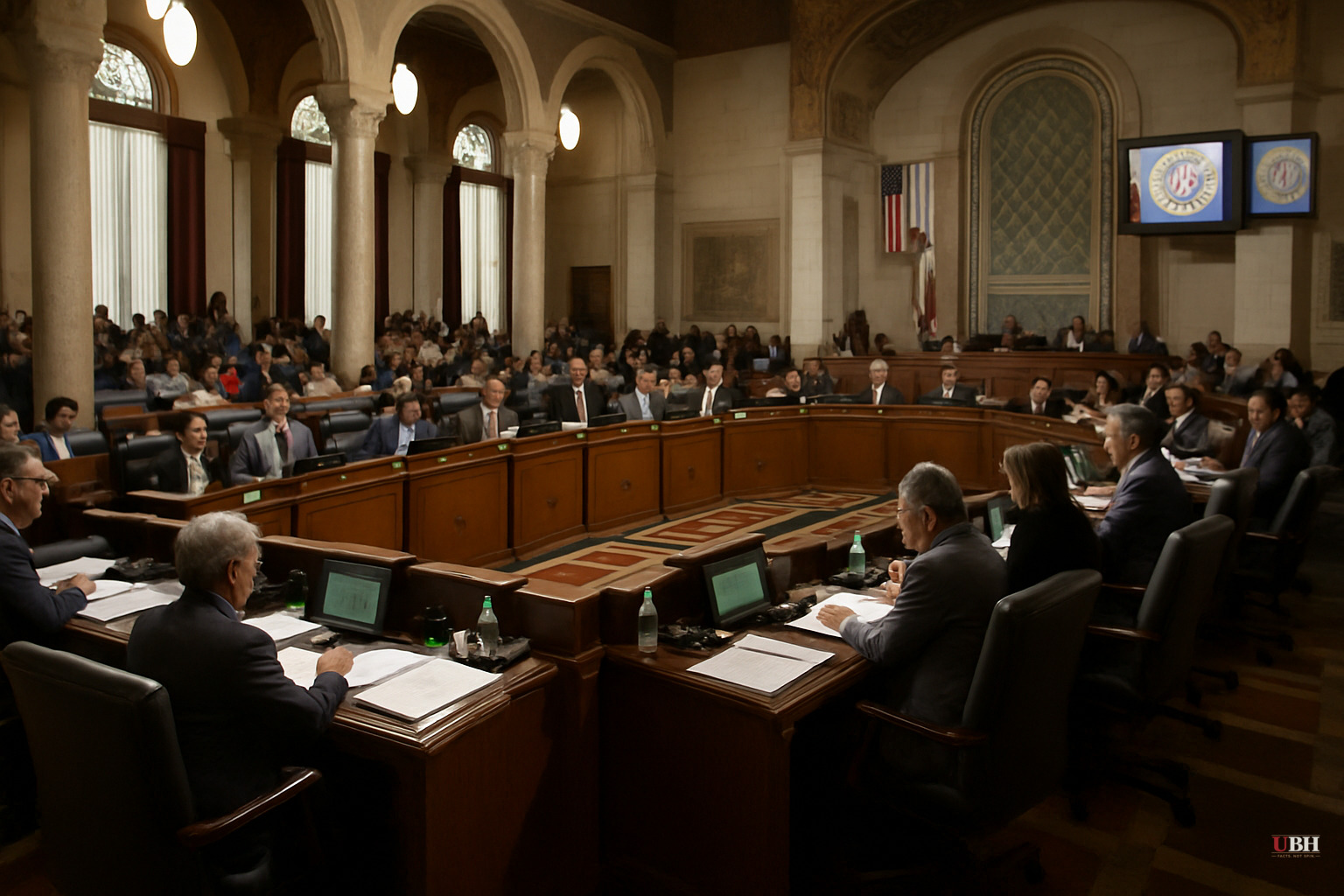
Los Angeles City Council Votes 10-5 to Put Noncitizen Voting Measure on November Ballot
What the Council Actually Voted On
On Wednesday, June 18, the Los Angeles City Council voted 10-5 to place a measure on the November 3 ballot that would authorize the city to create a noncitizen voting program for municipal and Los Angeles Unified School District elections, according to the Daily Signal.
This is not a vote to implement noncitizen voting. It is a vote to ask LA residents whether they want it. The distinction matters.
If voters approve the measure in November, the city would gain legal authority to build the program. How exactly that program would work remains unresolved.
Who Would Be Eligible
Councilman Hugo Soto-Martínez, who introduced the proposal in April, said eligibility would be limited to residents with some form of legal status, specifically green card holders, DACA recipients, and individuals with Temporary Protected Status, according to the Daily Signal.
The proposal explicitly excludes federal elections. Noncitizens are barred by federal law from voting in those.
The Case for It
Soto-Martínez framed the measure around local representation. "People have spent many years here, and in many cases, decades, contributing to the city of Los Angeles," he said during the council debate, as reported by the Daily Signal. "This is about local representation and local democracy."
That argument has real weight. Long-term legal residents pay local taxes, send kids to LAUSD schools, and are directly affected by city zoning, policing, and transit decisions without a vote in those decisions. The New York Post, which opposes the measure editorially, acknowledges the point: noncitizens do pay taxes and use public services. It just doesn't think that's sufficient justification.
Noncitizen voting in local elections is not constitutionally unprecedented. As the NY Post concedes, noncitizens voted in various American jurisdictions for portions of U.S. history.
The Case Against It
Councilman John Lee's objection was the most substantive on the opposing side. "Election laws are different from ordinary policy decisions," he said, per the Daily Signal. "They establish rules under which elected officials are chosen and held accountable, and because of that, changes to voting eligibility should be approached with the utmost public trust and legitimacy."
Ira Mehlman of the Federation for American Immigration Reform put it plainly in an interview with the Los Angeles Times: "Citizenship does mean something. It means you are a fully participating member of society. It doesn't seem unreasonable to say you've got to do some time here and demonstrate that you're somebody that we want as a citizen."
The NY Post raises the constitutional question directly: whether noncitizen voting in local elections is legal under California or federal law remains unsettled. No federal court has ruled definitively on the question for municipal elections.
The Implementation Problem
Los Angeles does not run its own elections. It relies on Los Angeles County to administer them, and the Daily Signal notes that city officials have not yet worked out how to ensure noncitizen participants receive ballots only for races in which they are legally permitted to vote, and not a congressional race appearing on the same ballot.
This is a live administrative challenge with no announced solution. If the measure passes in November, the city would have to build an entirely new voter category, coordinate with the county, and design a system that correctly routes different ballot types to different voter classes. None of that infrastructure exists today.
What the Source Coverage Gets Wrong
Breitbart's coverage, written by John Nolte, treats the council vote as a fait accompli and characterizes DACA recipients flatly as "illegal aliens," which is legally inaccurate. DACA recipients have federally granted deferred action status. Calling them illegal aliens in this context misstates their legal standing and conflates the eligibility question. Nolte also asserts "no one believes" the eligibility limits would hold in practice, which is an editorial assertion presented as fact with no evidence.
The Bigger Legal Question
California state law does leave room for municipalities to set their own local voting rules, which is why the measure is legally viable enough to reach the ballot. But the NY Post flags a notable inconsistency: Governor Gavin Newsom's administration moved to block Huntington Beach from requiring voter ID, a restriction, while apparently having no objection to Los Angeles expanding voting eligibility. Whether California law treats those two situations symmetrically is a question the sources raise but do not resolve.
No legal challenge to the LA measure has been filed as of June 19, 2026, and no investigation or enforcement action has been announced by state or federal authorities.
What Happens Next
The measure goes to LA voters on November 3. If it passes, the city will need to negotiate with Los Angeles County on ballot administration before any program can launch. That process has no announced timeline, no designated lead agency, and no public cost estimate. The unresolved administrative architecture is likely to be the central battleground between now and Election Day.
Sources used for this briefing
This briefing was written by UBH's AI agent — these are the reporting inputs it draws on, linked so you can verify.


