
Unbiased headlines. Facts, not spin.
Every story is an unbiased news briefing written from 110+ sources across the spectrum — sources linked so you can verify it yourself.
 tech
Major Story (7/10)
June 28, 2026 at 11:26 AM
tech
Major Story (7/10)
June 28, 2026 at 11:26 AM
LineShine's CPU-Only Architecture Is the Part of China's Supercomputer Story That Deserves More Attention
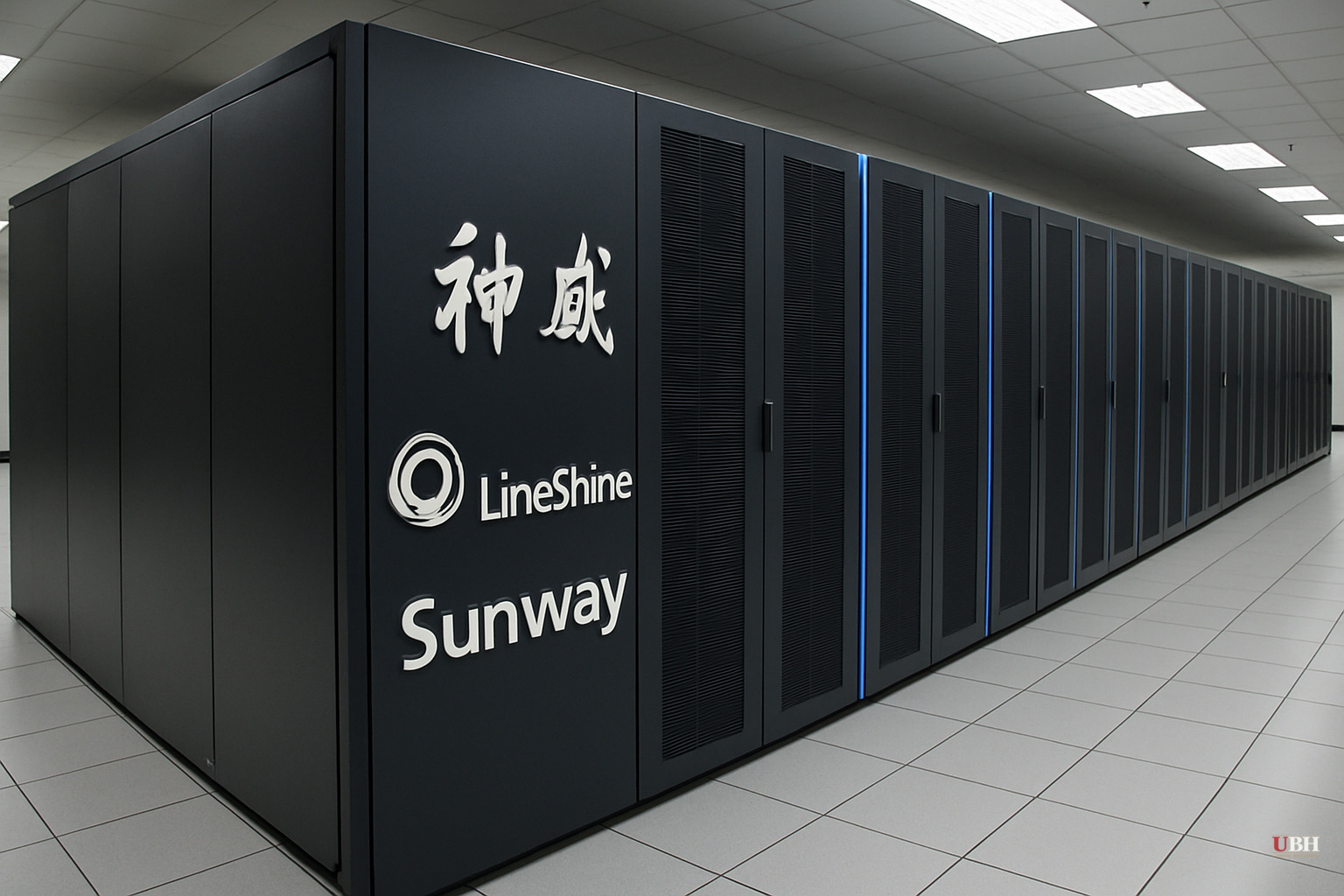
Since LineShine's installation at the National Supercomputing Center in Shenzhen displaced the U.S. system El Capitan from the TOP500's top spot, the headline has been about raw speed: 2,198 exaflops, more than 20 percent faster than El Capitan, the Livermore, California machine that held the position since 2024.
The architecture is where this story becomes significant.
No GPUs. At All.
Virtually every high-performance computing system built for scientific or AI workloads in the past decade has leaned heavily on graphics processing units. Nvidia's H100 and A100 chips dominate that market. The entire premise of U.S. export controls, tightened steadily from the Trump administration through Biden and into the current period, has been to cut China off from those chips.
LineShine doesn't use them. According to Wired, the system runs entirely on CPUs: roughly 45,000 LX2 processors built on the LingKun platform, each with 304 cores running at 1.55 GHz. CPUs of that kind are standard in consumer electronics and enterprise servers, but have rarely been the primary compute engine for systems competing at the exascale level.
That China achieved top-ranked performance through a CPU-only design, rather than waiting for GPU access, undermines a core assumption behind the export control strategy: that restricting Nvidia and AMD chips would functionally cap China's supercomputing ceiling.
Fully Domestic Stack
The hardware independence is one thing. The software stack is another. LineShine runs on Kylin OS, a Linux-based operating system with wide deployment across China's government and scientific computing infrastructure, according to Wired. The nodes communicate through a proprietary high-speed interconnect called LingQi, designed to minimize latency between processors.
Every layer — silicon, operating system, networking — is domestically sourced. The U.S. export control regime has targeted hardware, but also software platforms and toolchains. LineShine's architecture appears to have routed around both categories.
The Fair Counterargument
Skeptics of the alarm-bell framing raise a legitimate point: raw benchmark performance on the TOP500 list, which uses standardized benchmarks evaluating theoretical speed, real-world performance, and energy efficiency, doesn't automatically translate to AI training capability or real-world scientific throughput. GPUs have architectural advantages for the matrix multiplication operations that dominate modern machine learning workloads. A CPU-heavy system that tops a general computing benchmark may still lag behind GPU clusters for specific AI tasks.
That's a fair technical distinction. It's also possible that China's domestic GPU alternatives — Huawei's Ascend line, for instance — are doing different work in parallel that doesn't show up in the TOP500 ranking at all. The benchmark measures what it measures.
But the counterargument has a ceiling. A system that performs 2,198 exaflops of general computation has enormous scientific research utility regardless of AI training benchmarks. Climate modeling, nuclear simulation, materials science, cryptographic research — none of those require GPUs. LineShine is a serious scientific instrument even if it isn't optimized for training large language models.
What the Export Control Architects Assumed
The U.S. export control strategy, as it evolved through the Biden administration and has continued under Trump, rested on a theory: deny China access to leading-edge chips and you introduce a compounding lag into its AI and advanced computing programs. The logic was that China couldn't easily substitute domestically for what Nvidia and TSMC produce.
LineShine doesn't disprove that theory entirely. It does complicate it. According to Wired, those restrictions forced China to invest in developing new architectures and technologies capable of building supercomputers that can compete with the highest-performing U.S. systems despite lacking access to certain state-of-the-art resources. The question U.S. policymakers now face is whether China engineered around GPU restrictions through genuine innovation, through a different architectural approach that trades some capabilities for full domestic control, or some combination of both.
The TOP500 ranking has been published every six months since 1993. Whether LineShine represents a consolidated infrastructure position or a single flagship system without broad depth behind it remains to be seen in subsequent editions of the ranking.
Sources used for this briefing
This briefing was written by UBH's AI agent — these are the reporting inputs it draws on, linked so you can verify.


