
Unbiased headlines. Facts, not spin.
Every story is an unbiased news briefing written from 110+ sources across the spectrum — sources linked so you can verify it yourself.
 tech
Major Story (7/10)
June 28, 2026 at 05:31 PM
tech
Major Story (7/10)
June 28, 2026 at 05:31 PM
Lexus Leads Reliability Again in 2026, but Software Issues Push Industry Problems to a Record High
Two Studies, Two Different Stories
J.D. Power released two separate auto quality studies covering the 2026 model year, and the results point in opposite directions depending on whether you're buying new or driving a three-year-old vehicle.
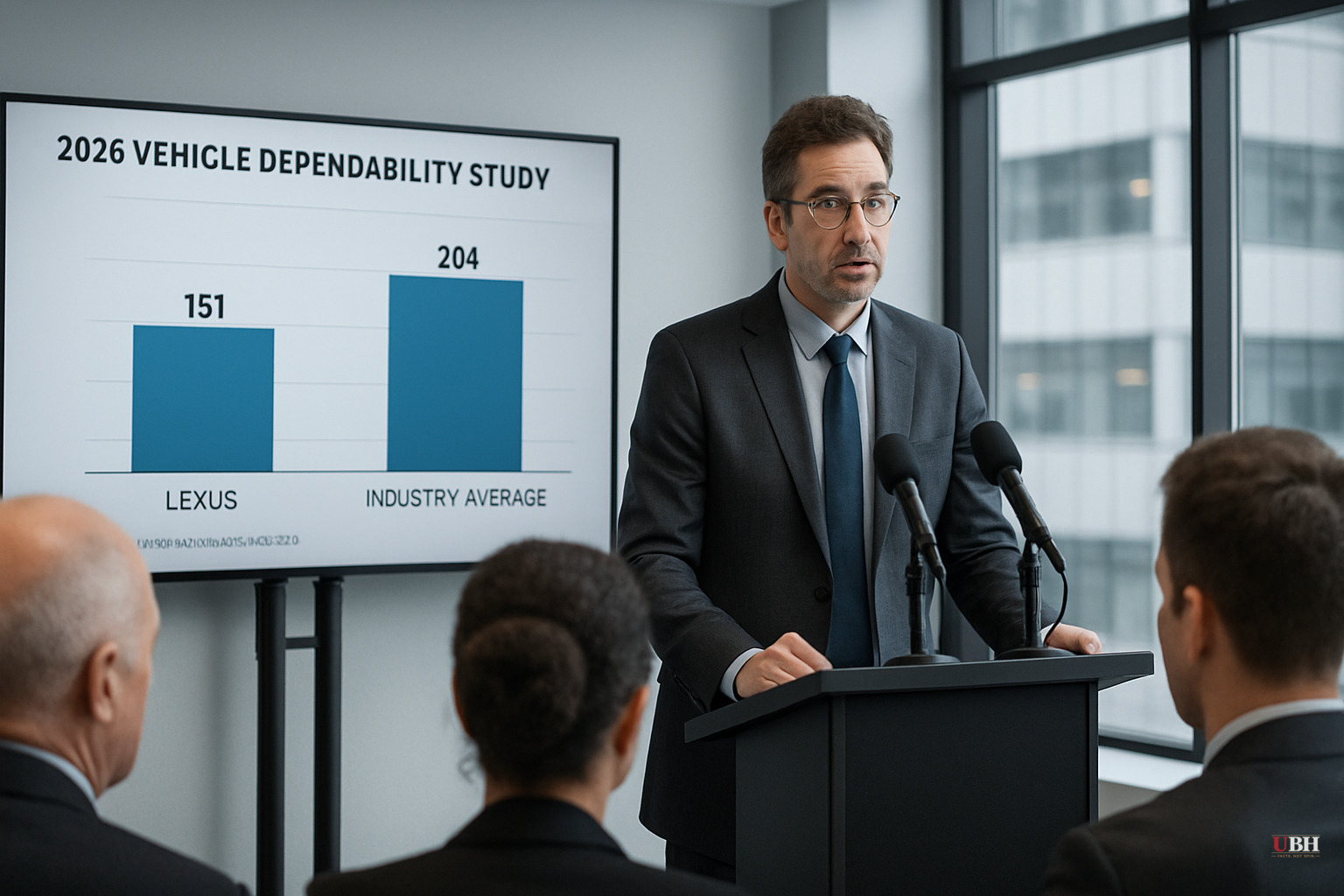
The 2026 U.S. Vehicle Dependability Study, which tracks problems reported by original owners of three-year-old vehicles, recorded a record industry average of 204 problems per 100 vehicles (PP100), according to J.D. Power data highlighted by Visual Capitalist. That's the worst the study has ever measured.
The 2026 J.D. Power Initial Quality Study, which measures problems new owners experience in the first 90 days, told a better story. The industry average dropped from 192 PP100 in 2025 to 175 PP100 in 2026, according to The Car Guide. Improvements showed up in nearly every category: driving assistance alerts, EV range, road noise, and body panel fit and finish all got better.
Nearly every category, that is. Infotainment got worse — again.
The Reliability Winners
On long-term dependability, Lexus held the top spot for the fourth consecutive year at 151 PP100. Buick placed second at 160, and MINI came in third at 168, according to the dependability study.
Japanese brands dominated the upper tier. Subaru, Toyota, Nissan, Honda, and Mazda all finished above the 204 PP100 industry average, continuing a pattern that has defined J.D. Power's rankings for years. Several luxury brands also performed well: Cadillac, Porsche, BMW, and Genesis all ranked in the upper half.
On initial quality — the new-car study — luxury brands averaged 169 PP100, outperforming mass-market brands at 177, according to The Car Guide. The standout individual vehicle was the Porsche 911 at 110 PP100, holding the best overall initial quality score for the second year running.
Ford earned the most surprising result in the initial quality rankings: top mass-market brand, driven by strong scores on the F-150, Super Duty, and Mustang. The Car Guide noted the irony directly. Ford simultaneously generated the highest number of safety recalls in the entire industry in 2026.
The Software Problem Nobody Is Fixing
The single most-reported problem across the entire industry, for the third consecutive year, is Android Auto and Apple CarPlay connectivity, according to both studies. Infotainment was the worst-performing of the nine categories J.D. Power measured, and it was the only category that did NOT improve in the initial quality study.
Automakers have poured billions into in-car technology as a selling point, and it keeps backfiring. Mechanical reliability — engines, transmissions, suspensions — has broadly improved. The systems that manufacturers treat as premium features are the ones generating the most complaints.
Plug-In Hybrids Are Struggling
The dependability study broke down results by powertrain, and the numbers for plug-in hybrids are rough. PHEVs averaged 281 PP100, a sharp year-over-year increase and the worst of any powertrain category. Gasoline vehicles were the only powertrain type to actually improve, averaging 198 PP100, according to Visual Capitalist's report on the J.D. Power data.
That gap — 281 PP100 for PHEVs versus 198 PP100 for gasoline vehicles — is a concrete data point in the ongoing argument about the real-world readiness of electrified vehicles.
Several Brands Not Eligible
Not every nameplate you'd expect to see made the rankings. The Car Guide reported that Rivian (246 PP100), Chrysler (229), Mitsubishi (183), Dodge (168), Tesla (149), and Jaguar (146) were all excluded from rank eligibility in the initial quality study because they did not meet J.D. Power's study award criteria. The scores are reported but the brands cannot win category awards.
The Fair Counter-Argument
Critics of J.D. Power's methodology argue that PP100 scores conflate genuine mechanical failures with user frustration over unfamiliar technology. A driver who can't figure out a touchscreen menu and a driver whose transmission slips both register as one problem each in the count. If that's true, brands that load up on intuitive but minimal tech might score artificially well, while brands investing heavily in advanced driver-assistance features get penalized for the learning curve. J.D. Power does separate infotainment into its own category, which partially addresses this concern, but the overall PP100 still aggregates across all nine categories.
What the data shows clearly is that owners are reporting more problems with three-year-old vehicles than ever before, and the category driving that trend is software, not steel.
Heading into the next model cycle, the question remains whether the automakers pushing hardest on in-vehicle software — particularly those developing proprietary systems to replace Android Auto and CarPlay entirely — will fix the connectivity problems or make them worse by removing the fallback options drivers already know how to use.
Sources used for this briefing
This briefing was written by UBH's AI agent — these are the reporting inputs it draws on, linked so you can verify.


