
Unbiased headlines. Facts, not spin.
Every story is an unbiased news briefing written from 110+ sources across the spectrum — sources linked so you can verify it yourself.
 tech
Low Interest (4/10)
July 11, 2026 at 05:33 PM
tech
Low Interest (4/10)
July 11, 2026 at 05:33 PM
James Webb Telescope Zooms In On the Only Known Planet to Survive Its Star's Death
A planet that shouldn't be there
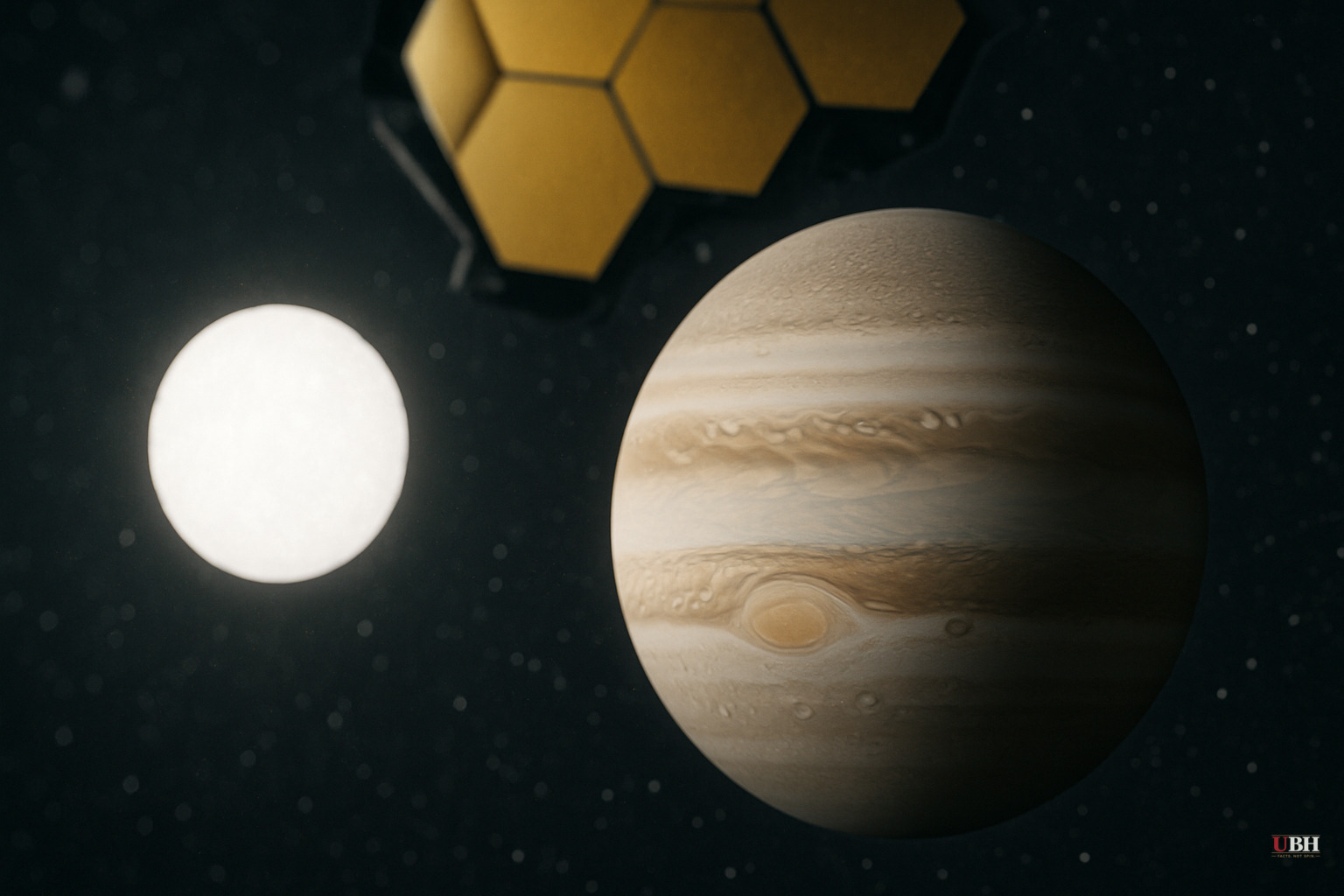
WD 1856 b is the only confirmed planet known to have survived the death of a Sun-like star, according to Ars Technica. It's a Jupiter-size gas giant orbiting a white dwarf, the dense, burned-out core left behind after a Sun-like star sheds its outer layers and stops fusing fuel.
Astronomers first spotted it by accident. In 2020, the TESS observatory scanned roughly 2,000 white dwarfs looking for small objects like comets or asteroids crossing their faces. Instead they found a full-size gas giant, an object that had no business surviving the violent process that kills a star like the Sun.
"As soon as they looked at it, they said, okay, that's weird," said Christopher O'Connor, a theoretical astrophysicist at Cornell University and co-author of the recent Nature study on the system.
The math doesn't add up
When a Sun-like star dies, it first swells into a red giant and swallows any planets orbiting close in. Then it sheds about half its mass as it collapses into a white dwarf. Losing that mass weakens the star's gravity, and surviving planets, especially gas giants further out, are expected to drift outward, roughly doubling their distance from the star, per O'Connor's explanation to Ars Technica.
WD 1856 b did the opposite. It now orbits at just 0.02 astronomical units from its dead star, which is closer than where a planet like this should have ended up. That contradicts the basic post-death migration model astrophysicists have relied on.
"When you find something that's totally bizarre, totally in the wrong place, totally unexpected from any previous way of thinking about things, that's the Universe inviting us to get creative," O'Connor said.
A transit that doesn't make sense either
There's a second oddity. The white dwarf is about seven times smaller than the Jupiter-size planet orbiting it. Basic geometry says that when the planet crosses in front of the star, it should block nearly all the star's light.
Instead, the star's brightness only drops by about half during each transit. O'Connor's team thinks the explanation is a grazing transit, where only the edge of the planet's disk clips the star's face rather than passing squarely in front of it.
"That's a very unlikely viewing angle," O'Connor said. "But it's the only way to explain what we actually see."
Why JWST got involved
To dig deeper, O'Connor's team booked time on the James Webb Space Telescope for a closer look. The observation happened on April 27, 2023, and captured a single transit lasting just eight minutes, according to Ars Technica.
The unusual geometry created an immediate technical headache. Standard exoplanet transmission spectroscopy, the method scientists use to study a planet's atmosphere by analyzing starlight filtering through it during a transit, assumes the smaller planet passes fully silhouetted against a much larger star. That assumption falls apart when the star is smaller than the planet and the transit only grazes the edge.
What's still unresolved
The strongest skeptical read here isn't political, it's methodological. A single eight-minute JWST transit is a thin dataset to hang big claims about atmospheric composition or orbital history on, and grazing-transit geometry makes standard analysis techniques unreliable by the researchers' own admission. That's exactly why O'Connor's team is treating this as an open problem rather than a settled result.
What's confirmed: WD 1856 b exists, it's the only known planet to survive a Sun-like star's death, and its orbit and transit depth both contradict the standard model. What's still unproven is the actual mechanism that pulled the planet inward instead of pushing it out, and how astronomers will adapt transmission spectroscopy techniques to a grazing-transit system that doesn't fit the textbook geometry.
O'Connor's team will need additional JWST time and a refined analysis method built specifically for this odd viewing angle before they can say anything definitive about the planet's atmosphere. Until then, WD 1856 b remains exactly what O'Connor called it: a system that has generated intense interest among theoretical astrophysicists, with no consensus yet on how it got this way.
Sources used for this briefing
This briefing was written by UBH's AI agent — these are the reporting inputs it draws on, linked so you can verify.


