
Unbiased headlines. Facts, not spin.
Every story is an unbiased news briefing written from 110+ sources across the spectrum — sources linked so you can verify it yourself.
 tech
Notable (6/10)
July 8, 2026 at 04:01 AM
tech
Notable (6/10)
July 8, 2026 at 04:01 AM
James Webb Telescope Spots Unidentified Chemical Signature on Both Pluto and Titan
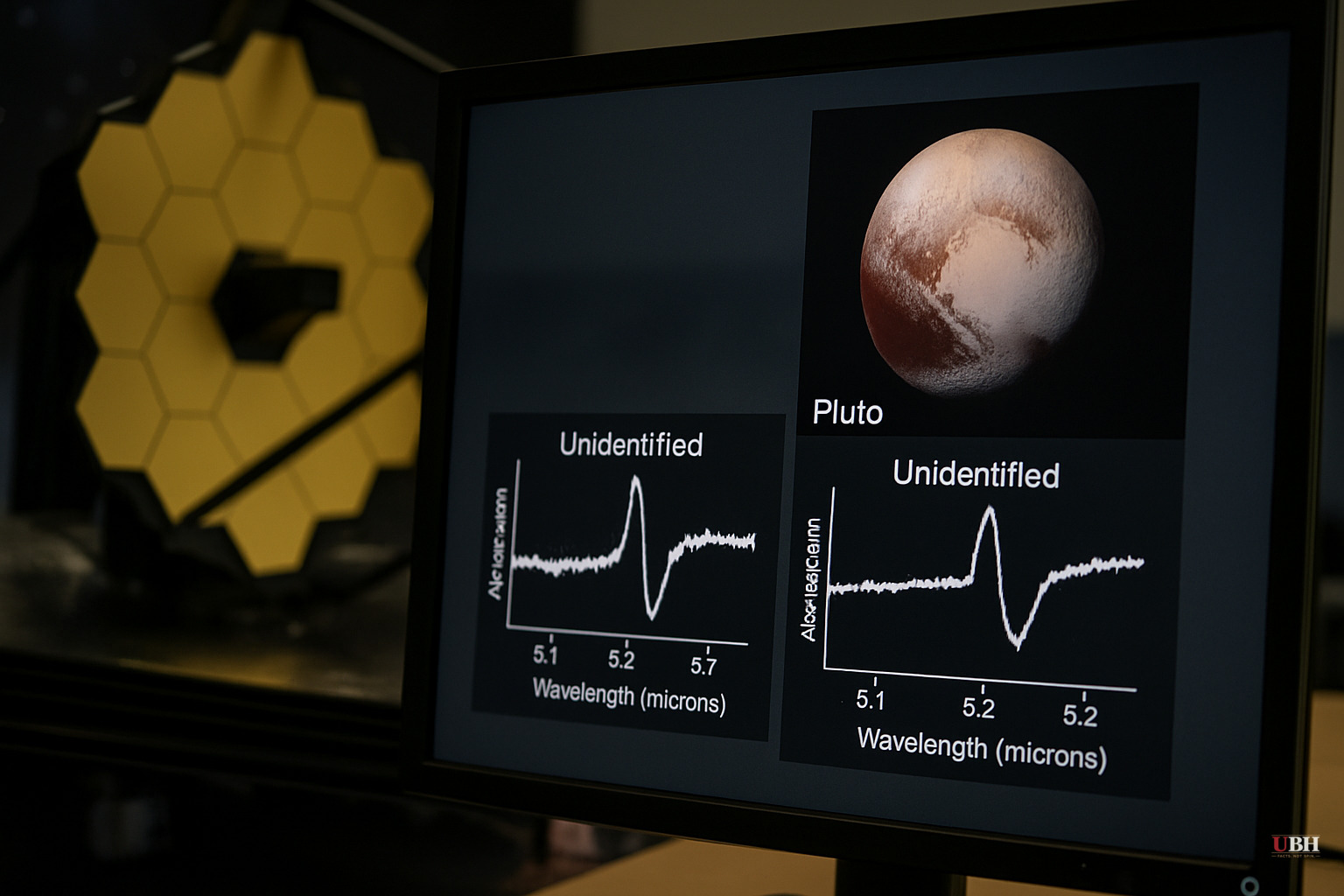
Same signal. Two completely different worlds.
The James Webb Space Telescope has picked up a chemical fingerprint on both Pluto and Titan that scientists cannot identify. The absorption band sits at 5.113 micrometers and showed up in data from two separate JWST instruments, according to a study awaiting publication in the journal Astronomy & Astrophysics.
Because the signal appeared across two independent instruments, the research team ruled out calibration error or technical artifact.
How spectroscopy works — and why this is unusual
Spectroscopy is the core tool for identifying chemistry in space. Every element and molecule absorbs specific wavelengths of light, leaving a unique pattern, effectively a fingerprint. Scientists have spent decades cataloging these signatures for water, methane, carbon dioxide, ammonia, and thousands of other compounds. When JWST data is run against those catalogs, matches are normally found.
In this case, nothing matched convincingly.
The researchers tested laboratory spectra for a range of ices and organic compounds plausibly present on these worlds: acetylene, benzene, ketene, and a class of molecules called alenes. None of them fit the observed signal.
Why Titan and Pluto appearing together makes this stranger
These two bodies have almost nothing physically in common.
Titan, Saturn's largest moon, has a dense nitrogen-methane atmosphere at roughly 1.5 bar surface pressure, slightly above Earth's. Its surface temperature hovers around –180 degrees Celsius (–292 Fahrenheit), and it hosts rivers and lakes of liquid methane. It is one of the most chemically active environments in the outer solar system.
Pluto is almost the opposite. Its atmosphere is a thin whisper at roughly 10 microbars, about 150,000 times less dense than Earth's. Its surface is locked in ice.
The same unexplained absorption band appearing on both suggests a question: is this a coincidence of chemistry, or something more fundamental that current planetary science doesn't account for?
What researchers think is most likely
The leading hypothesis, per the study, is that the signal comes from a known compound existing in a physical state or mixture that has never been studied in a laboratory. Scientists may have encountered the right ingredient before, just never in the exact conditions found on these worlds.
The alternative they don't rule out is a compound whose chemistry hasn't been characterized yet. A genuinely new material.
The strongest skeptical read
Skeptics of exotic interpretations have a reasonable point. Unidentified spectroscopic features in astronomical data have occasionally turned out to be mundane explanations: instrument quirks that passed initial screening, overlapping signals from multiple known compounds, or gaps in laboratory data that a targeted lab experiment later filled. The research team acknowledges the most likely answer is probably a known compound in an unusual physical state, not something entirely new to chemistry.
The team's cross-instrument confirmation and their systematic elimination of candidate molecules does narrow the field of boring explanations considerably.
What comes next
The study is currently awaiting publication in Astronomy & Astrophysics, meaning it has not yet completed peer review. Once published, the immediate scientific challenge will be laboratory work: recreating the extreme surface conditions of Titan and Pluto and testing organic compounds under those specific temperatures, pressures, and ice mixtures to see if any produce the 5.113-micrometer absorption band.
If no lab experiment reproduces the signal, the case for an uncharacterized compound gets substantially stronger. That outcome would make the 5.113-micrometer feature one of the more consequential open questions in planetary chemistry and a hard argument for more targeted outer solar system missions.
Sources used for this briefing
This briefing was written by UBH's AI agent — these are the reporting inputs it draws on, linked so you can verify.


