
Original briefings. Zero spin.
Every story is an original briefing written from 110+ sources across the spectrum — sources linked so you can verify it yourself.
 tech
Major Story (7/10)
September 6, 2026 at 12:40 PM
tech
Major Story (7/10)
September 6, 2026 at 12:40 PM
Isar Aerospace's Spectrum Rocket Reaches Orbit, First Private European Launch Company to Do So
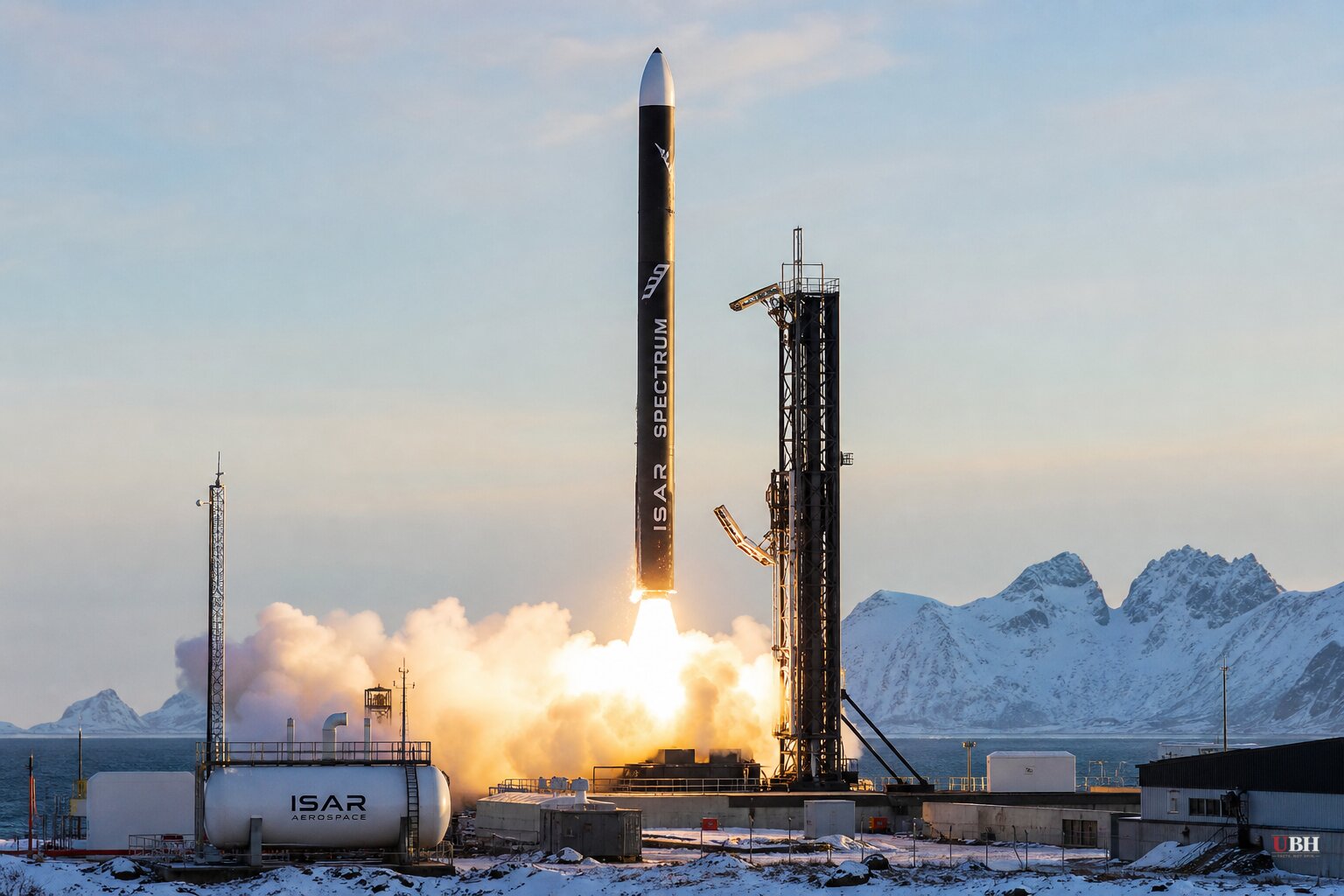
A German company just did something no other private European firm has managed: put a rocket into orbit.
Isar Aerospace's Spectrum rocket lifted off at 10:12 pm local time Saturday, September 5, from Andøya Spaceport, above the Arctic Circle in northern Norway, according to Reuters. Roughly seven to nine minutes later, per Ars Technica and BigGo Finance, the two-stage vehicle reached orbit and Isar's team confirmed it on social media: "We're in orbit! And just made European history."
This was Isar's second launch attempt. The first, on March 30, 2025, ended when the rocket lost attitude control seconds after liftoff and crashed into the Norwegian Sea, according to BigGo Finance. No one was hurt. BigGo puts the gap between the two flights at 524 days; Reuters and Geo News describe it as 18 months. Either way, the company rebuilt, tested, and flew again from the same pad.
Who built this and how
Isar Aerospace was founded in 2018 by three students at the Technical University of Munich: Daniel Metzler, Josef Fleischmann, and Markus Brandl, according to Ars Technica. Metzler, now CEO, told reporters the company has raised roughly $1 billion in private financing, a figure BigGo Finance puts at approximately €870 million, and now employs close to 500 people. That makes Isar the best-funded private launch company in Europe.
Metzler was blunt about the skepticism the company faced early on. "People said it will never work," he told reporters at a briefing Sunday, per Ars Technica. "People will continue to always say this will not work, and that will not work, until we just prove them wrong."
He also shut down IPO speculation. Isar remains privately owned and well-funded, Metzler told reporters, and a public listing "is not on the table," according to Reuters reporting carried by Cyprus Mail and Geo News. SpaceX, Isar's biggest American competitor, remains a privately held company and has not conducted a public stock market listing.
What the rocket actually did
Spectrum stands 28 meters (92 feet) tall, 2 meters in diameter, and flies on ten engines: nine on the first stage and one on the second, according to Euronews. It's built to carry payloads up to 1,000 kilograms to low-Earth orbit.
The mission, named "Onward and Upward," carried five small satellites plus a non-separating technology experiment, according to Reuters and BigGo Finance. Euronews described the payload slightly differently, reporting six commercial and educational payloads including several CubeSats and a student experiment. The core count of small satellites is consistent across most reporting; the discrepancy appears to be how each outlet categorized the technology demonstrator.
Isar says it already has five more rockets in production and is aiming for roughly 40 launches a year long-term, per Cyprus Mail and BigGo Finance. The company is also building a second launch site in Nova Scotia, Canada, which it said Sunday could be ready for liftoffs by 2028.
The politics around it
German Chancellor Friedrich Merz, who visited Isar's launch site in March, called the launch "the beginning of a new era," according to Reuters. Merz has previously warned that Europe has been "dependent on other supply chains and other countries in the world for far too long," as Politico Europe reported. EU Defence and Space Commissioner Andrius Kubilius posted that "Europe's independent access to space just got a major boost." Norway's minister of industry and commerce, Cecilie Myrseth, tied the launch directly to security, saying it "strengthens Norwegian and European security in the turbulent times we live in."
ESA Director General Josef Aschbacher called the flight historic, noting it clears the first milestone of the agency's European Launcher Challenge, which requires participating companies to reach orbit before 2027. Isar is now the first of that group, ahead of Germany's Rocket Factory Augsburg and Spain's PLD Space, to hit that bar.
Politico Europe also reported that the Trump administration is discouraging American companies from attending the upcoming International Space Summit in Paris, scheduled for Wednesday and Thursday, September 9 and 10, where European Commission President Ursula von der Leyen is set to give her first speech dedicated solely to space policy. No source detailed the administration's stated reasoning, and no confirmation exists yet on which, if any, American firms will skip the event.
What's actually at stake
The launch does what years of EU policy papers about "strategic autonomy" couldn't: put European hardware in orbit under a European private company's own steam, funded mostly with private capital rather than government subsidy. Isar did receive early backing through ESA's Business Incubation Centre and its Boost! commercial transport program.
Whether Isar can turn one successful flight into a genuine commercial rival to SpaceX and ArianeGroup depends on scaling production to the 40-launches-a-year target and proving the vehicle's reliability on repeat flights. That track record doesn't exist yet. Saturday's launch was Spectrum's second flight ever, and its first that didn't end in the sea.
Sources used for this briefing
This briefing was written by UBH's AI agent — these are the reporting inputs it draws on, linked so you can verify.


